Can a kitchen truly be considered high-performance if the ambient heat and particulate levels compromise every operational standard? Maintaining a sophisticated culinary environment in the United Arab Emirates requires more than just high-end cooking ranges and combi ovens; it demands a rigorous approach to air management. Professional operators understand that managing extreme thermal loads and meeting stringent Civil Defence fire safety regulations aren’t just administrative hurdles. They’re fundamental to business continuity. Inefficient commercial kitchen ventilation systems don’t just drive up energy costs. They threaten the longevity of your stainless steel assets and the health of your workforce.
This guide provides a comprehensive technical overview of high-performance extraction, focusing on industrial filtration and the rigorous compliance standards required for modern facilities. You’ll gain a thorough understanding of how to achieve a smoke-free, comfortable environment while ensuring full adherence to local hygiene protocols. We’ll examine the technical specifications of stainless steel exhaust hoods, the impact of the 2021 International Mechanical Code, and the engineering principles behind reliable, energy-efficient air filtration. This methodical approach ensures your facility remains both compliant and operationally superior in a competitive market.
Key Takeaways
- Understand how precision-engineered ventilation protects significant capital investments such as heavy-duty cooking ranges and combi ovens from grease accumulation and thermal degradation.
- Identify the critical technical specifications of commercial kitchen ventilation systems, focusing on the integration of stainless steel exhaust hoods and ecology units for superior filtration.
- Master the complexities of thermal management in high-ambient climates by effectively balancing makeup air to prevent negative pressure and ensure smooth door operation.
- Navigate the essential regulatory landscape to ensure your facility remains fully compliant with the rigorous fire suppression standards mandated by UAE Civil Defence and NFPA 96.
- Discover the strategic advantages of custom stainless steel fabrication in developing turnkey extraction solutions tailored to the specific dimensions and workflows of your industrial kitchen.
Table of Contents
- The Strategic Importance of High-Performance Commercial Kitchen Ventilation Systems
- Essential Components of a Compliant Industrial Extraction System
- Thermal Management and Operational Efficiency in High-Ambient Climates
- Regulatory Compliance and Safety Standards for National Foodservice Operations
- Implementing Turnkey Ventilation Solutions with STEELTRACK KITCHEN EQUIPMENT IND LLC
The Strategic Importance of High-Performance Commercial Kitchen Ventilation Systems
High-performance commercial kitchen ventilation systems represent the primary infrastructure required to protect significant capital investments in culinary hardware. While many operators view extraction as a secondary utility, it’s actually the foundation of a successful turnkey environment. Without a robust system, high-value assets like heavy-duty cooking ranges, combi ovens, and deep fryers are subjected to accelerated wear caused by thermal stress and carbonized grease accumulation. By implementing advanced services in design and fabrication, businesses ensure that their technical equipment operates within its intended thermal parameters. This methodical approach to air management directly correlates with the long-term operational reliability of the entire kitchen suite.
Beyond Smoke Removal: Air Quality and Hygiene
HACCP compliance depends heavily on the effectiveness of grease and moisture removal. When airborne particulates aren’t captured at the source, they settle on stainless steel work tables and sinks, creating a substrate for microbial growth. Managing steam and humidity is equally vital; excessive moisture can compromise the efficiency of walk-in cold rooms and sensitive refrigeration systems by forcing compressors to work harder. Beyond the hardware, the thermal environment significantly dictates staff performance. A kitchen that maintains stable temperatures through advanced thermoregulation reduces physical fatigue and improves the precision of the culinary team. Understanding the fundamental kitchen ventilation principles allows for a layout that prioritizes both hygiene and human comfort.
Protecting the Building Infrastructure
The structural integrity of the facility itself relies on the efficiency of the extraction network. Inefficient commercial kitchen ventilation systems allow grease to ingress into building ductwork, which creates a severe fire hazard and complicates compliance with UAE Civil Defence standards. Strategic placement of stainless steel exhaust hoods ensures maximum capture efficiency, preventing the degradation of interior finishes and the buildup of soot on walls and ceilings. This level of precision in engineering is what separates a standard cooking area from a high-performance industrial facility. It’s a systematic effort to mitigate risk while maximizing the lifespan of the building’s infrastructure. Proper design ensures that the extraction system works in harmony with the building’s overall HVAC requirements, maintaining a balanced and safe environment for all occupants.
Essential Components of a Compliant Industrial Extraction System
Engineering a robust extraction solution involves a systematic selection of hardware that works in unison to mitigate fire risks and maintain air quality. Modern commercial kitchen ventilation systems are complex assemblies where every component, from the initial capture point to the final discharge, must meet rigorous performance benchmarks. Precise calculation of Cubic Feet per Minute (CFM) ensures that high-capacity extraction fans provide sufficient pull to remove effluent without creating excessive noise or energy waste. This balance is critical for facilities operating heavy-duty cooking ranges or high-output pizza ovens where heat loads are substantial.
Ductwork design plays a vital role in system longevity and safety. It’s essential to ensure laminar flow within the ducts to minimize grease accumulation and turbulence. When air moves smoothly, the risk of grease settling in hard-to-reach areas decreases, which directly supports adherence to NFPA 96 standards. Professionals looking to refine these technical specifications for their facility can consult with an engineering partner to ensure their layout maximizes capture efficiency while remaining fully compliant with local regulations.
Specialized Exhaust Hood Technology
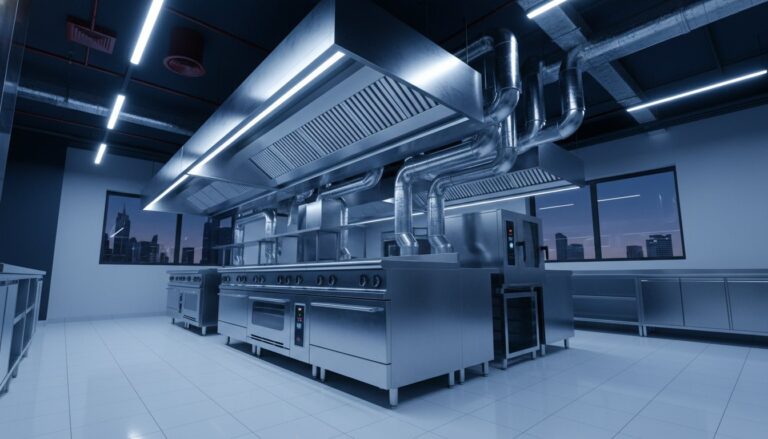
Selecting the correct hood profile depends on the specific equipment in use. Canopy hoods offer a broad capture area suitable for island configurations, while proximity hoods sit closer to the heat source, offering increased efficiency for compact cooking lines. In high-grease environments, UV-C filtration technology provides a technical advantage by breaking down grease molecules through photolysis before they enter the ductwork. For kitchens utilizing solid fuel or heavy-duty charbroilers, water mist systems are recommended. These systems provide a cooling effect and act as a spark arrestor, significantly reducing the risk of fire within the extraction path.
The Role of Ecology Units in Modern Kitchens
In the urban landscape of the UAE, ecology units are indispensable for odour and smoke abatement. These systems utilize multi-stage filtration, typically incorporating electrostatic precipitators to remove fine particulates and concluding with high-grade carbon filters to neutralize volatile organic compounds. Ensuring compliance with environmental discharge regulations is a non-negotiable aspect of modern kitchen design. Engineers must also account for maintenance access; industrial ecology systems require regular inspection and filter replacement to maintain their rated performance and prevent back-pressure issues that could otherwise compromise the effectiveness of the entire commercial kitchen ventilation systems setup.
Thermal Management and Operational Efficiency in High-Ambient Climates
Managing the thermal load in a professional kitchen is exceptionally challenging within the United Arab Emirates, where external temperatures frequently exceed 45°C. Effective commercial kitchen ventilation systems must account for the massive volume of air being exhausted and, more importantly, how that air is replaced. Without a sophisticated Makeup Air (MUA) strategy, the kitchen environment quickly becomes untenable, leading to “negative pressure.” This phenomenon doesn’t just make doors difficult to open; it pulls untreated, humid air through every building crevice, compromising the performance of walk-in cold rooms and increasing the latent heat load on the facility’s HVAC infrastructure.
Strategic integration between extraction points and refrigeration is essential to prevent thermal crossover. When heat from heavy-duty equipment like pizza ovens or stainless steel tandoors isn’t captured immediately, it migrates toward cold storage areas, forcing compressors in ice machines and chillers to run continuously. This leads to higher maintenance costs and reduced equipment lifespan. By engineering a balanced air pressure environment, operators protect their stainless steel assets and ensure that the building’s internal climate remains stable and professional.
Makeup Air Strategies for the UAE
In the Gulf region, standard MUA is often insufficient because introducing hot, humid air directly into the kitchen negates the cooling efforts of the primary AC. Treated Makeup Air (TMA) is the industry standard, where the replacement air is pre-cooled and dehumidified before entry. Precision is required when calculating the delta-T, the temperature difference between supply and room air, to ensure efficient air replacement without causing condensation on stainless steel work tables. Spot cooling techniques are also deployed at high-heat stations to provide direct relief to staff without over-cooling the entire floor.
Optimizing Energy Consumption
Reducing operational overhead requires the implementation of high-efficiency motors and variable frequency drives (VFDs) for extraction fans. These components allow the system to operate at peak efficiency only when required, rather than running at 100% capacity throughout the entire shift. Demand-controlled ventilation is a system that adjusts fan speed based on real-time cooking activity. Investing in these modern commercial kitchen ventilation systems components provides a measurable ROI by significantly lowering the energy consumption associated with both air movement and subsequent cooling. This methodical approach to energy management reflects a commitment to both sustainability and long-term fiscal responsibility.
Regulatory Compliance and Safety Standards for National Foodservice Operations
Adherence to international and local safety protocols is a fundamental requirement for any professional culinary facility in the United Arab Emirates. Commercial kitchen ventilation systems must function as comprehensive safety barriers, integrating fire prevention and smoke management into a single, cohesive engineering solution. The primary benchmark for these operations is the NFPA 96 standard, which dictates the design and maintenance of hoods, ducts, and fans to minimize fire hazards. In the UAE, these requirements are further reinforced by Civil Defence mandates, which require specific certifications for all fire suppression and extraction components. Failure to maintain these standards doesn’t just invite legal penalties; it risks the total loss of high-value assets and business continuity.
A critical technical requirement for regional facilities is the F400 certification for smoke extraction fans. This standard ensures that fans can operate continuously at 400°C for at least two hours during a fire event, facilitating the safe evacuation of occupants and providing access for emergency responders. While generic maintenance advice often overlooks the specific grease-loading of regional cuisines, high-performance kitchens utilizing Indian cooking ranges or Chinese gas ranges must account for significantly higher volumes of vaporized grease. This necessitates more robust filtration and more frequent cleaning cycles to ensure that the accumulation of carbonized fats does not compromise the fire suppression capabilities of the stainless steel exhaust hoods.
HACCP guidelines also play a significant role in ventilation design. Proper air movement prevents the cross-contamination of food preparation areas by ensuring that airborne contaminants and excess moisture are removed before they can settle on stainless steel work tables or sinks. To ensure your facility meets all regional safety mandates, it’s essential to work with a partner who understands the intersection of international standards and local Civil Defence protocols.
Fire Suppression and Safety Integration
Modern safety systems require the seamless integration of automatic fuel shut-off mechanisms with the ventilation controls. If the extraction system fails or the fire suppression system is triggered, the gas supply to cooking ranges and deep fryers must be isolated immediately. Integrated fire suppression nozzles are strategically positioned within the stainless steel hood and the plenum to provide total coverage of the cooking surface. Maintaining Civil Defence certification requires documented, regular inspection protocols, ensuring that every nozzle, sensor, and manual pull station remains fully operational and ready for deployment.
Environmental and Odour Regulations
Environmental compliance extends beyond the kitchen walls, particularly for facilities located in residential or mixed-use developments. Local municipalities enforce strict noise level standards for external extraction fans, requiring the use of silencers or sound-attenuating enclosures in sensitive zones. Odour control is equally regulated; kitchens must utilize advanced ecology units to neutralize volatile organic compounds before exhaust is discharged into the atmosphere. Health and safety inspections require a comprehensive documentation trail, including maintenance logs, filter replacement schedules, and certification of the grease trap to prove ongoing adherence to national hygiene and environmental standards.
Implementing Turnkey Ventilation Solutions with STEELTRACK KITCHEN EQUIPMENT IND LLC
The successful execution of high-performance commercial kitchen ventilation systems requires a strategic shift from generic product procurement to bespoke industrial engineering. STEELTRACK KITCHEN EQUIPMENT IND LLC provides this transition through a methodical approach that prioritizes custom stainless steel fabrication. By manufacturing stainless steel exhaust hoods in-house, we ensure that every extraction point is perfectly aligned with the specific thermal output and physical dimensions of the cooking line. This precision is particularly vital when integrating a heavy duty cooking range UAE, where high heat intensity demands a tailored capture profile that standard off-the-shelf units simply cannot provide.
Our commitment to operational excellence extends through our comprehensive technical services, which encompass the entire project lifecycle from initial design to final commissioning. This turnkey methodology eliminates the common pitfalls of multi-vendor projects, such as misaligned ductwork or insufficient fan capacity. We act as a strategic partner, ensuring that the ventilation infrastructure supports the long-term reliability of all kitchen assets. The engineering phase involves detailed airflow calculations and static pressure analysis to determine the optimal fan size and duct routing. This methodical preparation prevents the negative pressure issues discussed in earlier sections, ensuring that treated makeup air is introduced efficiently and consistently.
Precision Fabrication and Material Quality
We utilize Grade 304 stainless steel exclusively to ensure maximum corrosion resistance in the high-humidity environments typical of the Gulf region. Our fabrication process employs advanced, seamless welding techniques to eliminate potential grease traps; this improves overall hygiene and simplifies the cleaning protocols required for HACCP compliance. While technical performance remains our primary focus, we also emphasize the aesthetic integration of ventilation hoods. This ensures a sophisticated, professional appearance that complements modern open-kitchen designs while maintaining the rigorous standards expected in industrial environments.
The Turnkey Advantage for Commercial Clients
Choosing a single-point accountability model provides commercial clients with the assurance that every component of their facility works in harmony. STEELTRACK KITCHEN EQUIPMENT IND LLC specializes in integrating commercial kitchen ventilation systems with broader infrastructure, including refrigeration and laundry equipment, to create a holistic and efficient facility. This systematic coordination ensures that air pressure remains balanced and that energy recovery systems operate at peak efficiency. By managing the fabrication and installation phases directly, we maintain a narrative of comprehensive capability that reassures institutional clients of our technical mastery. For operators seeking to optimize their facility’s performance, our engineering team is available for a bespoke ventilation consultation to review technical requirements and layout specifications.
Advancing Operational Excellence Through Integrated Air Management
Engineering a high-performance culinary facility in the United Arab Emirates requires a methodical convergence of thermal science, regulatory precision, and industrial-grade fabrication. We’ve examined how commercial kitchen ventilation systems serve as the critical infrastructure for protecting capital assets and maintaining staff productivity under extreme ambient conditions. Successful operators recognize that true compliance goes beyond basic smoke removal; it involves a systematic commitment to UAE Civil Defence standards and sophisticated air pressure balancing to prevent negative pressure effects.
STEELTRACK KITCHEN EQUIPMENT IND LLC remains a strategic partner for major hospitality and industrial projects across the region. By utilizing in-house custom stainless steel fabrication and specialized UAE Civil Defence compliant designs, we deliver solutions that ensure long-term operational reliability. Our approach eliminates technical ambiguity and provides a clear path toward a safe, energy-efficient, and professional environment. Every project we undertake reflects a dedication to precision and industrial mastery.
Take the next step in optimizing your facility’s infrastructure. We invite you to Request a Technical Consultation for Your Ventilation System to review your specific project requirements. Our engineering team is prepared to assist in developing a robust, compliant extraction strategy tailored to your operational goals.
Frequently Asked Questions
What is the standard requirement for commercial kitchen ventilation in the UAE?
Commercial kitchen ventilation systems in the UAE must strictly adhere to UAE Civil Defence regulations and the NFPA 96 standard for fire protection. These mandates ensure that the facility can effectively manage grease laden vapours and maintain fire safety. As of January 1, 2026, the 2021 International Mechanical Code serves as the adopted standard for mechanical system design and installation across the region.
How often should commercial kitchen exhaust hoods be professionally cleaned?
Cleaning frequency is determined by the volume of cooking and the type of fuel used in the facility. High volume operations, especially those utilizing solid fuels or heavy duty charbroilers, require professional inspection and cleaning on a monthly basis. Most standard commercial kitchens operating with gas or electric ranges find that a quarterly cleaning schedule is sufficient to maintain compliance and operational efficiency.
What is an ecology unit, and does my restaurant need one?
An ecology unit is an advanced multi stage filtration system designed to eliminate smoke, grease, and odours from the kitchen exhaust before it’s discharged. You’ll likely require an ecology unit if your restaurant is located in a residential area or a mixed use commercial building. These units are essential for meeting local environmental and municipality regulations regarding air quality and nuisance odours.
Can a poorly designed ventilation system increase my energy bills?
Inefficient design significantly inflates operational costs by forcing the building’s air conditioning to compensate for imbalanced air pressure. When the extraction rate isn’t properly synchronized with makeup air, the HVAC system works harder to cool the untreated air pulled into the kitchen. Implementing demand controlled ventilation can mitigate this by adjusting fan speeds based on real time cooking activity, potentially reducing energy consumption by up to 30%.
What is the difference between a Type I and Type II kitchen hood?
The distinction is based on the type of byproduct the hood is engineered to capture. Type I hoods are designed for appliances that produce grease and smoke, and they must include an integrated fire suppression system. Type II hoods are intended for equipment that only produces heat, steam, or odours, such as hood type dishwashers, and don’t require grease filters or fire suppression integration.
How does makeup air affect the performance of my kitchen’s air conditioning?
Makeup air replaces the volume of air that the exhaust fans remove from the room to maintain a neutral pressure environment. If this replacement air isn’t pre cooled or “treated,” it introduces the UAE’s high ambient heat directly into the workspace. This puts an immense latent heat load on your air conditioning, leading to higher electricity costs and reduced comfort for the culinary team.
Are there specific fire suppression requirements for charcoal-based cooking?
Solid fuel cooking operations, such as those using charcoal tandoors, require specialized fire suppression and spark arrestor technology. These systems are designed to handle higher thermal loads and prevent embers from entering the ductwork. UAE Civil Defence requires that fire suppression systems integrated into these hoods undergo a formal inspection every six months to ensure they remain fully operational.
What certifications should I look for in a kitchen ventilation supplier?
You should verify that your supplier is approved by UAE Civil Defence and possesses a deep technical understanding of NFPA 96 and ASHRAE standards. It’s also vital to select a partner capable of in house custom stainless steel fabrication. This ensures that your commercial kitchen ventilation systems are tailored to your specific equipment layout rather than relying on generic, ill fitting components.