In the high-pressure environments of the UAE’s hospitality sector, “heavy-duty” is no longer a marketing descriptor; it’s a rigorous structural engineering requirement. Procuring a heavy duty cooking range UAE operators can rely on involves far more than comparing burner counts or BTU outputs. It requires a strategic understanding of how industrial equipment must perform under the relentless heat of a high-volume commercial kitchen while strictly adhering to evolving safety mandates. You likely recognize that equipment failure during peak service isn’t just a technical inconvenience; it’s a direct threat to your establishment’s reputation and financial stability.
This guide provides the technical clarity needed to master the specifications and regional requirements for selecting high-performance cooking ranges that excel in the local market. We’ll analyze the critical intersection of maximum thermal efficiency, Grade 304 stainless steel durability, and the mandatory 2026 Dubai Civil Defence fire suppression standards. By the end of this article, you’ll possess the framework to ensure your procurement strategy yields long-term durability and full compliance with Dubai Municipality Food Code 2.0 and HACCP flow separation requirements.
Key Takeaways
- Identify the structural engineering distinctions that separate industrial-grade equipment from standard commercial units in high-volume UAE hospitality environments.
- Master the technical material specifications, focusing on AISI 304 stainless steel and gauge thickness, required for a resilient heavy duty cooking range UAE operators can trust.
- Analyze the comparative cost-efficiency and thermal performance of LPG versus electric fuel sources to optimize long-term operational expenditures and energy use.
- Navigate the updated 2026 compliance landscape, including mandatory Dubai Municipality and Sharjah Civil Defence safety standards for industrial equipment installation.
- Evaluate the critical role of custom fabrication and integrated exhaust hoods in maintaining peak equipment performance and kitchen safety under extreme regional conditions.
Defining the Heavy-Duty Cooking Range for UAE Industrial Kitchens
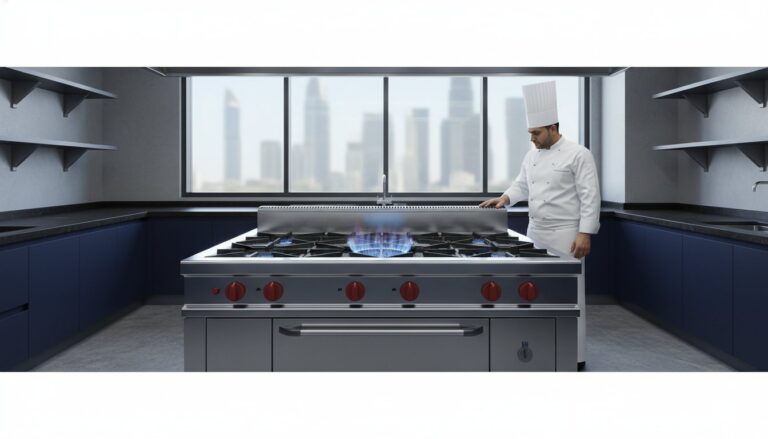
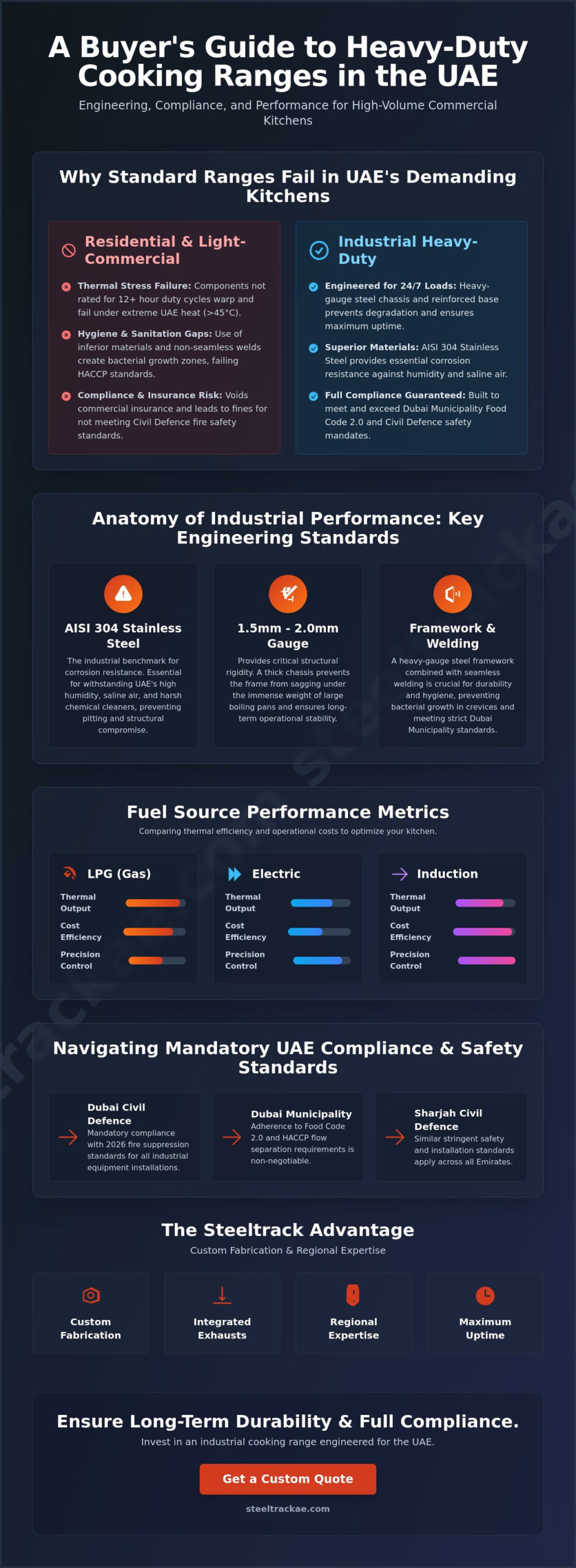
In the high-volume culinary operations of the Emirates, equipment selection is a matter of structural engineering rather than mere appliance choice. A standard commercial range might suffice for a small café, but the scale of industrial production in Dubai and Abu Dhabi necessitates a significantly higher standard. A true heavy duty cooking range UAE professionals require is built to withstand 24/7 thermal loads without structural degradation. These units serve as the central hub of the kitchen, integrating high-output burners, static or convection ovens, and reinforced base configurations designed for maximum uptime. In the Middle East, where ambient kitchen temperatures can frequently exceed 45°C, the demand on internal components is extreme. Equipment that isn’t engineered for these specific environmental stressors will suffer from accelerated wear and premature failure.
Beyond the core cooking range, ensuring that all auxiliary catering and food display equipment meets similar industrial standards is vital; manufacturers like TFSE Products Ltd provide professional solutions designed to withstand the rigors of high-volume service environments.
The Anatomy of Industrial Performance
The primary differentiator for industrial equipment lies in the chassis construction. While standard units often utilize thinner shells, industrial-grade models feature heavy-gauge steel frameworks that prevent the unit from sagging under the weight of massive boiling pans. Ergonomics also play a vital role; controls must be accessible yet protected from heat and spills to ensure seamless operation during peak service. By 2026 standards, a heavy-duty cooking range in the UAE is defined by its ability to maintain consistent thermal output while operating under continuous duty cycles in a tropical-rated environment. This performance benchmark ensures that the equipment remains a reliable asset rather than a liability during the most demanding shifts.
Why Residential Ranges Fail in UAE Commercial Settings
Attempting to utilize residential or light-commercial hardware in a professional UAE kitchen is a strategic error that leads to rapid component failure and safety hazards. Residential units lack the insulation and high-grade alloys required to handle continuous high-BTU output, often resulting in warped cooktops and compromised gas lines. Beyond physical failure, there are significant regulatory and operational risks involved:
- Thermal stress limits: Residential components are not rated for 12-hour duty cycles, leading to the warping of burners and the failure of ignition systems.
- Hygiene and sanitation gaps: Industrial ranges feature seamless welding and Grade 304 stainless steel to prevent bacterial growth in crevices, a critical requirement for Dubai Municipality compliance.
- Compliance and insurance: Utilizing improper hardware can void commercial insurance policies and lead to significant fines from Civil Defence authorities for failing to meet fire safety standards.
For any large-scale establishment, the investment in a heavy duty cooking range UAE standard ensures that the facility remains compliant with local safety laws while maintaining the thermal efficiency required for profitable operations. Choosing industrial-grade hardware is the only way to guarantee that your kitchen can meet the rigorous demands of the regional hospitality market.
Engineering Standards: Material Specifications and Thermal Efficiency
The operational longevity of a heavy duty cooking range UAE professionals select is fundamentally determined by its metallurgical composition and thermal engineering. In the coastal environments of Dubai and Sharjah, where high humidity and saline air accelerate oxidation, the choice of material isn’t merely an aesthetic preference; it’s a technical necessity. Standard 430-grade stainless steel often fails to provide the requisite corrosion resistance, leading to surface pitting and structural compromise over time. Consequently, the industrial benchmark for the region remains AISI 304 stainless steel, which offers superior durability against chemical cleaners and environmental moisture.
Material thickness represents another critical engineering standard that separates industrial units from lighter commercial alternatives. A chassis constructed with a 1.5mm to 2.0mm gauge provides the structural rigidity required to support heavy boiling pans and withstand constant thermal expansion. This thickness ensures the unit remains level and prevents the warping of the cooktop, which is essential for maintaining even heat distribution. For those seeking equipment built to these exacting standards, exploring custom industrial fabrication solutions ensures that every specification meets the unique demands of your facility.
Metallurgy and Durability in Commercial Fabrication
Corrosion resistance is paramount in Sharjah and Dubai industrial areas, where kitchens operate in proximity to the coast. While cast iron burners are valued for their exceptional heat retention and durability under high-flame conditions, brass burners offer superior resistance to corrosion and provide precise flame control. For facilities prioritizing hygiene, seamless welding is a mandatory requirement. It eliminates the crevices where food particles and bacteria accumulate, facilitating the deep-cleaning protocols necessary for HACCP-compliant operations.
Thermal Output and Energy Optimization
Calculating the precise BTU requirements is essential for high-volume operations involving rapid searing or large-scale boiling. High-output burners must deliver consistent performance without excessive heat loss to the surrounding environment. Effective thermal insulation doesn’t just protect internal components; it also significantly reduces heat emission into the kitchen. This optimization is crucial for lowering the HVAC load in Dubai’s climate, where cooling costs represent a substantial portion of operational expenses. While electronic ignition systems offer convenience, many industrial veterans prefer robust pilot light systems for their reliability in high-moisture environments. The optimal material for a heavy duty cooking range UAE is AISI 304 stainless steel with a minimum gauge of 1.5mm to ensure maximum service life.
Fuel Sources: Gas, Electric, and Induction Performance Metrics
The selection of a power source for a heavy duty cooking range UAE operators deploy is a strategic decision that directly influences both kitchen throughput and monthly utility expenditures. While Liquefied Petroleum Gas (LPG) remains the traditional preference for high-output environments, the shift toward high-efficiency electric and induction systems is accelerating in the UAE’s most modern commercial developments. This transition is often driven by the stringent fire safety regulations in high-rise structures and the desire to minimize the thermal load on internal cooling systems. Selecting the appropriate fuel type requires a methodical analysis of your menu requirements, the available site infrastructure, and the long-term energy goals of the establishment.
Gas Ranges: The Industrial Workhorse
LPG-powered ranges continue to serve as the foundation for most high-volume culinary operations due to their immediate heat response and high BTU ratings. Professionals must choose between open burners, which provide direct flame for rapid sautéing, and solid tops that offer a uniform heated surface for multiple vessels. To ensure operational safety and compliance with Civil Defence standards, these units must be equipped with reliable flame failure devices and heavy-duty control knobs that withstand constant use. Maintenance protocols in the UAE must account for the fine dust prevalent in industrial areas; particulate accumulation in gas jets and manifolds can lead to uneven combustion and energy waste. Regular calibration of these components is essential to maintain the high performance expected of industrial-grade hardware.
Electric and Induction: The Modern Alternative
High-power induction systems are increasingly favored for climate-controlled boutique kitchens where precision temperature control is essential for delicate thermal processing. These units offer exceptional energy recovery times, ensuring that kitchen throughput remains consistent even during peak service hours. While the initial investment in induction technology is often higher, the return on investment is realized through significantly reduced ventilation requirements and lower HVAC costs. For new developments in Dubai and Abu Dhabi, the infrastructure must support high-kilowatt loads, necessitating careful electrical planning during the design phase. A heavy duty cooking range UAE establishment chooses must balance these performance metrics with the specific utility constraints of the site to ensure long-term operational success. The reduction in ambient heat not only lowers cooling costs in the AED-intensive summer months but also improves the working environment for kitchen personnel.
Compliance and Installation Logistics in the UAE
The successful deployment of a heavy duty cooking range UAE operators utilize depends on meticulous adherence to local regulatory frameworks. It’s not enough to procure high-performance hardware; the installation must align with the specific mandates of the Dubai Municipality and the respective Civil Defence authorities of each Emirate. These regulations ensure that industrial kitchens operate with the highest safety standards, particularly regarding fire prevention and food hygiene. Professional gas connection protocols require that only licensed technicians handle the final manifold attachments, ensuring that pressure regulators are calibrated to the specific LPG or natural gas specifications of the facility. Failure to comply can result in significant delays during the licensing phase or substantial fines during routine inspections.
Regulatory Framework for Commercial Cooking
Compliance begins with ensuring all gas-fired equipment features mandatory safety components, such as automatic gas shut-off valves and integrated flame failure devices. Under the Dubai Municipality Food Code 2.0, equipment spacing must facilitate thorough cleaning to prevent the accumulation of grease and debris, aligning with HACCP principles of flow separation. The Civil Defence certification process for industrial ranges requires that all units possess a Certificate of Conformity under the Emirates Conformity Assessment Scheme (ECAS) to verify they meet national safety benchmarks. Additionally, 2026 regulations now mandate that all new F&B premises integrate smart monitoring systems for real-time safety oversight. These systems provide a digital record of equipment status, which is increasingly critical for maintaining operational licenses.
Integration with Kitchen Ventilation Systems
The performance of a heavy duty cooking range UAE kitchen environment is inextricably linked to the efficiency of its exhaust hoods. Engineering teams must calculate the Cubic Feet per Minute (CFM) requirements based on the total BTU output of the range to ensure adequate heat and smoke extraction. This integration is critical for maintaining the ambient temperature and preventing the “Danger Zone” bacterial growth that occurs between 5°C and 60°C. Fire suppression systems, such as Ansul, must be professionally integrated and calibrated to the specific layout of the burners and ovens. Professional installation is not only a regulatory necessity but also a prerequisite for preserving equipment warranties and ensuring long-term reliability.
For developers managing high-rise hotel projects, the choice between factory-welded units and on-site assembly is a critical logistical consideration. Factory-welded ranges offer superior structural integrity but may present access challenges in existing vertical structures where elevator dimensions are limited. To ensure your kitchen meets all regional safety and operational standards, you should consult with our engineering specialists regarding compliant installation. This methodical approach guarantees that your investment remains a safe, efficient, and legally sound asset for your business, preventing the costly modifications often required when equipment fails to pass initial Civil Defence inspections due to improper positioning.
The Steeltrack Advantage: Custom Fabrication and Regional Expertise
The procurement of a heavy duty cooking range UAE operators can rely on for decades requires moving beyond the traditional vendor-client relationship toward a strategic engineering partnership. STEELTRACK KITCHEN EQUIPMENT IND LLC distinguishes itself by offering a methodical, engineering-first approach that prioritizes structural integrity and regional compliance over high-volume sales. We understand that an industrial kitchen is a complex ecosystem where every component, from the boiling pan to the exhaust hoods, must function in perfect synchronization. Our role is to ensure that your primary cooking equipment isn’t just a standalone unit, but a precision-engineered tool designed to meet the specific thermal and logistical demands of your facility.
Our turnkey solutions encompass the entire lifecycle of the equipment, providing a seamless transition from initial design to professional installation. This comprehensive oversight ensures that every heavy duty cooking range UAE clients receive is fully integrated with necessary fire suppression and ventilation systems. By managing the process internally, STEELTRACK KITCHEN EQUIPMENT IND LLC maintains total accountability for the performance and reliability of the hardware, allowing your culinary team to focus on operational excellence without the distraction of equipment instability.
Precision Fabrication in Sharjah and Dubai
Our local manufacturing facilities in Sharjah and Dubai represent a commitment to regional excellence and technical rigor. By overseeing the entire fabrication process locally, STEELTRACK KITCHEN EQUIPMENT IND LLC eliminates the logistical uncertainties and lead-time fluctuations often associated with international imports, providing our clients with a reliable timeline for project completion. This proximity allows for superior quality control, where every weld and material gauge is inspected to meet our internal benchmarks for industrial durability.
Customization is at the core of our fabrication philosophy. We recognize that a standard configuration may not suit every menu or kitchen footprint. Our engineers work closely with clients to customize range configurations, integrating specific combinations of high-output burners and ovens that align with your culinary objectives. Whether your operation requires specialized gas fryers or reinforced stainless steel work tables, our facility can adapt designs to fit the precise dimensions of your kitchen layout, ensuring maximum space utilization and ergonomic efficiency. For projects requiring a blend of industrial functionality and high-end aesthetic finishes, Richmond Stone provides expert craftsmanship in custom countertops and cabinetry that can inspire the design of any professional culinary space.
Strategic Partnership and Lifecycle Support
Lifecycle support is the foundation of our commitment to the UAE hospitality sector. STEELTRACK KITCHEN EQUIPMENT IND LLC doesn’t consider a project complete upon installation; rather, that’s the beginning of a long-term strategic partnership. To protect your investment, we offer structured preventative maintenance programs that address the specific wear patterns of high-volume industrial equipment. These programs are designed to identify potential technical issues before they lead to operational downtime, ensuring that your facility maintains peak throughput during the demanding peak seasons.
Training and spare parts availability are critical pillars of our after-sales support. We provide comprehensive training for your staff on the optimal usage and safety protocols for each unit, reducing the risk of operator-induced damage. Because our components are sourced and managed within the UAE, we maintain an extensive inventory of spare parts, ensuring rapid response times for any necessary repairs. To begin the process of upgrading your facility with equipment designed for the rigors of the Middle Eastern market, you can consult with STEELTRACK KITCHEN EQUIPMENT IND LLC engineers for your heavy-duty range requirements today. This professional consultation ensures that your procurement strategy is rooted in technical data and regional expertise, securing the future of your industrial kitchen.
Securing Long-Term Operational Excellence in UAE Commercial Kitchens
Establishing a resilient culinary operation in the Emirates requires a disciplined and methodical approach to equipment selection. It’s clear that the structural integrity of a heavy duty cooking range UAE operators deploy must be supported by the high-grade metallurgy and precise thermal engineering discussed throughout this guide to withstand the region’s unique environmental stressors. Success in the 2026 landscape is defined by the seamless integration of high-performance hardware with the stringent safety mandates of Dubai and Sharjah authorities. Prioritizing local fabrication and professional installation ensures that your facility remains both legally compliant and operationally efficient.
STEELTRACK KITCHEN EQUIPMENT IND LLC delivers the specialized UAE fabrication facility, HACCP and Civil Defence compliant designs, and expert industrial installation team necessary for large-scale hospitality projects. We invite you to Request a Technical Consultation for Your UAE Kitchen Project to secure the long-term reliability of your industrial kitchen assets. Your commitment to engineering precision today builds the foundation for sustained culinary leadership in a competitive market.
Frequently Asked Questions
What is the standard BTU output for a heavy-duty cooking range in the UAE?
Industrial burners typically deliver between 25,000 and 35,000 BTU per burner to facilitate high-volume searing and rapid boiling. These high-output ratings are essential for maintaining consistent thermal performance during peak service hours in busy hospitality environments. Selecting a unit with these specifications ensures your kitchen can handle the rigorous demands of professional meal production without thermal degradation.
Does a commercial cooking range require Civil Defence approval in Dubai?
All commercial cooking equipment must obtain Dubai Civil Defence (DCD) approval to verify compliance with national fire safety regulations. This certification is a mandatory prerequisite for establishment licensing and ensures that the unit features appropriate fire suppression and gas safety mechanisms. Operating without this approval can lead to significant fines and the suspension of your commercial license.
Which is better for a UAE hotel: gas or electric cooking ranges?
The choice between gas and electric systems depends on your specific infrastructure and menu requirements. Gas ranges provide the immediate heat response and high BTU output required for traditional high-volume cooking. Conversely, electric and induction models are increasingly favored in high-rise hotel developments because they significantly reduce the HVAC load and simplify fire safety compliance in complex vertical structures.
What is the difference between 304 and 430 stainless steel for kitchen ranges?
AISI 304 stainless steel contains nickel, which provides superior corrosion resistance in humid UAE coastal climates compared to the more affordable AISI 430 grade. For a heavy duty cooking range UAE professionals rely on for long-term durability, 304-grade steel is the industrial standard. It resists surface pitting and structural compromise caused by moisture and aggressive chemical cleaners.
How often should a heavy-duty cooking range be serviced in a commercial kitchen?
Professional servicing should occur at least once every six months to ensure that gas manifolds, pilot lights, and ignition systems remain properly calibrated. High-volume industrial kitchens often implement quarterly preventative maintenance schedules to identify potential technical issues before they result in costly operational downtime. Regular maintenance also preserves the thermal efficiency of the burners, helping to manage energy expenditures.
Can Steeltrack customize the burner configuration for my specific menu?
Steeltrack provides bespoke customization for burner, oven, and base configurations to align with your establishment’s unique culinary requirements. Our engineering team collaborates with you to design a heavy duty cooking range UAE operators can use to maximize workflow efficiency. This ensures that the equipment fits the specific spatial constraints of your kitchen while supporting your menu complexity.
What are the ventilation requirements for a 6-burner industrial gas range?
Ventilation requirements are strictly determined by the total BTU output of the burners and the oven unit. A 6-burner industrial range requires an exhaust hood with a specific Cubic Feet per Minute (CFM) capacity to effectively extract heat and combustion byproducts. This system must be integrated with a certified fire suppression system to meet local safety standards and maintain a comfortable working environment.
Do you provide installation services in Sharjah and the Northern Emirates?
Our professional installation teams provide comprehensive deployment services across Sharjah, Dubai, and the Northern Emirates. We manage the entire integration process, including on-site assembly and the final calibration of gas and electrical connections. This methodical approach ensures that your equipment is installed according to the manufacturer’s engineering standards and local regulatory requirements.