
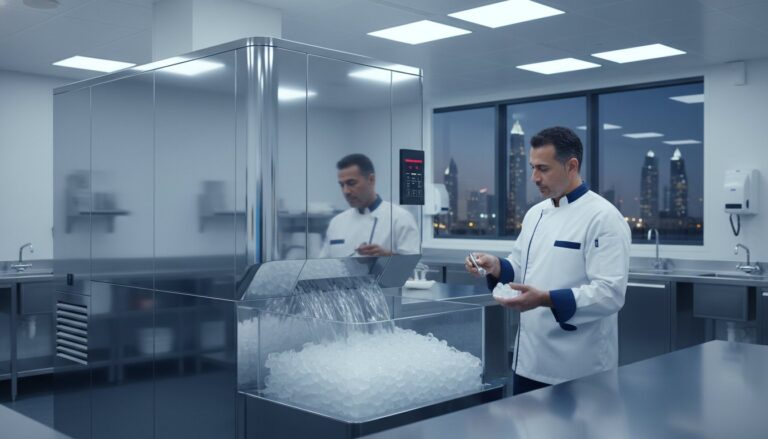
Can your current cooling infrastructure maintain peak output when ambient temperatures exceed 45°C, or is your facility one compressor failure away from a service crisis? For hospitality and food service leaders, selecting an industrial ice machine UAE requires a shift in perspective from viewing equipment as a standalone purchase to treating it as a vital component of thermal engineering. With the local hospitality market projected to reach approximately AED 110.36 billion by 2031, the demand for reliable, high-volume ice production is critical for maintaining professional standards.
We recognize that local challenges like mineral-heavy water and the May 30, 2026, deadline for greenhouse gas emissions reporting add layers of complexity to your procurement process. This article, brought to you by STEELTRACK KITCHEN EQUIPMENT IND LLC, offers a comprehensive technical roadmap to help you navigate these hurdles while ensuring your systems remain HACCP-compliant and energy-efficient. You’ll gain insights into specifying hardware that meets MoIAT conformity standards and integrates seamlessly with your stainless steel work tables and sinks, alongside strategies to reduce water consumption and mitigate scaling issues in the UAE’s unique climate.
Key Takeaways
- Analyze the performance stability of water-cooled versus air-cooled systems to maintain consistent high-volume output during extreme seasonal temperature peaks.
- Identify the precise filtration requirements needed to mitigate the impact of high mineral content and Total Dissolved Solids on your equipment’s internal components.
- Learn the technical criteria for selecting an industrial ice machine UAE that meets mandatory 2026 energy efficiency labeling and food safety standards.
- Explore the advantages of custom stainless steel integration, allowing modular ice units to be seamlessly incorporated into existing preparation areas and worktables.
- Understand the specific capacity planning needed to support the UAE’s expanding hospitality sector, ensuring your facility can meet demands exceeding 500kg daily.
The Critical Role of Industrial Ice Machines in the UAE’s Hospitality Sector
The UAE hospitality sector operates at an intensity few other global markets can match. With hotel occupancy rates reaching approximately 85% in early 2026, the logistical pressure on back-of-house operations is immense. A high-capacity industrial ice machine UAE is no longer a luxury for large-scale facilities; it’s a fundamental utility required to sustain continuous service. Relying on external ice suppliers introduces significant operational risks, including fluctuating delivery costs in AED and potential breaches in the cold chain that could compromise HACCP compliance. Producing ice on-site allows for total control over water filtration and hygiene, ensuring every cube or flake meets the rigorous safety standards mandated by the Dubai Municipality Food Safety Department.
Beyond hygiene, the economic argument for on-site production is compelling. High-volume users, such as 5-star resorts and large hospitals, often require upwards of 500kg of ice daily. When you calculate the long-term expenditure of purchasing bagged ice versus the energy and water costs of an efficient industrial system, the return on investment typically manifests within the first 18 to 24 months of operation. This financial predictability is essential for maintaining lean operational margins in a competitive commercial landscape.
Industrial Scale vs. Commercial Capacity
In the context of UAE mega-kitchens and regional catering hubs, “industrial” refers to systems capable of exceeding 500kg of daily output. While under-counter units serve smaller bars, large-scale operations require modular ice heads mounted on high-capacity storage bins. These oversized bins provide a critical buffer during peak demand periods, such as large banquet events or high-turnover holiday services. Transitioning to modular systems also allows for easier maintenance and the ability to scale production by adding secondary heads without redesigning the entire kitchen footprint.
Regional Environmental Factors
Engineers must account for the history of industrial ice machines and how their cooling cycles have evolved to handle extreme climates. Standard European or North American specifications often fail in cities like Dubai or Sharjah, where ambient temperatures frequently surpass 45°C. High heat loads place extraordinary strain on compressors, often leading to premature failure if the system isn’t specifically rated for tropical desert conditions. Additionally, high humidity levels in coastal areas can lead to condensation issues and mold growth within the machine’s chassis. Selecting an industrial ice machine UAE engineered for 24/7 operation in the Middle East is the only way to protect your investment and ensure operational longevity in these punishing environments.
Selecting Ice Types: From Gourmet Cubes to Industrial Flake Ice
Choosing the correct ice geometry is a strategic decision that directly influences both product quality and operational efficiency. In any professional environment, ice is classified as a food ingredient. This classification necessitates strict adherence to hygiene protocols that mirror international benchmarks like FDA ice safety regulations. For most hospitality leaders, the primary choice revolves around the specific thermal requirements of their service model. High-density cube ice remains the standard for luxury dining and beverage service across the UAE. Its reduced surface area ensures minimal dilution, which is a critical factor for maintaining the integrity of premium beverages in the region’s high-ambient temperatures.
This focus on ice quality is shared by regional specialty beverage leaders like Caffeine Lab, who understand that the right ice is essential for preserving the nuances of premium coffee in extreme heat.
Catering and Hospitality Applications
Sizing an industrial ice machine UAE requires a precise calculation of peak-hour guest counts and specific service types. A hotel with 500 rooms requires vastly different ice configurations for its banquet halls compared to its signature cocktail bars. While cubes are preferred for glass service, flake ice is indispensable for maintaining the temperature integrity of seafood buffets and chilled displays. The soft, moldable texture of flake ice provides maximum surface contact. This ensures that perishable items remain within safe thermal zones throughout the entire service period.
Industrial and Food Processing Uses
Beyond the dining room, industrial-grade ice serves the UAE’s robust export and construction sectors. Scale ice is harder and colder than standard flake ice. It’s frequently utilized in large-scale dough mixing for industrial bakeries to prevent premature yeast activation during the high-heat months. In the construction industry, specifically during the peak of summer in Dubai and Abu Dhabi, scale ice is integrated into concrete mixing processes to regulate chemical hydration heat. This level of high-volume production requires robust equipment that can be seamlessly integrated with stainless steel work tables and customized storage solutions to maintain a methodical workflow.
For businesses within these export-heavy sectors, Global Exclusive Trading (GET) provides the strategic trade facilitation needed to connect domestic production with international markets.
Nugget and chewable ice are also seeing a surge in demand within the UAE healthcare and fast-casual sectors. This ice type is preferred for patient hydration in hospitals due to its soft texture and ease of consumption. Regardless of the type chosen, the focus remains on selecting a system that can sustain its rated output despite the environmental pressures of the Middle East. It’s not just about producing ice; it’s about ensuring that the production remains consistent when the facility is operating at maximum capacity.
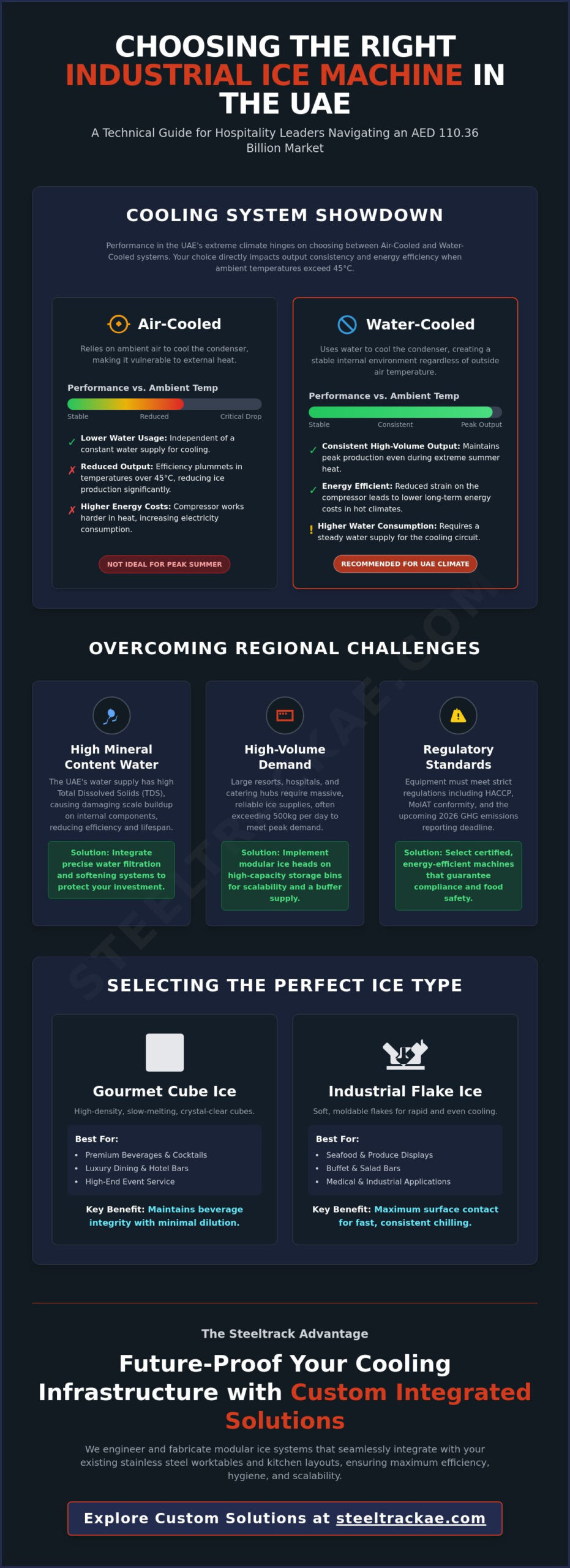
Technical Specifications: Cooling Systems and Capacity Planning
Selecting an industrial ice machine UAE requires an engineering-first approach to cooling infrastructure. While standard specifications might suffice in temperate climates, the Middle East demands a rigorous evaluation of how heat is rejected from the system. Adhering to global Commercial refrigeration energy standards ensures operational efficiency, but local conditions dictate whether an air-cooled or water-cooled configuration is more sustainable. Facilities must also prepare for the transition to eco-friendly refrigerants as mandated by the UAE Climate Law (Federal Decree-Law No. 11 of 2024), which emphasizes the reduction of greenhouse gas emissions by 2026.
The Air-Cooled vs. Water-Cooled Debate
Air-cooled systems are typically preferred for their lower installation complexity, yet they release significant heat into the immediate environment. This can overwhelm your kitchen’s HVAC system, leading to higher energy bills in AED. In contrast, water-cooled units offer superior performance stability when ambient temperatures exceed 40°C, but they involve higher water consumption and require careful management of scale buildup. For facilities located in UAE malls or high-rise developments, remote air-cooled condensers are often the gold standard. By moving the condenser to an external service area, you remove the thermal load from the kitchen while maintaining high harvest rates despite the dusty regional environment.
Calculating True Output (The 32/21 Standard)
A critical error in capacity planning is relying on “rated capacity,” which manufacturers typically measure at an ambient temperature of 21°C. In the UAE, real-world conditions are significantly more punishing. Because the refrigeration cycle must work harder to reject heat when incoming water is warm and ambient air is hot, a machine rated for 500kg daily may only produce 380kg during the peak of July. This discrepancy occurs because high ambient temperatures extend the freezing cycle and reduce the efficiency of the heat exchange process. To mitigate this inevitable performance drop, Steeltrack recommends a 20% capacity buffer for all regional installations. This proactive approach ensures your facility maintains a consistent ice supply even when external temperatures are at their most extreme.
Proper capacity planning also involves evaluating your storage needs. An undersized bin will cause the machine to shut down prematurely, while an oversized bin can lead to ice clumping and hygiene issues. Integrating your ice production with high-quality reach-in refrigerators or walk-in cold rooms can help manage the distribution of ice across different departments. By treating your ice production as a critical utility rather than a simple appliance, you ensure that your production levels remain stable, your energy costs stay predictable, and your facility remains fully compliant with evolving regional regulations.
Operational Longevity: Water Filtration and Maintenance Standards
The operational lifespan of an industrial ice machine UAE is dictated as much by the quality of the water entering the system as the ambient temperature surrounding it. In the United Arab Emirates, facility managers face a unique challenge: desalinated water often carries a high concentration of Total Dissolved Solids (TDS). When this water is subjected to the refrigeration cycle, minerals precipitate and form scale on the evaporator plates. This scale acts as a powerful insulator, forcing the system to work harder to achieve the same cooling effect, which inevitably leads to inflated energy bills in AED and premature compressor fatigue.
Water Quality Management
Effective water management requires a multi-stage approach to filtration. While standard carbon filters may remove chlorine and sediment, they’re often insufficient for the high mineral content found in many industrial zones. Implementing a Reverse Osmosis (RO) system or high-capacity polyphosphate feeders is essential to protect the evaporator from scale buildup. Beyond protecting the machinery, proper filtration ensures the production of “gourmet” quality ice that is clear and odorless. It’s also vital to monitor incoming water temperatures; in the height of summer, water entering the machine can be significantly warmer, which slows down the harvest cycle and increases the thermal load on the refrigeration system.
The Maintenance Lifecycle
Maintaining high-capacity ice systems in the UAE’s dusty environment necessitates a rigorous preventative schedule. Dust and airborne particulates quickly clog condenser coils, especially in air-cooled units located near high-traffic kitchen areas or external service bays. A monthly cleaning of these coils is a non-negotiable requirement to maintain airflow and prevent the high-pressure safety switches from tripping. Professional calibration of sensors and bin controls is equally critical, as it ensures the machine doesn’t overfill or run dry, both of which can cause systemic damage.
To assist facility managers in maintaining peak performance through 2026, we recommend the following monthly checklist:
- Chemical Descaling: Perform a full cycle cleaning using food-grade nickel-safe solutions to remove internal mineral deposits.
- Sanitization: Execute manual sanitization of the storage bin and internal water lines to ensure total HACCP compliance.
- Condenser Inspection: Clear all dust and debris from the cooling fins to optimize heat rejection.
- Filter Replacement: Monitor pressure gauges across your filtration bank and replace cartridges before flow rates drop.
- Sensor Testing: Verify that the bin level sensors and water flow probes are communicating accurately with the control board.
Ensuring your equipment remains in peak condition requires a partnership with experts who understand regional technical demands. Secure your facility’s operational efficiency by exploring our high-performance ice machines engineered specifically for the region’s unique water and environmental conditions.
Steeltrack Solutions: Custom Fabrication and System Integration
Achieving peak efficiency with an industrial ice machine UAE requires more than just selecting a high-performance unit. It demands a sophisticated integration strategy that aligns the equipment with your facility’s physical layout and operational workflow. Steeltrack provides a specialized approach by offering bespoke stainless steel housings that allow modular ice heads to be seamlessly incorporated into custom stainless steel work tables. This level of customization ensures that ice production is positioned exactly where it’s needed, reducing staff movement and enhancing the speed of service in high-pressure environments like Dubai’s premium hotel kitchens.
Our engineering team designs custom storage solutions, including high-capacity bins fabricated to fit specific kitchen footprints. These tailored bins prevent the spatial inefficiencies common with generic equipment and ensure that your ice buffer is always sufficient for peak demand periods. By managing the entire turnkey installation process, we handle the complex plumbing, electrical, and drainage requirements necessary for high-yield units, ensuring every component meets the rigorous MoIAT conformity standards required in the Emirates.
Engineering Seamless Workflows
Precision engineering is vital when managing the high-volume output of industrial systems. We focus on designing ice access points that prioritize ergonomic throughput while addressing the technical necessity of custom drainage. Poorly planned drainage leads to standing water and significant hygiene risks, which can jeopardize your facility’s standing with the Dubai Municipality Food Safety Department. Our solutions integrate ice production with larger cooling ecosystems, such as walk-in cold rooms and reach-in refrigerators, creating a centralized and methodical refrigeration strategy that optimizes energy consumption across the board.
Strategic Partnership and Support
Managing the complex regulatory landscape of 2026, including the May 30 deadline for greenhouse gas emissions reporting, requires a partner with deep regional expertise. Steeltrack operates with a comprehensive understanding of the industrial zones in Sharjah and Dubai, providing the technical skill needed to maintain a high-performance industrial ice machine UAE. Our involvement doesn’t end with the physical installation; we provide technical consultation for large-scale hospitality projects throughout the Northern Emirates, ensuring your staff is fully trained on maintenance protocols and sanitization cycles.
By choosing a partner that understands the methodical nature of industrial fabrication, you ensure that your cooling infrastructure is both resilient and scalable. Whether you’re specifying equipment for a new hospital in Abu Dhabi or retrofitting a catering hub in Sharjah, our engineers provide the technical skill necessary to maintain high-capacity production in the UAE’s extreme climate. Consult with Steeltrack engineers for your custom ice production setup to ensure your facility meets the highest standards of industrial excellence.
Securing Your Cooling Infrastructure for 2026 and Beyond
Maintaining a high-volume ice supply in the Middle East requires a departure from standard off-the-shelf equipment. You’ve seen how regional ambient temperatures and water mineral content dictate the necessity for specialized cooling systems and multi-stage filtration. By prioritizing technical specifications like remote condensers and capacity buffers, your facility can withstand the most punishing summer peaks while remaining fully compliant with 2026 energy and environmental regulations. It’s a matter of technical precision over simple procurement.
Selecting a high-performance industrial ice machine UAE is a strategic investment in your facility’s operational resilience. Steeltrack facilitates this transition through our specialized UAE fabrication facility, where we engineer bespoke solutions that integrate seamlessly with your existing workflow. With strategic locations in Sharjah and Dubai, we provide the regional expertise required for HACCP-compliant kitchen design and long-term system reliability. Our methodical approach ensures your infrastructure is built for endurance and professional excellence.
Contact Steeltrack for a Custom Industrial Refrigeration Quote to ensure your production capacity remains stable and efficient. We’re ready to help you implement a cooling solution that meets the highest industrial standards and supports your long-term growth.
Frequently Asked Questions
What is the best type of ice machine for a high-volume hotel in Dubai?
High-volume hotels in Dubai benefit most from modular cube ice systems integrated with high-capacity storage bins. These units provide the dense, slow-melting ice necessary for luxury beverage service while allowing for the scalability required during peak tourism seasons. Selecting a modular industrial ice machine UAE allows your facility to stack units as demand grows without needing additional floor space.
How does the UAE summer heat affect industrial ice production rates?
Ambient temperatures exceeding 45°C can reduce harvest rates by approximately 25% to 30% compared to standard factory ratings. This drop occurs because the refrigeration cycle must work longer to reject heat from the condenser and cool warmer incoming tap water. It’s essential to specify equipment with a capacity buffer to ensure your supply remains consistent during the peak of summer.
Is a water-cooled or air-cooled ice machine better for Sharjah’s industrial areas?
Air-cooled units equipped with remote condensers are generally superior for Sharjah’s industrial zones to minimize water utility expenses in AED. While water-cooled units offer excellent thermal stability in extreme heat, they can be significantly more expensive to operate given local water tariffs. Remote condensers allow you to move the heat load outside the building, protecting your kitchen’s HVAC efficiency.
What kind of water filtration is required for commercial ice makers in the UAE?
Effective filtration must address the high Total Dissolved Solids (TDS) and chlorine levels found in regional desalinated water supplies. Systems should include high-grade pre-sediment filters followed by Reverse Osmosis or polyphosphate feeders. These components are critical to prevent scale buildup on the evaporator plates, which otherwise leads to increased energy consumption and frequent component failure.
Can Steeltrack fabricate a custom storage bin for my existing ice machine?
Steeltrack specializes in bespoke stainless steel fabrication for high-capacity storage bins designed to fit specific kitchen footprints. These bins are engineered to interface perfectly with existing modular heads, providing a durable and hygienic solution for bulk ice management. Our custom bins ensure that your storage capacity matches your peak-hour demand without wasting valuable square footage.
How often should an industrial ice machine be serviced in the Middle East?
Monthly maintenance is the professional standard for units operating in the Middle East’s dusty and high-heat environment. This schedule must include cleaning the condenser coils to maintain airflow and performing chemical descaling to remove mineral deposits. Quarterly deep cleaning and sanitization are also required to maintain total HACCP compliance and ensure the longevity of the compressor.
What are the power requirements for a 1000kg modular ice machine?
A 1000kg modular unit typically requires a dedicated three-phase electrical connection (400V to 415V) to ensure stable operation. This specialized power supply is necessary to handle the high start-up amperage of industrial-grade compressors. It’s vital to verify that your facility’s electrical infrastructure can support these loads before proceeding with a high-yield installation.
Does Steeltrack provide installation services for ice machines across the UAE?
We manage comprehensive turnkey installations across all seven emirates, including the necessary plumbing, electrical, and drainage connections. Our technical team ensures that each industrial ice machine UAE installation complies with local municipality regulations. We also focus on seamless integration with your existing stainless steel sinks and work tables to optimize kitchen workflow and hygiene.