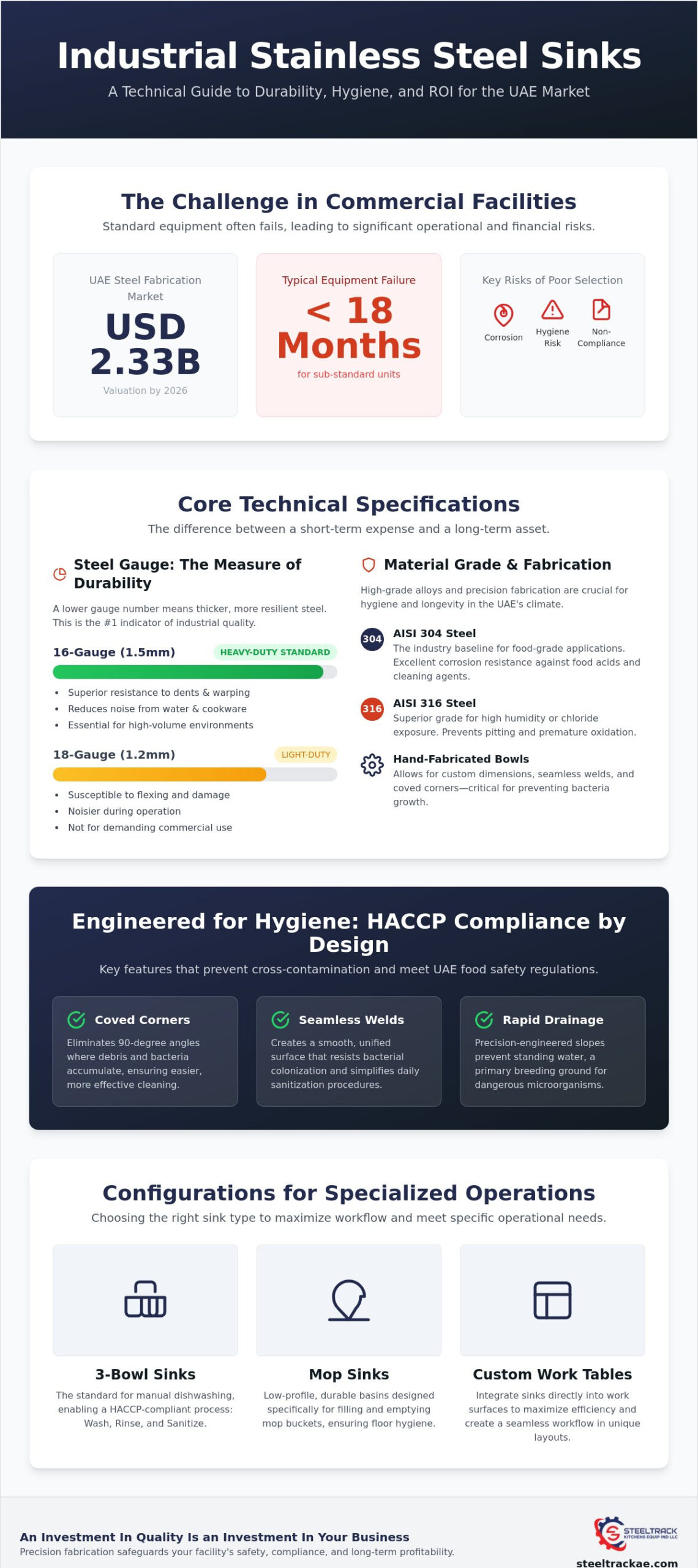
The UAE structural steel fabrication market has reached a valuation of USD 2.33 billion in 2026, yet many commercial facilities continue to lose capital on equipment that fails within eighteen months of installation. You likely recognize that an industrial sink is far more than a simple utility; it’s a foundational element of your facility’s hygiene infrastructure and daily operational efficiency. Identifying the premier stainless steel sink manufacturers UAE offers is essential to avoid the common pitfalls of premature corrosion and poor drainage design that often plague standard units. These technical failures don’t just disrupt your workflow; they compromise your HACCP compliance and long-term profitability.
This guide provides the technical framework necessary to select and procure industrial-grade sinks that withstand the most demanding environments. We’ll examine the metallurgical requirements for AISI 304 food-grade steel and the precision engineering required for custom fabrication in specialized layouts. This overview serves as a strategic roadmap for achieving superior ROI through equipment that meets the highest regional standards for safety, durability, and institutional excellence.
Key Takeaways
- Understand how industrial stainless steel sinks act as essential hygiene barriers and why specific metallurgical integrity is required to meet UAE food safety regulations.
- Identify the technical differences between 16-gauge and 18-gauge steel to ensure your equipment withstands the rigorous demands of a high-volume commercial environment.
- Evaluate the structural advantages of hand-fabricated bowls versus press-drawn units when sourcing from premier stainless steel sink manufacturers UAE.
- Determine the optimal configuration for your facility, including the implementation of 3-bowl sinks for HACCP-compliant manual sanitation and specialized mop sinks.
- Learn when to prioritize custom-fabricated work tables with integrated sinks over ready-made solutions to maximize operational efficiency in unique kitchen layouts.
The Role of Industrial Stainless Steel Sinks in UAE Food Safety
In the context of high-volume commercial operations, the industrial stainless steel sink functions as a primary defense against microbiological hazards. It’s a critical hygiene barrier designed to withstand the rigors of chemical sanitization and constant mechanical stress. Within the United Arab Emirates, this equipment must adhere to stringent regulatory frameworks, including Federal Law No. 10 of 2015 on Food Safety. Leading stainless steel sink manufacturers UAE ensure that every unit is fabricated to facilitate total decontamination, as food-grade surfaces are a non-negotiable requirement for authorities such as the Dubai Municipality Food Safety Department and the Abu Dhabi Quality and Conformity Council. These institutions demand equipment that prevents bacterial proliferation through the use of non-porous, inert materials that don’t react with food acids or cleaning agents.
Hygiene Standards and HACCP Compliance
HACCP compliance is central to modern kitchen design and institutional safety. Industrial sinks must prevent cross-contamination through intentional engineering and precise fabrication. This includes the use of coved corners, which eliminate the 90-degree angles where organic matter typically accumulates. Seamless welding and polished joins are equally vital, as they create a unified surface that resists bacterial colonization. When stainless steel sink manufacturers UAE provide units for commercial dishwashing or hand-wash stations, they must ensure the design facilitates rapid drainage and eliminates standing water. This methodical approach to fabrication ensures that facilities can maintain the high sanitation levels required for international food safety certification.
Material Selection for Harsh Environments
The environmental conditions in the UAE, characterized by high ambient temperatures and significant humidity, necessitate the use of high-grade alloys. AISI 304 stainless steel serves as the baseline for industrial applications due to the specific properties of stainless steel, including excellent corrosion resistance and structural stability. While lower-grade alloys might appear cost-effective during the procurement phase, they frequently succumb to pitting and oxidation in the region’s harsh climate. Steeltrack focuses on heavy-duty 304 and 316-grade units to ensure long-term ROI by preventing premature material failure. These high-integrity materials maintain their non-porous integrity even under the stress of industrial use, ensuring that the equipment remains a reliable asset within the facility’s hygiene infrastructure for years to come. Investing in superior metallurgical standards is a strategic decision that safeguards both public health and corporate reputation.
Technical Manufacturing Standards for Commercial Sinks
Precision in manufacturing distinguishes industrial equipment from standard domestic units. While aesthetic appeal remains a factor, structural resilience is the primary objective for high-volume environments where equipment must endure constant mechanical stress. Engineering excellence begins with the selection of the correct material thickness and the application of methodical fabrication techniques. Leading stainless steel sink manufacturers UAE prioritize these technical standards to ensure that every unit maintains its structural integrity under the weight of industrial cookware and the rigors of high-pressure cleaning.
Gauge Thickness and Structural Integrity
The gauge of the steel is the most significant indicator of a sink’s durability and longevity. In industrial applications, 16-gauge (approximately 1.5mm) is the preferred standard for heavy-duty operations, as it offers superior resistance to denting and warping compared to the lighter 18-gauge (1.2mm) alternatives. Thicker steel also provides inherent sound dampening properties, significantly reducing the “drumming” noise common in busy kitchens. High-quality industrial fabrication is identifiable by the weight of the unit and the absence of flex in the sink basin or drainboard when pressure is applied. Choosing a higher gauge ensures that the equipment remains a stable platform for daily operations, preventing the micro-cracks that can occur in thinner materials over time.
The fabrication process itself varies between mass-produced press-drawn bowls and hand-fabricated units. Press-drawn bowls are created by stretching a single sheet of steel into a mold, which can lead to thinning at the corners. In contrast, hand-fabricated sinks involve precise cutting and welding of individual panels, allowing for uniform thickness throughout the entire basin. This method is particularly advantageous for custom layouts where specific dimensions or deeper bowls are required to handle large-scale prep work.
Welding and Finishing Excellence
Structural failure often begins at the joins, making welding techniques a critical point of evaluation. Argon-shielded TIG (Tungsten Inert Gas) welding is the industry benchmark for industrial sinks because it creates high-strength, clean bonds without the risk of oxidation at the weld site. This process preserves the corrosion-resistant properties of the alloy, ensuring the sink remains hygienic and structurally sound. Following the welding process, a #4 brushed finish is applied to the surface. This specific grain is favored in professional environments because it effectively masks minor scratches from daily use while providing a smooth texture that is easy to sanitize. The inclusion of heavy-duty under-structures, such as reinforced hat-sections or cross-braced channels, is essential to prevent the sink deck from bowing or vibrating under the weight of industrial cookware.
Achieving these standards requires a deep understanding of both metallurgy and modern engineering. If you are designing a new facility or upgrading your existing infrastructure, you can consult with our technical team to determine the exact specifications required for your specific operational load.
Types of Stainless Steel Sinks for Specialized Operations
Operational efficacy in a commercial kitchen or industrial facility depends heavily on the strategic selection of sink configurations. While standard single or double-bowl units suffice for basic prep work, specialized operations require equipment designed for specific workflows and high-volume throughput. Leading stainless steel sink manufacturers UAE provide a range of engineered solutions that align with international sanitation protocols while maximizing the available floor plan. Choosing the correct configuration is not merely a matter of convenience; it’s a technical decision that impacts labor efficiency and regulatory compliance.
Triple Bowl Sinks for Manual Warewashing
The Stainless Steel 3 Bowl Sink remains the gold standard for manual sanitation in facilities where automated dishwashing is either unavailable or unsuitable for oversized equipment. This configuration facilitates the systematic wash-rinse-sanitize workflow required by global food safety standards. The first basin is dedicated to heavy-duty detergent washing, the second to clear-water rinsing, and the third to chemical sanitization. For industrial applications, these basins must be sized to accommodate large stockpots and industrial pans, often requiring depths of 300mm or more. Integration with high-performance pre-rinse faucets and high-flow drainage systems is essential to manage the volume of water and debris generated during peak hours. This methodical approach to warewashing ensures that all utensils meet the necessary hygiene benchmarks before returning to the production line.
Specialized Utility and Mop Sinks
Maintaining facility-wide sanitation requires dedicated zones for cleaning equipment, which is why the Stainless Steel Mop sink is a staple in institutional design. These units are typically available in floor-mounted or wall-mounted configurations. Floor-mounted models are particularly effective for heavy-duty use, as they eliminate the need to lift heavy, water-filled buckets, thereby reducing the risk of workplace injury. These utility sinks are engineered with heavy-duty splashbacks to protect surrounding masonry from chemical exposure and moisture. In the UAE, managing greywater and ensuring proper grease trap integration is a regulatory priority. Industrial mop sinks must be compatible with advanced filtration systems to prevent solid waste and oils from entering the municipal sewage lines, ensuring the facility remains compliant with local environmental mandates.
For operations that prioritize space optimization, integrated Stainless Steel Work Tables with built-in sinks offer a hybrid solution. These units combine preparation and washing zones into a single, seamless footprint, reducing the movement required by staff and streamlining the transition from raw ingredient handling to cleaning. By consolidating these functions into high-integrity furniture, facility managers can achieve a more logical and hygienic workflow within limited square footage.
Custom Fabrication vs. Ready-Made Sink Solutions
Ready-made equipment offers a convenient solution for immediate replacements, yet it frequently fails to address the complex spatial and operational requirements of high-capacity facilities. When standard dimensions don’t align with a kitchen’s architectural footprint, the resulting gaps create significant hygiene risks and operational bottlenecks. Strategic collaboration with experienced stainless steel sink manufacturers UAE allows facility managers to bypass these limitations through bespoke engineering. Custom-fabricated units are designed to integrate seamlessly with existing plumbing and drainage infrastructure, ensuring that every square millimeter of floor space is utilized effectively. This methodical approach to design ensures that the equipment supports, rather than hinders, the facility’s workflow.
Optimizing Kitchen Flow with Bespoke Designs
Bespoke fabrication allows for the precise tailoring of sink dimensions to match the footprints of specific commercial appliances, such as combi ovens or high-performance cooking ranges. This level of customization extends beyond simple dimensions; it encompasses the integration of drawers, shelves, and base cabinets directly into the sink unit. By consolidating preparation, washing, and storage into a single piece of high-integrity furniture, facilities can significantly improve ergonomics and reduce staff movement. Eliminating dead space between units doesn’t just improve workflow; it also removes the hard-to-reach areas where debris and moisture typically accumulate. This precision directly supports your HACCP compliance goals by simplifying the daily sanitation routine.
Procurement Considerations for UAE Projects
The procurement of custom equipment requires a more methodical approach than purchasing off-the-shelf units. While lead times for custom fabrication are longer due to the engineering and prototyping phases, the long-term ROI usually justifies the initial investment. It’s essential to ensure that technical drawings are verified against site-specific requirements before production begins to avoid installation delays. This is particularly critical in the UAE, where plumbing standards and grease trap requirements may vary between different municipal jurisdictions. You can explore our custom fabrication and stainless steel solutions to understand how tailored equipment can transform your operational efficiency and ensure compliance with regional standards.
For projects with non-standard layouts or specialized plumbing needs, a one-size-fits-all approach is rarely the most cost-effective path. If you are currently evaluating your facility’s requirements, you can request a technical consultation to discuss your specific design constraints with our fabrication experts.
Steeltrack: Precision Stainless Steel Fabrication for the UAE
Steeltrack Kitchen Equipment Ind LLC maintains a position of regional leadership by prioritizing engineering precision over mass-market convenience. In a sector where equipment longevity is the primary metric of success, we serve as a strategic partner for facilities that require uncompromising standards. While other stainless steel sink manufacturers UAE offers may prioritize the rapid delivery of standard units, our focus remains on the fabrication of high-integrity systems designed to withstand the mechanical and chemical stresses of 24-hour operations. This commitment to industrial reliability ensures that our clients achieve a superior return on investment through reduced maintenance costs and extended equipment lifecycles.
Comprehensive Industrial Kitchen Solutions
Our expertise extends across the full spectrum of professional kitchen infrastructure, allowing us to deliver cohesive turnkey solutions that go beyond simple equipment supply. By integrating custom sinks with heavy-duty cooking ranges and stainless steel work tables, we create a unified operational environment where every component is engineered to the same rigorous specification. This single-source approach eliminates the technical compatibility issues that often arise when sourcing from multiple vendors. Whether we’re fabricating specialized 3-bowl units, mop sinks, or heavy-duty floor gratings, our methodical production process ensures that every weld and finish meets the institutional standards required by UAE hospitality and healthcare leaders. This holistic view of kitchen design ensures that your facility operates as a synchronized, high-performance unit.
Expert Installation and Technical Support
The functionality of a high-grade sink is ultimately dependent on the precision of its installation within the wider facility infrastructure. Our technical teams oversee every aspect of the setup process, from verifying site-specific plumbing alignment to ensuring perfect leveling on uneven industrial floors. This attention to detail prevents the water pooling and drainage failures that can compromise hygiene and lead to premature material fatigue. Following installation, we offer structured technical support to preserve the non-porous integrity of the steel and ensure continued compliance with local food safety regulations. This comprehensive lifecycle support is central to our reputation as a trusted provider for all your industrial kitchen equipment and fabrication needs. We remain dedicated to supporting the UAE’s industrial growth through the delivery of smart, durable, and HACCP-compliant solutions that define the future of commercial kitchen standards.
Advancing Institutional Hygiene Standards for 2026
The selection of high-integrity equipment is a strategic investment in your facility’s long-term operational health. As discussed, the transition toward more unified national food safety systems in the UAE demands a methodical approach to procurement. Choosing stainless steel sink manufacturers UAE that prioritize technical manufacturing standards, such as AISI 304 grade alloys and precision TIG welding, ensures that your infrastructure remains compliant and durable. By opting for bespoke fabrication rather than restrictive ready-made units, you can optimize your floor plan and eliminate the ergonomic bottlenecks that hinder productivity.
Steeltrack specializes in AISI 304 industrial-grade fabrication and provides full turnkey design and installation services. We’re proud to be trusted by leaders across the UAE hospitality and industrial sectors for our commitment to precision engineering and industrial reliability. We invite you to request a custom fabrication quote from Steeltrack to begin the process of upgrading your facility with high-performance solutions. Our technical team is ready to assist you in designing a kitchen environment that reflects the highest standards of professional excellence.
Frequently Asked Questions
What is the best grade of stainless steel for commercial sinks in the UAE?
AISI 304 is the industry standard for commercial food preparation environments in the UAE due to its excellent corrosion resistance and non-porous nature. For facilities located in coastal areas or those utilizing high-salinity water, AISI 316 is often recommended as it contains molybdenum to resist chloride-induced pitting. Selecting the appropriate grade is essential for meeting the hygiene requirements enforced by the Dubai Municipality Food Safety Department and other regional authorities.
How do I choose between a 16-gauge and 18-gauge stainless steel sink?
You should prioritize 16-gauge (1.5mm) stainless steel for high-volume industrial environments where heavy cookware and constant mechanical stress are expected. While 18-gauge (1.2mm) is suitable for light-duty prep stations, the thicker 16-gauge material offers superior sound dampening and resistance to denting. Leading stainless steel sink manufacturers UAE typically recommend 16-gauge for institutional kitchens to ensure a higher return on investment through extended equipment lifecycles.
Are 3-bowl sinks mandatory for commercial kitchens in the UAE?
Yes, 3-bowl sinks are generally required for facilities that perform manual warewashing to comply with the standard wash-rinse-sanitize protocol. This configuration ensures that all utensils are properly cleaned and chemically sanitized before reuse, which is a core component of HACCP compliance. While specific requirements may vary between the Dubai and Abu Dhabi municipalities, the 3-bowl system remains the gold standard for institutional food safety and professional hygiene.
Can I get a custom-sized stainless steel sink fabricated for my kitchen?
Custom fabrication is the most effective way to address unique kitchen layouts where standard units might leave unhygienic gaps or create ergonomic bottlenecks. Steeltrack specializes in the design and production of bespoke industrial sinks, including integrated work tables and specialized 3-bowl units. This process allows for the precise tailoring of basin depths and dimensions to match your facility’s specific operational throughput and architectural constraints.
What is the difference between AISI 304 and AISI 316 stainless steel?
The primary difference lies in the chemical composition; AISI 316 contains approximately 2% to 3% molybdenum, which provides significantly higher resistance to corrosion from chlorides and industrial acids. While AISI 304 is the standard for most food-grade applications, AISI 316 is reserved for the most demanding environments, such as coastal hospitality venues or pharmaceutical laboratories. Both materials maintain the non-porous integrity required for professional sanitation in industrial fabrication.
How do I maintain my industrial stainless steel sink to prevent rusting?
Maintaining the passivated surface of the steel requires regular cleaning with mild detergents and non-abrasive microfiber cloths. It’s critical to avoid using steel wool or chlorine-based cleaners, as these can disrupt the protective oxide layer and lead to localized pitting or rust. Ensuring the sink is dried after use prevents mineral deposits from accumulating, preserving the #4 brushed finish and maintaining the equipment’s structural integrity over the long term.
Does Steeltrack provide installation services for fabricated sinks?
Steeltrack offers comprehensive turnkey services that include professional installation for all fabricated stainless steel furniture and kitchen equipment. Our technical teams ensure that units are perfectly leveled and correctly aligned with the facility’s plumbing and drainage systems to prevent water stagnation. This professional setup is vital for ensuring that the equipment functions according to its engineering specifications and meets all regional health and safety standards.
What are the drainage requirements for a commercial mop sink?
Commercial mop sinks in the UAE must be integrated with high-flow drainage systems and compliant grease traps to manage greywater effectively. Municipal regulations require that solid debris and oils are filtered before entering the public sewage network to prevent environmental contamination. When sourcing from reputable stainless steel sink manufacturers UAE, ensure the unit’s drainage diameter matches your facility’s specific plumbing infrastructure to facilitate rapid water clearance and maintain a hygienic environment.