The profitability of a high-volume UAE kitchen is often decided by the thermal recovery speed of its primary cooking assets rather than the menu alone. You likely recognize that during peak service hours, even a slight drop in oil temperature can compromise food quality and slow down your entire production line. Precision is no longer optional. Selecting the right commercial deep fryer Dubai requires more than comparing tank capacities; it demands a deep understanding of industrial engineering and local regulatory alignment. As the 2026 Unified National Food Safety System now mandates stricter digital logging via FoodWatch, your equipment must perform with absolute accuracy to avoid significant non-compliance penalties.
This guide offers a comprehensive technical analysis for selecting, installing, and maintaining high-performance frying systems tailored for the unique demands of the UAE market. We’ll explore the critical differences between gas and electric thermal processing, focusing on how specific configurations affect energy efficiency and long-term durability. You’ll gain insights into meeting the latest Dubai Civil Defence fire suppression requirements and ESMA certifications to ensure your facility remains both safe and profitable. By the end of this guide, you’ll have the strategic knowledge necessary to implement a frying solution that delivers consistent excellence and superior operational margins.
Key Takeaways
- Identify the technical distinctions between light-duty retail units and industrial-grade thermal processing equipment to ensure sustained performance in demanding UAE kitchens.
- Master the critical metric of recovery time when selecting a commercial deep fryer Dubai to maintain superior food quality and throughput during peak operational hours.
- Assess the strategic trade-offs between gas-powered burners and electric immersion elements to optimize energy efficiency and thermal precision within your facility.
- Integrate mandatory safety features, such as high-limit thermostats and automatic shut-off valves, to align with updated 2026 regional safety regulations and fire codes.
- Utilize custom stainless steel fabrication and turnkey installation services to create a seamless, high-efficiency workflow that maximizes long-term return on investment.
Defining the Industrial Deep Fryer for High-Volume UAE Kitchens
An industrial-grade Deep fryer represents a sophisticated thermal processing unit engineered for the relentless pace of large-scale hospitality. While retail marketplaces often highlight compact appliances for light cafe use, these lack the robust architecture required for industrial environments. A high-performance commercial deep fryer Dubai is distinguished by its high-capacity output and its ability to maintain operational stability under extreme stress. These units are typically integrated into larger cooking ranges or stand as independent, heavy-duty modules designed for continuous throughput. Precision engineering ensures these systems don’t just cook food; they manage heat with systematic efficiency.
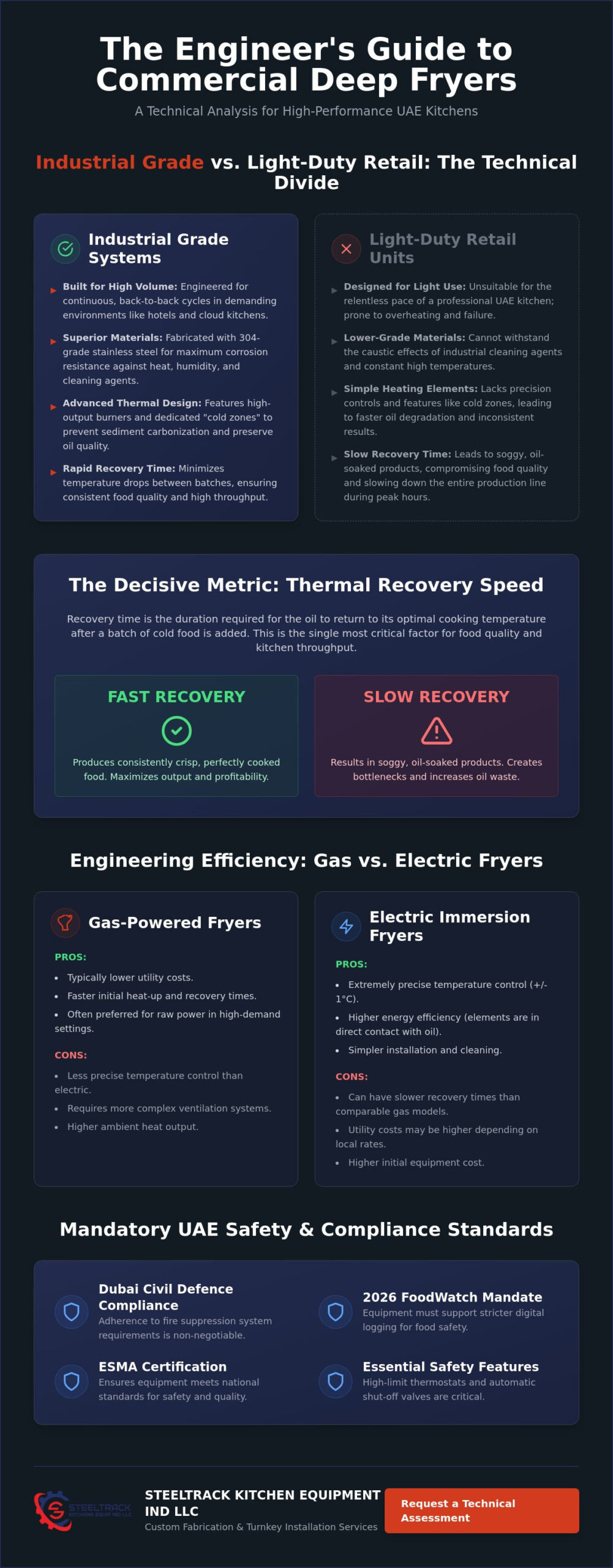
Material selection is the foundation of equipment longevity. In the UAE, where humidity and high ambient temperatures accelerate wear, 304-grade stainless steel is the industry standard for industrial fabrication. This material offers superior resistance to oxidation and chemical corrosion, ensuring the unit remains hygienic and structurally sound over years of heavy use. Investing in high-grade materials prevents the premature equipment failure often seen in lower-quality retail alternatives, which can’t withstand the caustic nature of boiling oil and industrial cleaning agents.
Key Components of Industrial Frying Systems
The heart of thermal efficiency lies within high-output burners or immersion heating elements. These components are designed to transfer heat rapidly to the oil, minimizing the window between batches. Industrial vats also feature dedicated “cold zones” at the base. This design allows food sediment to settle in a lower-temperature area, preventing carbonization that would otherwise spoil the oil and degrade food flavor. Advanced thermostatic controls complete the system, providing the precision required to maintain exact temperatures in high-output environments where even a five-degree variance can impact consistency.
Why Industrial Grade Matters for UAE Operations
Dubai’s commercial kitchens operate in a unique environment where ambient heat and humidity are constant factors. Industrial equipment is engineered with superior insulation and heat dissipation systems to protect internal components. Furthermore, high-volume sectors like cloud kitchens and hotel banqueting require fryers that handle back-to-back cycles without significant temperature drops. Retail units often struggle with slow recovery times, leading to soggy, oil-soaked products that fail to meet professional standards. Choosing industrial-grade solutions ensures your facility remains compliant with national safety and hygiene regulations, providing a reliable foundation for professional kitchen services and large-scale catering operations.
Engineering Efficiency: Gas vs. Electric Commercial Deep Fryer Performance
The selection between gas and electric power sources is a strategic engineering decision that dictates the long-term operational costs and throughput capabilities of a facility. Procuring a commercial deep fryer Dubai involves assessing the specific thermal requirements of your menu against the available utility infrastructure. While both systems aim to achieve the same culinary outcome, the physics of heat transfer differ significantly between gas-fired burners and electric immersion elements. In high-volume environments, these differences manifest in recovery time, energy efficiency, and maintenance cycles. For assistance in calculating the thermal load and utility requirements for your facility, you may consult our engineering team for a technical assessment.
Recovery time serves as the definitive metric for industrial performance. It measures the duration required for the frying medium to return to its set point after a cold product load is introduced. If the recovery is too slow, the product absorbs excessive oil, resulting in a compromised texture and increased waste. Industrial engineering trends in 2026 indicate a 5.77% compound annual growth rate in the commercial fryer market, driven largely by the demand for units that minimize this thermal lag. Whether you’re managing a central production unit or a high-traffic restaurant, the ability to maintain consistent oil temperatures during peak hours is non-negotiable for food quality and safety compliance.
Gas Fryers: Power and Rapid Recovery
Gas-powered systems are the traditional choice for high-volume UAE operations due to their immense raw power. These units utilize high-BTU burners that heat the oil through tubes or the exterior of the vat. They’re exceptionally effective for heavy loads, such as frozen proteins, where rapid heat injection is required to prevent temperature crashes. However, gas fryers require specialized infrastructure, including dedicated gas lines and robust exhaust hoods that meet the updated 2026 Dubai Municipality ventilation standards. Maintenance is also more intensive, as burners and pilot assemblies require regular calibration to ensure safety and fuel efficiency.
Electric Fryers: Precision and Thermal Efficiency
Electric models utilize immersion heating elements that are submerged directly in the oil, achieving nearly 100% heat transfer efficiency. This direct contact allows for incredibly precise temperature management, which is vital for delicate items that require strict thermal windows. Modern kitchen layouts often favor electric units because they eliminate the need for complex gas plumbing and are generally easier to install in cloud kitchens or high-rise developments. As the UAE moves toward smarter, more sustainable kitchen environments, the electrification of frying systems is becoming a preferred path for operators seeking lower ambient heat emissions and simplified compliance with ESMA electrical safety certifications.
- Thermal Transfer: Electric elements provide direct heat, while gas utilizes combustion via heat exchangers.
- Infrastructure: Gas requires DCD-approved piping; electric requires high-capacity three-phase power panels.
- Operational Cost: Gas often provides lower utility costs for 24/7 operations, though electric models reduce load on air conditioning systems.
Strategic Equipment Selection: Freestanding vs. Countertop Models
Selecting a commercial deep fryer Dubai requires an objective assessment of your facility’s spatial layout and projected production velocity. Equipment configuration shouldn’t be an afterthought; it’s a fundamental aspect of kitchen engineering that influences staff movement and fire safety compliance. While freestanding models serve as the backbone of industrial production lines, countertop units offer the agility required for specialized stations or smaller footprints. The decision hinges on whether your operation demands the raw output of a dedicated station or the modularity of a multi-purpose work zone.
Strategic integration often involves housing fryers within larger Cooking Ranges to create a unified thermal processing zone. Custom-fabricated stands and work surfaces are frequently utilized to bridge the gap between off-the-shelf equipment and the specific dimensions of a kitchen’s footprint. This methodical approach to equipment placement minimizes unnecessary movement and optimizes the flow of raw ingredients to finished products. By prioritizing structural integrity and workflow efficiency, operators can ensure their kitchen remains a high-output environment capable of meeting the rigorous demands of the Dubai hospitality sector.
Freestanding Deep Fryers for High-Volume Production
Freestanding units excel in environments where the demand for fried goods is constant and heavy. These systems often feature single or double tank configurations, allowing operators to segregate proteins and prevent flavor transfer across different menu items. A significant engineering advantage of industrial freestanding models is the inclusion of integrated oil filtration systems. These automated circuits extend the life of the frying medium by systematically removing carbonized particles, which directly lowers operational costs. Their heavy-duty construction ensures the structural stability necessary to support large volumes of oil and heavy baskets without compromising safety during peak service hours.
Countertop Solutions for Compact Kitchen Layouts
For boutique cafes, specialized dessert bars, or cloud kitchens with limited floor area, countertop solutions provide essential modularity. These units allow for a flexible kitchen design that can be scaled or reconfigured as menu requirements evolve. To maintain the professional standards required in the UAE, these fryers should be paired with industrial-grade Stainless Steel Work Tables or specialized Stainless Steel Oven tables. This combination ensures that the equipment sits at an ergonomic height while providing a heat-resistant, hygienic surface that meets municipal health codes. Countertop models are particularly effective for secondary frying tasks that don’t justify the footprint of a full-sized unit.
- Throughput: Freestanding units are designed for continuous, high-capacity output; countertop models are better suited for intermittent or low-volume use.
- Filtration: Most freestanding industrial units include built-in filtration, whereas countertop models typically require manual oil management.
- Spatial Efficiency: Countertop units maximize vertical space by utilizing existing work surfaces, while freestanding models require dedicated floor real estate.
Safety Standards and Operational Rigor in Industrial Frying
Operating an industrial kitchen in the UAE requires a rigorous adherence to safety protocols that extend beyond basic equipment operation. For a high-capacity commercial deep fryer Dubai, safety is fundamentally an engineering requirement. Integrated high-limit thermostats serve as a critical fail-safe, automatically disconnecting power or gas flow if oil temperatures exceed safe thresholds to prevent flash fires. Similarly, automatic shut-off valves are essential for gas-powered units, ensuring that any pilot light failure or pressure irregularity immediately halts fuel delivery. Professional installation isn’t merely a recommendation; it’s a prerequisite for meeting Dubai Civil Defence (DCD) and Emirates Authority for Standardization and Metrology (ESMA) standards, which are strictly enforced for trade license renewals in 2026.
A methodical maintenance schedule is the primary defense against catastrophic equipment failure. This includes monthly calibration of thermostatic sensors and quarterly inspections of gas lines and electrical connectors. Neglecting these systematic checks can lead to significant downtime and potentially hazardous conditions. To ensure your facility meets all regional compliance mandates, you should schedule a professional safety audit with a qualified engineering partner to verify your equipment’s operational integrity.
HACCP and Hygiene Compliance
Hygiene and food safety are now managed through the Unified National Food Safety System, which requires real-time digital logging via the FoodWatch portal. Industrial deep fryers must be designed with hygiene as a priority, utilizing coved corners and large-diameter drain valves that facilitate thorough cleaning and prevent the buildup of organic debris. Stainless steel surfaces must meet food-grade standards to resist bacterial growth and withstand the high-temperature sanitization required by UAE health inspectors. Proper oil management, including documented disposal protocols, is essential to avoid the severe fines associated with inaccurate safety logs, which can range from AED 50,000 to AED 100,000 for serious violations in 2026.
Ventilation and Heat Management
Managing the extreme heat generated by industrial frying is a complex engineering challenge, particularly within the UAE’s high ambient temperature environment. Integrating frying stations with high-performance commercial exhaust hoods is mandatory for maintaining air quality and fire safety. These hoods must be equipped with automatic wet-chemical fire suppression systems as required for all Type I cooking equipment. Modern extraction systems must also comply with the 2026 updated minimum airflow velocity limits to effectively remove grease-laden vapors and heat, protecting both the kitchen staff and the structural integrity of the facility.
Comprehensive Kitchen Solutions: Custom Fabrication and Installation
Success in high-volume UAE hospitality depends on more than just high-spec units; it requires a cohesive ecosystem where every component is engineered for maximum workflow efficiency. Procuring a standalone commercial deep fryer Dubai is only the initial phase of facility development. True operational excellence is achieved through custom fabrication that integrates frying stations seamlessly into the kitchen’s specific footprint. This methodical approach ensures that every square centimeter of floor space contributes to throughput, ultimately maximizing your return on investment through reduced labor friction and enhanced safety protocols.
Adopting a strategic partnership approach to kitchen design allows operators to move beyond simple procurement toward a fully optimized industrial environment. When equipment is custom-fitted rather than forced into a standard layout, the risk of technical failure and safety violations decreases significantly. Our focus remains on creating high-performance facilities that reflect the professional standards and institutional strength required by large-scale commercial clients across the region.
The Steeltrack Advantage in Custom Fabrication
Our expertise lies in the precision manufacturing of bespoke stainless steel kitchen setups that transcend the limitations of standard retail offerings. We specialize in the design and fabrication of dedicated frying zones integrated with heavy duty cooking ranges, ensuring a unified and efficient thermal processing line. By utilizing advanced engineering and high-grade materials, we produce Stainless Steel Work Tables, Sinks, and Exhaust Hoods that are perfectly dimensioned for your specific commercial deep fryer Dubai. Local manufacturing capabilities within the UAE allow us to provide rapid delivery and immediate technical support, ensuring your project timeline remains on schedule without the delays often associated with international logistics.
Professional Installation and Technical Support
A turnkey installation service is essential for national hospitality projects where compliance and reliability are non-negotiable. Our engineering teams manage the entire process, from ensuring seamless utility connections for gas and electric units to conducting rigorous operational testing before final handover. We don’t just place equipment; we verify that every fire suppression system and ventilation component functions according to the updated 2026 regulatory standards. This comprehensive approach guarantees that your facility is ready for immediate operation and trade license renewal.
Following installation, we provide structured training for kitchen staff, focusing on equipment safety, daily maintenance, and optimal performance settings to extend the life of your assets. We offer ongoing technical support and preventative maintenance services designed for industrial clients who require absolute stability in their operations. This long-term commitment ensures your kitchen remains a productive asset that consistently meets the evolving standards of the UAE food and beverage sector.
Optimizing Thermal Processing Infrastructure for 2026 and Beyond
Achieving operational excellence in a high-volume kitchen requires a shift from simple procurement to strategic engineering. You’ve seen that the long-term performance of a commercial deep fryer Dubai depends on rapid thermal recovery and strict adherence to the 2026 Unified National Food Safety System. By prioritizing 304-grade stainless steel fabrication and professional installation, you ensure your facility remains both compliant and highly productive during peak service hours. Precision in equipment selection isn’t just about cooking; it’s about protecting your margins and your reputation.
As a premier UAE manufacturer of stainless steel solutions, we specialize in custom industrial kitchen fabrication designed for the region’s unique environmental demands. Our team provides national coverage for professional installation and ongoing support, ensuring your equipment operates with institutional reliability. We’re committed to delivering methodical progress and technical mastery for every project we handle. We’re ready to help you build a kitchen that sets new standards for efficiency and safety.
Take the next step in your facility’s development. Request a Technical Consultation for Your Industrial Kitchen Setup to align your operations with the highest industrial standards.
Frequently Asked Questions
What is the typical recovery time for an industrial deep fryer?
Industrial recovery times typically range between two and four minutes for high-capacity units processing standard frozen loads. This window’s critical for maintaining the structural integrity of the food’s exterior and preventing excessive oil saturation. High-output burners and immersion elements are engineered specifically to minimize this thermal lag. Precise recovery speeds fluctuate based on the initial oil volume and the thermal conductivity of the heating system employed within the facility.
Are gas or electric deep fryers more efficient for high-volume UAE kitchens?
Electric fryers achieve nearly 100% thermal efficiency through direct immersion elements, making them highly effective for consistent temperature management. Gas units often present a more economical choice for 24/7 industrial operations due to lower local utility rates for natural gas or LPG. The optimal choice for a commercial deep fryer Dubai depends on your facility’s existing electrical capacity and the specific volume of your production cycles.
What are the essential safety features for a commercial deep fryer in Dubai?
Mandatory safety features include high-limit thermostats that prevent oil ignition and automatic shut-off valves for gas-powered systems. All industrial frying stations must be integrated with a Dubai Civil Defence approved wet-chemical fire suppression system. These components are essential for maintaining compliance with the 2026 unified national food safety standards and ensuring the safety of your kitchen staff during high-intensity service periods.
How does oil filtration impact the ROI of an industrial frying system?
Integrated oil filtration can extend the usable life of frying oil by up to 50% by systematically removing carbonized sediments. This reduction in oil consumption directly translates to lower operational expenses and improved product consistency over time. By investing in automated filtration, industrial operators achieve a faster return on investment through decreased raw material waste and reduced labor requirements for manual oil management.
Can deep fryers be integrated into a custom heavy-duty cooking range?
Industrial frying units are frequently integrated into bespoke Cooking Ranges to create a centralized thermal processing zone. This configuration optimizes kitchen workflow by grouping primary cooking assets under a single extraction system. Custom fabrication allows for the seamless alignment of frying wells with work surfaces and other appliances, ensuring a methodical approach to large-scale food production within specialized UAE facilities.
What grade of stainless steel is recommended for commercial kitchen equipment?
304-grade stainless steel is the professional standard for industrial kitchen equipment due to its high chromium and nickel content. This specific alloy provides the necessary resistance to oxidation and chemical corrosion required in Dubai’s high-humidity environments. Utilizing 304-grade ensures that your equipment remains structurally sound and hygienic under the caustic conditions of boiling oil and intensive industrial cleaning protocols.
What are the ventilation requirements for installing a commercial deep fryer?
Installation requires a Type I exhaust hood equipped with an automatic fire suppression system and grease extraction filters. These systems must comply with the 2026 Dubai Municipality technical requirements for minimum extract airflow velocity. Proper ventilation’s essential for removing grease-laden vapors and managing the heat output of a commercial deep fryer Dubai, ensuring a safe and comfortable working environment for your culinary team.
How often should an industrial deep fryer undergo professional maintenance?
Industrial frying systems should undergo professional technical inspections at least once every quarter to ensure operational rigor. This schedule includes the calibration of thermostatic controls, testing of safety fail-safes, and inspection of gas or electrical connections. Regular maintenance prevents unexpected equipment downtime and ensures that your facility continues to meet the rigorous safety and performance standards established by regional regulatory authorities.