

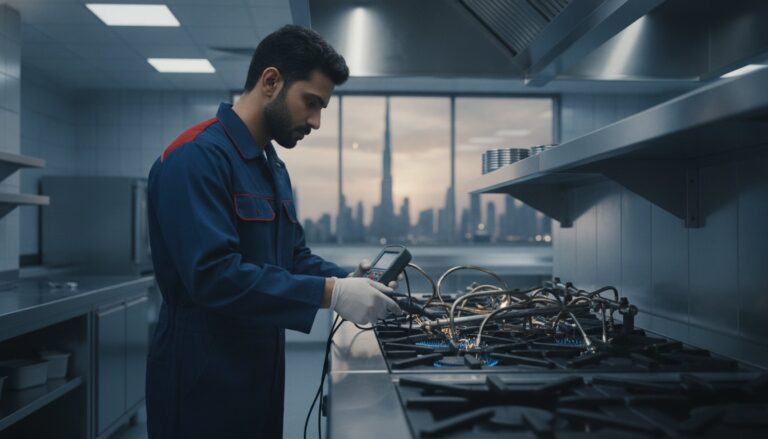
In a regional food service market projected to reach USD 26.26 billion by the end of 2026, the margin for mechanical error in a high-volume kitchen has effectively vanished. When a primary heat source fails, the resulting revenue loss and disruption to HACCP-mandated workflows represent a critical threat to institutional stability. You understand that a malfunctioning burner or an inconsistent thermal profile is more than a technical nuisance; it’s a direct compromise of food quality and safety standards. Securing reliable commercial cooking range repair Dubai services is no longer just about fixing a part; it’s about safeguarding your facility’s operational integrity and ensuring compliance with the latest UAE industrial regulations.
This guide provides a rigorous technical framework for addressing industrial cooking range failures through the lens of precision engineering and fabrication-led repair. We’ll explore how to navigate the upcoming EN 16282-7:2026 fire safety standards and implement predictive maintenance protocols that extend the lifecycle of your heavy-duty assets. By examining the nuances of gas safety, thermal efficiency, and SS 304 material integrity, you’ll gain the strategic insights necessary to maintain a high-performance kitchen environment that meets the demanding requirements of the Dubai Municipality and Civil Defence.
Key Takeaways
- Identify the financial and operational risks associated with industrial range failure and learn strategies to mitigate revenue loss during critical service hours.
- Understand the technical complexities of Commercial cooking range repair Dubai, focusing on the calibration of industrial thermostats and high-performance burner assemblies.
- Recognize the engineering distinctions between residential units and industrial equipment to ensure compliance with UAE gas safety and material durability standards.
- Implement systematic preventive maintenance protocols, including thermal efficiency audits, to prevent carbon buildup and maintain long-term equipment reliability.
- Discover how professional fabrication expertise can restore specialized or obsolete components, providing a strategic advantage over simple part replacement.
Mitigating Operational Disruptions: The Impact of Industrial Range Failure
In the context of the UAE’s sophisticated hospitality sector, an industrial cooking range functions as a primary piece of critical infrastructure rather than a mere appliance. When these systems fail, the disruption radiates through the entire supply chain, affecting everything from inventory management to final guest satisfaction. Professional Commercial cooking range repair Dubai must be viewed as a specialized engineering intervention designed to restore the systematic thermal processing capabilities of a facility. Neglecting these assets creates systemic risks that can undermine the operational integrity of even the most established brands.
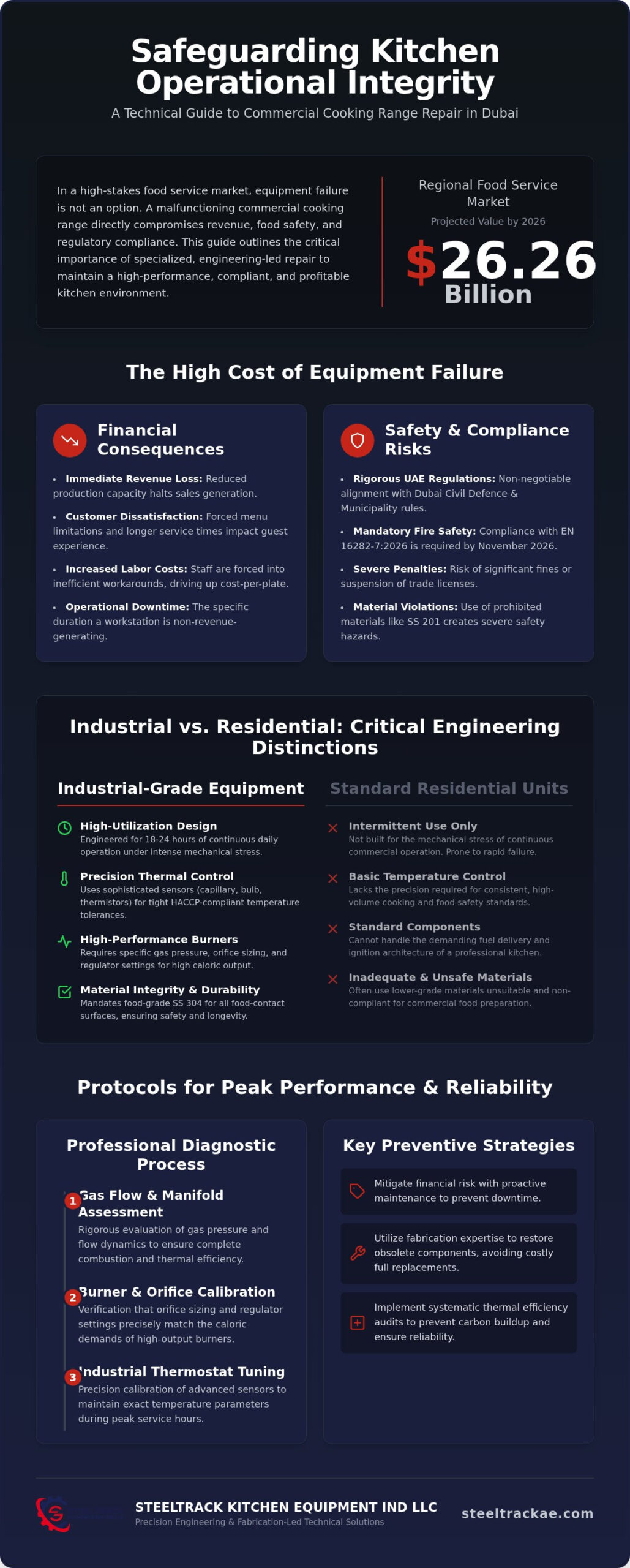
Commercial kitchens operate under intense mechanical stress, often running for eighteen to twenty-four hours a day. This high-utilization environment means that even minor component degradation can lead to a total system shutdown. Maintaining national food safety standards requires more than just clean surfaces; it demands that the core cooking equipment operates within precise temperature parameters to ensure HACCP compliance and prevent biological hazards.
The Financial Consequences of Cooking Equipment Failure
Revenue loss in a high-volume kitchen is measured by the minute. When a primary range goes offline, the immediate result is a reduction in production capacity, which forces menu limitations and leads to customer dissatisfaction. Beyond the immediate loss of sales, the impact on staff productivity is profound. Kitchen teams are forced to work around broken equipment, which extends service delivery schedules and increases labor costs per plate. Operational downtime is the specific duration during which a technical malfunction prevents a kitchen from meeting its design-rated production capacity, effectively halting the generation of revenue from that specific workstation.
Safety and Compliance Risks in the UAE
The regulatory environment in Dubai is exceptionally rigorous regarding gas safety and fire prevention. With the November 2026 deadline for the EN 16282-7:2026 fire safety standard approaching, the necessity for compliant equipment has never been higher. Industrial-grade pressure testing and gas leak detection are non-negotiable components of Commercial cooking range repair Dubai. Failure to align with Dubai Civil Defence and Municipality regulations can result in significant penalties or the suspension of trade licenses.
Certified technical services play a vital role in liability management. Attempting unauthorized repairs or utilizing non-industrial materials, such as grade 201 stainless steel which is prohibited for food-contact surfaces, creates severe safety hazards. Professional intervention ensures that all thermal processing equipment remains compliant with UAE Federal Law No. 10 of 2015, protecting the business from the legal and physical consequences of equipment failure.
Technical Diagnostics for Commercial Cooking Range Repair in Dubai
Effective Commercial cooking range repair Dubai requires a methodical approach that transcends basic part replacement. Industrial thermal equipment operates under extreme pressure and temperature variables that demand a systematic assessment of the entire fuel delivery and ignition architecture. Our diagnostic process begins with a rigorous evaluation of manifold integrity and gas flow dynamics. In heavy-duty setups, even a minor deviation in gas pressure can lead to incomplete combustion, which compromises both cooking speed and air quality. Engineers must verify that orifice sizing and regulator settings align with the specific caloric requirements of high-output burners.
Precision thermal processing relies heavily on the accurate calibration of industrial thermostats. Unlike residential units, commercial ranges utilize sophisticated capillary and bulb sensors or digital thermistors that must maintain tight tolerances during peak service hours. Adherence to established Commercial kitchen fire safety standards is the primary metric for diagnostic success. This involves testing fail-safe mechanisms and ensuring that automatic shut-off valves respond instantly to flame failure or overheating conditions. For modern hybrid systems and combi-ovens, diagnostics extend to the electrical control boards and high-limit switches that manage complex cooking cycles.
Common Industrial Faults in Gas and Electric Systems
In high-volume environments, thermocouple failure is a frequent cause of operational downtime, particularly in specialized equipment like Indian and Chinese gas ranges. These components are subjected to intense, concentrated heat that can lead to rapid degradation of the sensing element. Pilot light instability often stems from carbon buildup within the burner ports or obstructed primary air shutters. For electric industrial ranges, we focus on the technical resolution of heating element degradation. Oxidation of the internal resistance wire often results in uneven heat distribution, which directly impacts food consistency and HACCP compliance. Identifying these faults early through technical services prevents the need for more costly emergency interventions.
Component Integrity and OEM Parts
The engineering integrity of an industrial range is only as robust as its weakest component. Utilizing non-standard or low-grade replacement parts is a significant risk that can lead to premature system failure and potential safety violations. High-specification components are designed to withstand the rigorous demands of 24-hour kitchen operations. Our approach emphasizes the use of industrial-grade materials that meet or exceed original equipment manufacturer (OEM) specifications. In cases where components for specialized or older ranges are no longer available, we leverage our manufacturing expertise to fabricate durable, custom solutions. This fabrication-led approach ensures that the equipment’s structural and functional standards remain uncompromised. For facilities experiencing intermittent performance issues, an initial technical consultation can identify underlying manifold issues before they lead to systemic failure.
Industrial vs. Residential Standards: Why Professional Expertise Matters
Residential appliance repair centers often struggle with the sheer scale and technical density of industrial units. While a domestic cooker is designed for intermittent use, a commercial range must maintain structural integrity under constant thermal stress. In Dubai, this distinction is codified by the Municipality, which mandates the use of SS 304 food-grade stainless steel; using grade 201 is strictly prohibited. Professional Commercial cooking range repair Dubai requires an understanding of these material sciences to prevent premature corrosion and structural fatigue in high-moisture environments.
Standard home cookers operate on low-pressure gas lines with simplified manifolds. Conversely, industrial setups involve complex gas-air premix systems and high-BTU burner assemblies that require precise pressure regulation. General repair shops rarely possess the specialized fabrication tools, such as TIG welding stations or heavy-duty sheet metal brakes, necessary to restore a warped chassis or a compromised burner housing. Attempting to apply residential-grade solutions to industrial infrastructure often leads to recurring failures and potential safety violations.
Engineering for High-Volume Production
Industrial equipment operates on duty cycles that would cause a residential unit to fail within days. Restoring these assets requires diagnostic tools capable of measuring high-volume gas flow and manifold pressure at scale. Adhering to OSHA safety standards for kitchen equipment ensures that repairs don’t just fix the immediate fault but also mitigate long-term operational risks. Fabrication-led repair is essential for maintaining the longevity of stainless steel structures, as it allows for the reinforcement of load-bearing points that suffer from repetitive thermal expansion and heavy vessel weights.
Specialized Technical Competencies
Technicians handling industrial gas installations must hold specific certifications that go beyond basic appliance repair. These professionals rely on detailed technical drawings and engineering schematics to navigate the internal architecture of multi-burner systems and integrated ovens. Precision is the baseline for every project. You can explore our technical services to understand how engineering-led solutions differ from conventional maintenance. Utilizing a strategic partner who understands the rigorous demands of Commercial cooking range repair Dubai ensures that your facility remains compliant with the upcoming EN 16282-7:2026 fire safety standards, protecting your investment from regulatory scrutiny.
Preventive Maintenance Protocols for Industrial Kitchen Reliability
Transitioning from reactive Commercial cooking range repair Dubai to a predictive maintenance model is essential for the sustained success of large-scale hospitality operations. This systematic approach involves regular thermal efficiency audits to ensure that heat exchangers and burner assemblies are operating at peak design capacity. Monitoring gas pressure and electrical load profiles allows technical teams to identify anomalies before they escalate into catastrophic system failures. A proactive approach to Commercial cooking range repair Dubai significantly extends the operational lifespan of your stainless steel assets.
Range performance is inextricably linked to the efficiency of the commercial exhaust hood. Restricted airflow within the ventilation system can lead to heat entrapment, which accelerates the degradation of sensitive gas valves and electrical components. Proper maintenance ensures that the entire cooking station functions as a cohesive, high-performance unit.
Daily and Weekly Maintenance Frameworks
Implementing robust Standard Operating Procedures (SOPs) for daily cleaning is the first line of defense against equipment failure. Staff should utilize non-corrosive agents to remove grease from burner caps and aeration shutters. Maintaining optimal burner hygiene directly reduces gas consumption by ensuring a complete stoichiometric combustion process, thereby preventing the waste of fuel through unburnt hydrocarbons. Weekly visual inspections must include checking gas hoses for abrasions and ensuring that electrical connections remain seated and free of moisture.
Professional Quarterly Technical Audits
While daily care is vital, quarterly audits performed by technical service providers are necessary for deep-system reliability. These sessions involve the disassembly of gas manifolds for internal cleaning and the calibration of safety shut-off valves. Engineers test thermal protection systems to ensure they trigger according to the specific safety thresholds required by Dubai Civil Defence. This level of technical oversight is critical for maintaining the high standards expected in the UAE’s industrial sector.
Maintaining detailed maintenance logs is a mandatory requirement for local regulatory inspections. These documents serve as proof of adherence to the UAE Food Code and the upcoming EN 16282-7:2026 fire safety standards. To establish a compliant maintenance schedule for your facility, you may contact our engineering team for a professional site assessment.
Steeltrack’s Comprehensive Industrial Technical Solutions
Steeltrack operates at the intersection of manufacturing precision and technical service excellence. Our position as an established UAE manufacturer allows us to approach Commercial cooking range repair Dubai with a level of metallurgical and mechanical insight that standard repair vendors cannot match. We don’t merely replace components; we analyze the root cause of structural or thermal failure and apply engineering-led solutions to prevent recurrence. This methodical approach ensures that your heavy-duty assets maintain their operational rigor in high-volume environments.
Our technical capabilities extend beyond simple maintenance to include the restoration of complex industrial setups. We understand that a kitchen’s productivity depends on the seamless integration of gas systems, ventilation, and structural stainless steel. By positioning ourselves as a strategic engineering partner, we provide turnkey support that addresses the specific challenges of the UAE’s hospitality and catering sectors. Whether managing a single facility or a regional fleet, our commitment to excellence remains the cornerstone of every project.
Fabrication-Led Repair and Restoration
One of the primary challenges in industrial kitchen maintenance is the procurement of components for specialized or older equipment. We leverage our custom fabrication expertise to produce high-specification replacement parts for equipment like Chinese and Indian gas ranges when OEM solutions are no longer viable. Every restoration project utilizes SS 304 food-grade stainless steel, ensuring full compliance with Dubai Municipality standards and UAE Federal Law No. 10 of 2015. Our ability to refurbish heavy-duty boiling pans and high-performance deep fryers allows clients to extend the lifecycle of their capital equipment without compromising on safety or performance.
Strategic Asset Management and Support
Managing the technical requirements of a large-scale hospitality fleet requires a systematic and data-driven approach. We develop customized maintenance plans for industrial catering facilities that prioritize long-term reliability and regulatory compliance. Our technical teams operate across Dubai and the Northern Emirates, providing consistent support for a wide range of equipment, including Combi Ovens and Rational units. This strategic oversight ensures that your facility is prepared for the rigorous demands of the upcoming 2026 fire safety standards. To secure the longevity of your industrial kitchen infrastructure, you can Contact Steeltrack for professional technical services and experience the advantage of a manufacturer-led service partnership.
Advancing Operational Excellence through Strategic Engineering
Maintaining a high-volume kitchen requires a deliberate transition from basic mechanical fixes to a rigorous, engineering-led maintenance model. We’ve examined how fabrication-led restoration and strict adherence to SS 304 material standards safeguard your facility against the financial risks of operational downtime and regulatory non-compliance. As a dedicated B2B specialist with deep-seated industrial fabrication expertise, Steeltrack provides comprehensive national UAE service coverage to ensure your heavy-duty gas and thermal systems remain fully operational and compliant with the evolving 2026 safety standards.
Professional Commercial cooking range repair Dubai is the essential mechanism for ensuring that your primary heat sources operate at peak efficiency while meeting the rigorous demands of the Dubai Municipality and Civil Defence. By prioritizing technical precision and systematic audits, you protect both your capital investment and your brand reputation. You can Secure Your Industrial Kitchen Continuity with Steeltrack Technical Services to establish a resilient infrastructure that supports your facility’s long-term growth. Your commitment to technical mastery today ensures a safer, more productive environment for your culinary teams tomorrow.
Frequently Asked Questions
What are the primary indicators that an industrial cooking range requires professional repair?
Primary indicators include inconsistent flame patterns, burner ignition delays, and unexplained fluctuations in thermal output. These symptoms often point to gas manifold obstructions or failing thermocouple sensors that require immediate technical attention. Ignoring these signs can lead to total system failure and increased operational risks during peak service hours. You should monitor for any unusual gas odors or soot accumulation, as these suggest incomplete combustion and potential safety hazards.
How does professional maintenance impact the lifespan of a commercial gas range?
Professional maintenance significantly extends the lifecycle of industrial ranges by preventing the accumulation of carbon deposits and corrosive bypass. Systematic calibration of thermal sensors and regular manifold cleaning ensure that internal components aren’t subjected to excessive heat stress. This proactive approach to Commercial cooking range repair Dubai preserves the structural integrity of the stainless steel chassis over several years of high-volume use, maximizing your capital investment.
Is it necessary to use OEM parts for industrial kitchen equipment repairs in the UAE?
Utilizing OEM or high-specification equivalent components is critical for maintaining the engineering integrity and safety certification of the unit. Non-standard parts often fail to meet the specific BTU ratings or pressure tolerances required for heavy-duty gas systems. In the UAE, using certified components ensures that the equipment remains compliant with Civil Defence regulations and manufacturer warranty terms, reducing the risk of catastrophic component failure during service.
What safety standards must a technician meet for commercial gas range repair?
Technicians must adhere to the UAE Food Code and the upcoming EN 16282-7:2026 fire safety standards for all industrial interventions. This includes conducting rigorous gas leak detection, pressure testing of manifolds, and verifying the functionality of automatic shut-off valves. Compliance with these standards is a mandatory requirement for maintaining a valid trade license and ensuring the highest levels of institutional safety within the Dubai hospitality sector.
How often should a heavy-duty cooking range undergo a technical audit?
Heavy-duty cooking ranges should undergo a comprehensive technical audit at least once every quarter. These audits go beyond daily cleaning to include internal component inspection, thermal calibration, and safety system testing. High-utilization facilities, such as industrial catering centers, may require more frequent assessments to prevent unexpected downtime and ensure continuous HACCP compliance throughout the fiscal year. Regular audits are the foundation of a reliable preventive maintenance strategy.
Can specialized fabrication solve structural issues in older commercial ranges?
Specialized fabrication is the most effective solution for addressing warped frames or compromised burner housings in older industrial ranges. By utilizing TIG welding and heavy-duty sheet metal brakes, engineers can reinforce load-bearing points and restore the unit’s structural stability. This fabrication-led approach to Commercial cooking range repair Dubai provides a cost-effective alternative to complete equipment replacement while maintaining industrial-grade durability and meeting current municipality material requirements.
What is the typical timeframe for diagnosing an industrial range fault?
A systematic diagnosis of an industrial range fault typically takes between sixty and ninety minutes, depending on the complexity of the gas and electrical architecture. This process involves pressure testing the fuel lines, inspecting the ignition sequence, and verifying the accuracy of thermal sensors. A thorough diagnostic phase is essential for identifying the root cause of failure and developing a precise restoration plan that minimizes operational disruptions.
How does range performance affect the overall efficiency of a kitchen ventilation system?
Range performance directly influences ventilation efficiency; incomplete combustion or excessive heat bypass forces the exhaust system to work harder to maintain air quality. When burners are improperly calibrated, they produce higher levels of grease-laden vapors, which leads to rapid buildup in the exhaust hoods and ducts. Maintaining optimal range performance reduces the mechanical load on your ventilation infrastructure and improves the overall environmental conditions of the kitchen.