
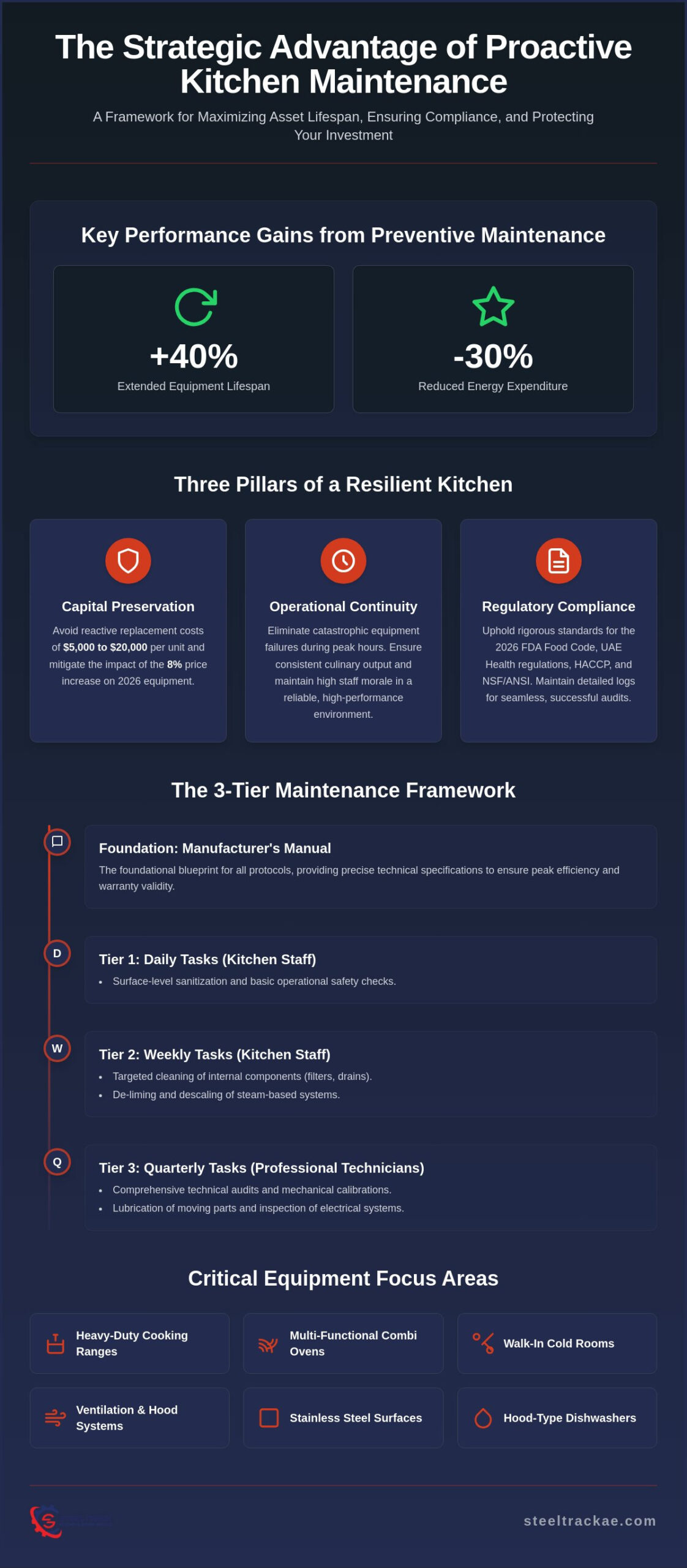
Did you know that a disciplined preventive maintenance program can extend the functional lifespan of your industrial culinary assets by up to 40% while simultaneously reducing energy expenditure by 30% or more? Mastering the methodology of how to maintain commercial kitchen equipment is no longer optional; it’s a financial necessity. In an environment where equipment acquisition costs have escalated due to 2026 tariff adjustments and shifting supply chains, the financial impact of unexpected downtime during peak operational hours is more than a mere inconvenience. You recognize that a reactive approach to repairs is an inefficient use of capital and that maintaining a flawless health and safety record is essential for long-term institutional stability.
This professional guide establishes the definitive technical framework required to ensure both operational continuity and regulatory compliance. We provide the systematic protocols necessary to protect your heavy-duty investments and uphold the rigorous standards demanded by the 2026 regulatory environment. You’ll gain a comprehensive understanding of the latest ENERGY STAR efficiency mandates, mandatory NFPA 96 inspection intervals, and the precise cleaning cycles necessary to secure a competitive advantage in today’s demanding culinary market.
Key Takeaways
- Discover how to maximize the return on investment for your culinary assets by implementing systematic protocols that prevent catastrophic equipment failure during high-volume service periods.
- Establish a clear hierarchy of accountability by distinguishing between essential daily staff tasks and the specialized technical audits required for industrial compliance.
- Master the precise engineering requirements for how to maintain commercial kitchen equipment, with a specific focus on heavy-duty cooking ranges and multi-functional combi ovens.
- Understand the technical science behind preserving food-grade stainless steel surfaces and custom-fabricated ventilation systems to ensure long-term structural integrity.
- Identify the critical operational indicators that necessitate professional technical intervention to maintain continuity and uphold the latest 2026 safety standards.
The Strategic Importance of Commercial Kitchen Equipment Maintenance
In the high-pressure environment of industrial culinary operations, the technical integrity of your infrastructure is the primary determinant of your enterprise’s resilience. Understanding how to maintain commercial kitchen equipment is not merely a matter of hygiene; it’s a fundamental pillar of strategic asset management. When equipment is treated as a critical industrial component rather than a disposable tool, the financial benefits are substantial. Industry data indicates that preventive maintenance can increase equipment life by 20% to 40%, a vital metric when considering that the average cost to replace a single unit in 2026 ranges from $5,000 to $20,000. By prioritizing the structural and mechanical health of your assets, you ensure that your facility remains a stable and productive environment.
Beyond capital preservation, systematic maintenance ensures that your facility remains operational during high-volume service periods. A catastrophic failure of a primary cooking range or walk-in cold room during peak hours doesn’t just result in lost immediate revenue; it erodes your brand’s reputation and diminishes staff morale. Precise calibration of equipment also ensures consistent culinary output, as fluctuating temperatures in ovens or fryers can compromise the quality of the final product delivered to the client. A well-maintained kitchen projects an atmosphere of excellence and precision, reinforcing a culture of professional pride among your culinary team.
Protecting Capital Investment and Operational Continuity
Viewing your kitchen assets as long-term industrial investments is essential in an era of rising acquisition costs. With 2026 price increases of up to 8% on commercial equipment and parts, the financial burden of “reactive” maintenance has become unsustainable. Proactive strategies focus on identifying mechanical wear before it results in total system collapse, thereby extending the functional lifecycle of heavy-duty cooking ranges and multi-functional combi ovens. This methodical approach transforms maintenance from a fluctuating overhead expense into a predictable protective shield for your balance sheet. It’s a commitment to excellence that ensures your kitchen remains a high-performance asset rather than a liability.
Regulatory Compliance and Food Safety Standards
Upholding the highest standards of food safety is a non-negotiable requirement for any professional kitchen. Adherence to Hazard Analysis and Critical Control Points (HACCP) principles requires rigorous documentation of equipment performance and sanitation. In 2026, with the introduction of new FDA Food Code editions and updated UAE health requirements, maintaining detailed maintenance logs is critical for successful audits. Well-maintained equipment, such as stainless steel work tables and hood-type dishwashers, plays a central role in preventing cross-contamination and ensuring that your facility meets the latest NSF/ANSI 2-2025 sanitation requirements. For organizations seeking to formalize these processes, engaging with a turnkey service and maintenance partnership provides the technical oversight necessary to ensure ongoing compliance and operational safety.
Implementing a Preventative Maintenance Framework
Success in industrial culinary operations relies on a structured hierarchy of care that eliminates ambiguity. When determining how to maintain commercial kitchen equipment, the original manufacturer manual serves as the foundational blueprint for all protocols. These documents provide precise technical specifications for load capacities, temperature tolerances, and component access. Relying on these engineering standards ensures that your warranty remains valid and your equipment operates at peak efficiency. A professional framework should categorize tasks into three distinct levels:
- Daily: Surface-level sanitisation and basic operational safety checks performed by kitchen staff.
- Weekly: Targeted cleaning of internal components and descaling of steam-based systems.
- Quarterly: Comprehensive technical audits and mechanical calibrations conducted by qualified service partners.
Accountability must be clearly delineated within this framework to prevent operational lapses. While internal staff manage the immediate hygiene of the facility, external technical experts should handle complex diagnostics. This division of labor ensures that high-value assets, like Rational Combi ovens or walk-in cold rooms, receive the specialized attention they require. Utilizing digital maintenance logs provides the transparency needed for 2026 regulatory compliance, allowing management to track completion rates and identify recurring mechanical issues before they lead to costly downtime.
Daily Operational Inspections and Sanitisation
Daily protocols are the first line of defense against equipment degradation and safety hazards. Every morning, staff must execute pre-service checks on gas connections and electrical integrity to ensure a secure working environment. At the conclusion of each shift, rigorous FDA Food Code cleaning requirements must be followed for all high-contact surfaces. Monitoring temperature gauges on refrigeration units, such as chef bases and bottle coolers, is also critical to prevent food spoilage and comply with the latest 2026 energy standards which mandate a 15% reduction in power consumption for commercial refrigeration.
Scheduled Deep Cleaning and Component Calibration
Beyond daily tasks, weekly and quarterly interventions preserve the internal mechanics of your assets. Weekly descaling of steam-based systems, including combi ovens and hood-type dishwashers, prevents mineral buildup that can lead to heating element failure. Monthly inspections should focus on the integrity of gaskets, seals, and hinges to maintain thermal efficiency and prevent energy waste. On a quarterly basis, technical partners should calibrate thermostats and pressure valves to ensure precise performance during high-volume service periods. If you require assistance in establishing these rigorous technical standards, consulting with a fabrication expert can help tailor a framework to your specific facility requirements.
Maintenance Protocols for Primary Culinary and Laundry Assets
Executing a comprehensive strategy for how to maintain commercial kitchen equipment requires a granular focus on the mechanical requirements of each asset class. While general cleaning is a baseline requirement, industrial-grade equipment demands a deeper level of technical care to sustain its engineering specifications. From high-output thermal units to precision refrigeration, each system operates under unique stresses that dictate its maintenance lifecycle. Implementing category-specific protocols ensures that your facility maintains its operational resilience even during the most demanding service periods.
Industrial Cooking Ranges and Thermal Equipment
The performance of heavy-duty cooking ranges is the primary driver of kitchen productivity. To ensure consistent thermal output, burners and pilot lights must be cleared of carbon deposits and food debris on a weekly basis. This prevents uneven flame patterns that can compromise cooking precision and increase gas consumption. For pizza ovens and combi units, degreasing the interior chambers is vital to prevent the accumulation of combustible residues. Additionally, deep fryer heating elements should be inspected for scale buildup, and oil filtration systems must be serviced to maintain the quality of the culinary output and the safety of the workspace.
Refrigeration Systems and Industrial Cold Rooms
In high-ambient temperature environments, such as those found in the UAE, refrigeration assets face extreme operational stress. The 2026 Department of Energy standards mandate a 15% reduction in power consumption for commercial refrigeration, making the cleanliness of condenser coils a critical financial priority. When coils are obstructed by dust or grease, the compressor must work significantly harder to maintain internal temperatures, leading to premature degradation. Staff should also inspect walk-in cold room door seals for thermal leaks and perform monthly ice machine sanitisation to prevent microbial growth. These actions are essential components of a professional approach to how to maintain commercial kitchen equipment in a challenging climate.
Industrial Laundry and Warewashing Systems
Warewashing and laundry systems require systematic descaling to remain effective. Hood-type dishwashers should be checked daily for nozzle obstructions and arm rotation efficiency to ensure full compliance with sanitisation standards. Utilizing a commercial kitchen cleaning checklist allows management to verify that these technical tasks are performed with consistency. For industrial laundry operations, lint trap management and drum balance inspections are necessary to prevent mechanical strain on tumble dryers. Precise chemical dosage calibration is also required to ensure that every cycle meets the rigorous hygiene standards expected in a professional B2B environment.
Preserving Stainless Steel Integrity and Ventilation Efficiency
Preserving the structural integrity of your facility requires a sophisticated understanding of the metallurgical properties of your infrastructure. While previous sections focused on mechanical components, the longevity of your custom-fabricated work tables, preparation sinks, and storage solutions depends on maintaining their surface chemistry. When determining how to maintain commercial kitchen equipment, the preservation of food-grade stainless steel is a critical discipline. Stainless steel’s resilience is derived from a microscopic chromium oxide layer that protects the underlying metal from oxidation. In high-humidity coastal environments, such as those found across the UAE, this passive layer is under constant environmental stress from saline air and moisture.
Proper Care for Food-Grade Stainless Steel Surfaces
Maintaining the integrity of stainless steel requires the strict avoidance of abrasive cleaning tools and chloride-based chemicals. Utilizing steel wool or harsh scouring pads can physically breach the protective chromium oxide barrier, leading to permanent pitting and corrosion. Staff must be trained to wipe surfaces following the direction of the polished grain to prevent the accumulation of debris in microscopic crevices. Immediate removal of acidic food residues or high-salt solutions is essential, as these substances can cause localized staining and degrade the metal’s finish. For facilities utilizing custom-fabricated solutions like stainless steel wall cabinets or floor grating, these hygiene protocols are the primary defense against premature material failure.
Maintaining Ventilation and Exhaust Hood Performance
Ventilation efficiency is a cornerstone of both fire safety and operational air quality. Stainless steel exhaust hoods must have their filters degreased daily to ensure optimal airflow and suction. According to the NFPA 96 standard, high-volume cooking operations require professional exhaust system inspections and cleanings at least quarterly to mitigate the risk of grease fires. Beyond cleaning, maintenance teams should regularly inspect fan motors and drive belts for signs of mechanical fatigue or misalignment. Neglecting these components can lead to system failure, resulting in poor air circulation and increased heat stress on other kitchen assets. Efficient grease management also extends to the maintenance of stainless steel grease traps, which must be cleared systematically to prevent drainage blockages and foul odors. If you require expert guidance on preserving your facility’s structural assets, contact our technical fabrication team for professional support.
Professional Servicing and Systematic Equipment Audits
While daily and weekly protocols are essential, they represent only one facet of a comprehensive asset protection strategy. Understanding how to maintain commercial kitchen equipment at an institutional level requires a transition from basic sanitation to systematic technical auditing. Professional intervention identifies latent mechanical failures that are often invisible to the untrained eye, such as hairline fractures in heat exchangers or gradual voltage fluctuations in induction components. By conducting annual infrastructure audits for gas, water, and electrical systems, operators ensure that the entire facility supports the peak performance of individual assets. This holistic approach prevents the “cascading failure” effect, where a utility imbalance in one area leads to premature degradation of high-value equipment elsewhere.
Identifying the precise moment that requires professional intervention is a critical skill for facility managers. Signs such as irregular thermal cycling, unusual acoustic signatures from motors, or persistent error codes on digital interfaces indicate that internal components have reached a threshold of wear. Transitioning from basic maintenance to total lifecycle management involves tracking these performance metrics over time to predict when an asset should be refurbished or replaced. This data-driven methodology ensures that capital expenditure is allocated with precision, avoiding the high costs associated with emergency replacements during peak operational hours.
The Role of Expert Technical Support
Manufacturer-trained technicians possess the specialized diagnostic tools necessary for complex industrial repairs. For mission-critical systems like walk-in cold rooms and Rational Combi ovens, the use of genuine spare parts is non-negotiable to maintain warranty validity and structural integrity. A professional emergency response plan should be established to mitigate the impact of unforeseen failures. This level of technical oversight transforms maintenance from a reactive burden into a strategic component of operational resilience. It’s an investment in certainty that ensures your culinary team can focus on output rather than infrastructure instability.
Establishing a Long-Term Maintenance Partnership
Selecting a turnkey service and maintenance partnership allows for the customization of protocols based on the specific architectural and operational needs of your facility. A strategic partner provides more than just repairs; they offer a roadmap for technical evolution. Leveraging fabrication expertise allows for seamless equipment upgrades and custom modifications that enhance workflow efficiency. Professional installation remains the most significant factor in reducing long-term maintenance requirements, as it ensures that every unit is calibrated to the facility’s specific utility parameters. This methodical approach to how to maintain commercial kitchen equipment secures the longevity of your industrial culinary assets and reinforces your commitment to professional excellence.
Securing Operational Excellence in the 2026 Culinary Landscape
The transition toward a more regulated and cost-intensive industrial environment requires a fundamental shift in how organizations manage their culinary infrastructure. As established throughout this guide, mastering how to maintain commercial kitchen equipment is a multifaceted discipline that integrates daily staff diligence with rigorous technical auditing. By prioritizing the structural integrity of your food-grade stainless steel and the mechanical precision of your thermal assets, you protect your capital investments from premature degradation. Systematic maintenance isn’t merely a defensive measure against downtime; it’s a strategic commitment to consistent quality and long-term institutional growth.
Managing the complexities of 2026 efficiency standards and safety mandates is more effective when supported by a seasoned industry veteran. As a leading manufacturer with deep technical expertise in the UAE, Steeltrack provides the specialized support required for heavy-duty and custom-fabricated systems. Whether you operate a high-volume industrial kitchen or a complex laundry facility, our team offers the comprehensive solutions necessary to ensure your operations remain flawless. We invite you to Partner with Steeltrack for Professional Kitchen Solutions and Maintenance to secure the future of your culinary assets. Your commitment to excellence deserves an infrastructure that never falters.
Frequently Asked Questions
How often should commercial kitchen equipment be professionally serviced?
High-volume industrial facilities should schedule professional technical audits at least once every quarter. This frequency ensures that mechanical components are inspected before wear leads to operational failure. For moderate-volume operations, semi-annual servicing is typically sufficient to maintain industrial standards. Consistent technical oversight ensures long-term reliability and helps your facility stay ahead of potential mechanical issues that could disrupt peak service hours.
What is the best way to clean stainless steel without damaging it?
The most effective method for cleaning food-grade stainless steel involves using a soft, non-abrasive cloth and a mild, chloride-free detergent. It’s essential to wipe in the direction of the polished grain to prevent the accumulation of microscopic debris. Avoiding steel wool and harsh chemicals preserves the protective chromium oxide layer. This layer is vital for preventing pitting and corrosion in professional environments, especially in high-humidity coastal regions.
Can poor maintenance void my equipment warranty?
Yes, neglecting systematic maintenance protocols can result in the immediate voiding of your equipment warranty. Manufacturers typically require documented evidence of regular servicing by qualified technicians to honor warranty claims. Establishing a rigorous framework for how to maintain commercial kitchen equipment ensures that your industrial culinary assets remain protected under their original engineering guarantees and performance standards, shielding your business from unexpected capital expenditures.
Why is my commercial refrigerator not holding the correct temperature?
Temperature fluctuations in commercial refrigeration are most commonly caused by obstructed condenser coils or degraded door gaskets. When coils accumulate dust and grease, the compressor must work harder to dissipate heat, leading to mechanical strain and reduced cooling efficiency. Regularly inspecting these components ensures that your walk-in cold rooms and chef bases refrigerators remain compliant with 2026 energy standards, which mandate significant reductions in power consumption.
How do I prevent grease fires in my kitchen exhaust system?
Preventing grease fires requires a combination of daily filter sanitisation and scheduled professional duct cleaning. According to NFPA 96 standards, high-volume operations must undergo professional exhaust system cleaning at least quarterly to mitigate the accumulation of combustible residues. Maintaining clean stainless steel exhaust hoods ensures optimal airflow and significantly reduces the risk of catastrophic fire incidents. This proactive approach is essential for maintaining a secure and professional working environment.
What are the daily maintenance tasks for a combi oven?
Daily maintenance for a combi oven should include executing the manufacturer’s recommended automatic cleaning cycle and inspecting the door gaskets for thermal leaks. Staff should also wipe down the exterior with a soft cloth to prevent grease buildup. These simple tasks are essential components of how to maintain commercial kitchen equipment. They ensure that multi-functional units like Rational Combi ovens operate with the consistent precision required for industrial culinary output.
Is it necessary to descale my industrial dishwasher every month?
Descaling your hood-type dishwasher on a monthly basis is necessary to prevent mineral buildup on heating elements and internal nozzles. In regions with hard water, scale accumulation can rapidly decrease mechanical efficiency and lead to component failure. Regular descaling ensures that every wash cycle meets the rigorous hygiene standards required for 2026 health and safety audits. This practice also helps maintain the operational lifespan of the unit’s internal plumbing and spray arms.
How does the UAE climate affect commercial refrigeration maintenance?
The extreme ambient heat and humidity in the UAE place significant operational stress on commercial refrigeration systems. High temperatures require compressors to run more frequently, necessitating more frequent condenser coil cleanings to prevent overwork and system failure. Professional installation and custom-fabricated solutions are vital in this region. These measures ensure that refrigeration assets can handle the environmental load while maintaining optimal power consumption in accordance with regional sustainability goals.