

Standard cooling specifications designed for temperate climates almost inevitably fail when subjected to the UAE’s extreme 55°C summer peaks. For industrial operators, this isn’t just a technical oversight; it’s a direct threat to operational continuity and food safety compliance. You’ve likely experienced the frustration of soaring energy bills or equipment that struggles to maintain the mandatory 5°C ceiling for chilled goods. Identifying the best cold room manufacturer in uae is about more than sourcing a vendor. It’s about securing a strategic partner capable of engineering a thermal envelope that withstands the region’s unique environmental pressures.
We recognize that your priority is a system that offers consistent temperature control and long-term durability through superior stainless steel construction. In this article, you’ll discover the technical standards and fabrication excellence required to implement high-performance cold storage solutions that meet strict HACCP regulations. We provide a methodical overview of the engineering principles behind industrial-grade insulation and the precise manufacturing processes that eliminate costly operational downtime.
Key Takeaways
- Understand the engineering requirements for maintaining internal thermal stability despite the UAE’s extreme ambient heat and high humidity levels.
- Learn how high-density polyurethane (PUF) panels and professional-grade stainless steel fabrication contribute to superior insulation and structural longevity.
- Identify the technical distinctions between chiller and freezer room specifications to ensure your facility meets exact food safety and pharmaceutical storage regulations.
- Evaluate the procurement standards necessary to partner with the best cold room manufacturer in uae for reliable, high-performance industrial cooling.
- Discover the advantages of a turnkey approach to cold storage that integrates custom design with professional installation for reduced operational downtime.
The Strategic Importance of Cold Storage in the UAE Industrial Sector
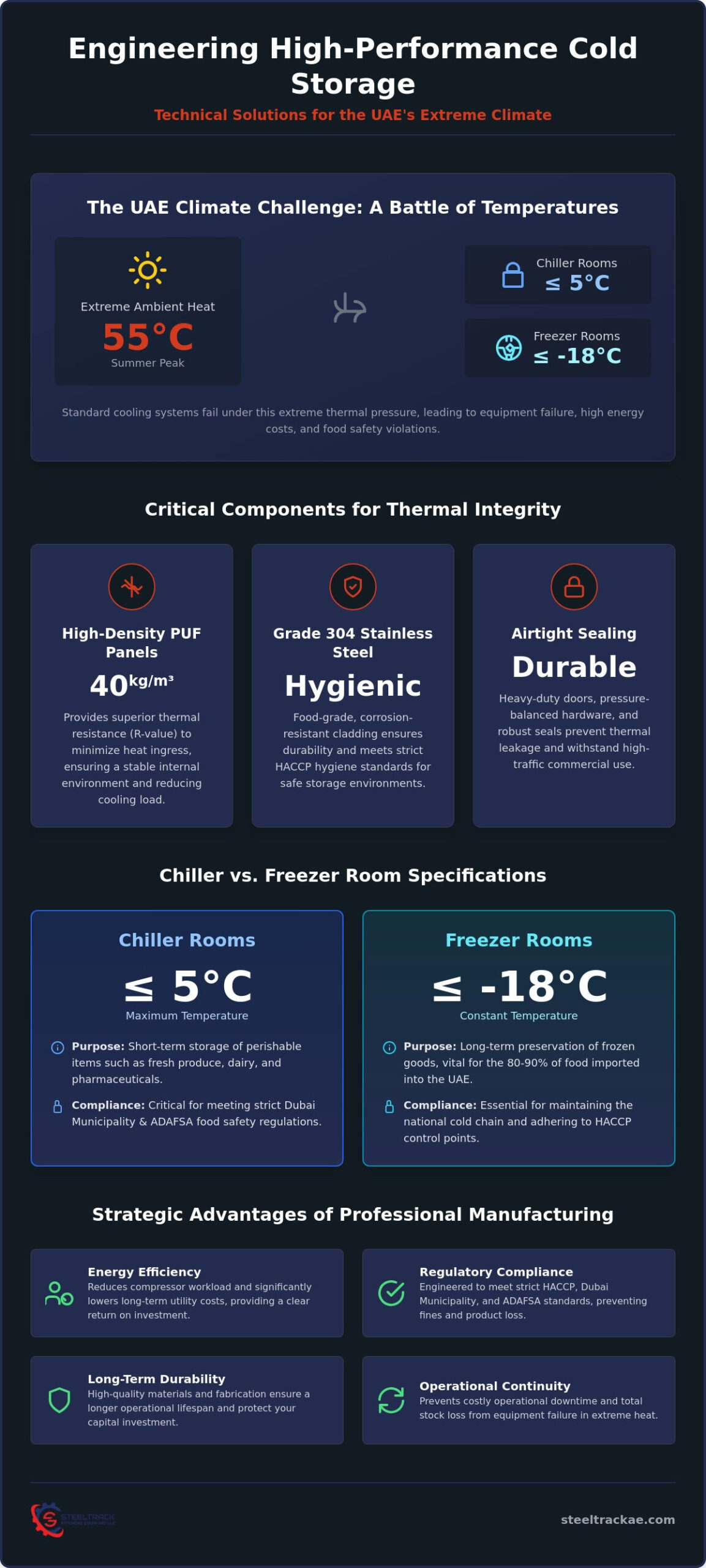
The UAE’s industrial landscape operates under a unique set of thermal pressures that demand specialized engineering solutions. With the nation importing between 80% and 90% of its food supplies, the integrity of the cold chain is a cornerstone of the National Food Security Strategy 2051. A high-performance cold store acts as a critical safeguard against spoilage, ensuring that products remain viable from the point of entry to the end consumer. However, the region’s extreme ambient temperatures, which frequently escalate between 45°C and 55°C, present a significant challenge to standard refrigeration equipment.
Generic, off-the-shelf cooling units often lack the robust thermal resistance required to operate efficiently in such harsh conditions. These systems typically experience premature mechanical failure or fail to maintain the strict temperature setpoints mandated by local authorities. Selecting the best cold room manufacturer in uae is therefore a strategic business decision that directly impacts the stability of your inventory and the longevity of your capital investment. Precision in the fabrication process ensures that the thermal envelope remains uncompromised, even when external conditions are at their most volatile.
Temperature Integrity and Product Safety
Maintaining precise thermal ranges isn’t merely a matter of quality control; it’s a legal requirement enforced by the Dubai Municipality and the Abu Dhabi Agriculture and Food Safety Authority (ADAFSA). Perishable items must be held at a maximum of 5°C, while frozen goods require a constant environment of -18°C or below. In a high-volume hospitality or commercial environment, even minor thermal fluctuations can lead to total stock loss and severe regulatory penalties. Hazard Analysis and Critical Control Points (HACCP) in the UAE serves as a systematic preventive approach to food safety that identifies physical, chemical, and biological hazards in cold storage environments to ensure regulatory compliance. Our professional services focus on creating environments that eliminate these risks through precision fabrication.
Energy Efficiency in Extreme Climates
Superior manufacturing directly correlates with reduced operational costs. When a walk-in cold room is engineered with high-density polyurethane (PUF) panels and airtight seals, it minimizes thermal leakage. This reduces the workload on compressor units, preventing the equipment from running continuously to compensate for heat gain. By investing in high-spec industrial refrigeration, organizations can achieve a significant reduction in long-term utility costs and maintenance requirements. Methodical construction ensures that the cooling system operates within its optimal parameters, even during the peak of the UAE summer, providing a reliable return on investment through energy conservation and reduced operational waste.
Technical Specifications: Engineering High-Performance Walk-in Cold Rooms
Engineering a high-performance walk-in cold room requires a methodical approach to material selection and structural assembly. A professional system isn’t merely a collection of parts; it’s a sophisticated interplay of high-density insulation, industrial refrigeration, and precision-engineered hardware. The best cold room manufacturer in uae understands that the integrity of the thermal envelope depends on the quality of its weakest point. Every component must be specified to resist the aggressive humidity and heat characteristic of the Gulf region, ensuring that the internal environment remains decoupled from external fluctuations.
High-density polyurethane (PUF) panels serve as the primary barrier against heat ingress. These panels are typically engineered with a density of approximately 40kg/m³, providing a high thermal resistance (R-value) that keeps the cooling load manageable. When these panels are combined with food-grade stainless steel cladding, the result is a structure that’s both thermally efficient and hygienically superior. Precision door seals and heavy-duty, pressure-balanced hardware are also essential to withstand the rigors of high-traffic commercial use, preventing the “vacuum effect” that can compromise panel alignment during rapid cooling cycles.
Stainless Steel Fabrication Standards
Grade 304 stainless steel is the preferred material for both internal and external cladding due to its exceptional resistance to oxidation and ease of sanitization. While modular components are available for standard setups, custom fabrication remains the superior choice for specialized industrial kitchens and laboratories. This allows for a bespoke fit that maximizes available floor space while maintaining the highest hygiene standards. Precision-welded joints and radius corners are often incorporated to eliminate bacterial traps. You can Explore our stainless steel solutions to see how custom-built components enhance operational efficiency.
Insulation and Thermal Envelope Integrity
Thermal efficiency is largely determined by panel thickness, which must be tailored to the specific temperature requirements of the application. For instance, maintaining a freezer room at -20°C in a 45°C ambient environment requires significantly thicker insulation than a standard chiller. This precision is vital for storing food safely and preventing the degradation of temperature-sensitive inventory. Cam-lock systems are employed to ensure panels are joined with airtight precision, eliminating the risk of thermal bridging and moisture ingress. Furthermore, in high-traffic environments where heavy trolleys and pallets are frequent, reinforced floor panels with non-slip stainless steel or aluminum finishes are mandatory to prevent structural degradation. If you’re planning a new facility, it’s advisable to consult with a technical expert to ensure your specifications meet these industrial demands.
Chiller Rooms vs. Freezer Rooms: Analyzing Thermal Requirements
The distinction between chiller and freezer environments involves more than simply adjusting a thermostat; it requires a fundamental shift in refrigeration engineering and component selection. Chiller rooms typically operate within a range of 0°C to +10°C, focusing on heat extraction while maintaining specific humidity levels to prevent product desiccation. In contrast, freezer rooms must maintain temperatures between -18°C and -40°C, requiring more robust insulation and specialized defrosting cycles to handle the significant thermal differential. As the best cold room manufacturer in uae, we prioritize the precise sizing of evaporators and condensers to ensure rapid pull-down times, which is essential for protecting the integrity of high-value inventory.
Managing the latent heat load is a technical challenge that varies significantly between these two types of storage. While chillers are often used for short-term preservation of fresh items, freezers are designed for long-term stability. The selection of the cooling unit must account for the frequency of door openings and the volume of product being introduced at any given time. High-performance systems utilize advanced controllers to monitor these variables, ensuring that the internal environment remains stable even during peak operational hours.
Chiller Solutions for Fresh Produce and Proteins
Fresh produce and proteins require delicate airflow management to maintain quality. If the air velocity is too high, it leads to surface dehydration; if it’s too low, hot spots develop, which accelerates spoilage. For facilities involved in large-scale food preparation, these systems are often integrated with heavy-duty cooking ranges to facilitate efficient cook-chill workflows. This methodical approach ensures that cooked products are safely brought down to storage temperatures within regulatory windows. Additionally, specialized meat display and storage areas require precise humidity control to preserve the color and texture of the protein, a standard that generic cooling solutions often fail to meet.
Freezer Technology for Long-Term Preservation
Sub-zero storage introduces technical challenges such as ice accumulation on evaporator coils and door gaskets. Professional freezer technology utilizes advanced electric or hot-gas defrost mechanisms to clear frost without compromising internal temperatures. Safety features such as pressure relief valves are also critical, as they prevent structural damage caused by air pressure changes during cooling cycles. Heated door frames are another standard requirement to prevent the seals from freezing shut, ensuring continuous access in high-traffic industrial environments. Consulting with the best cold room manufacturer in uae ensures that these technical considerations, including blast-freezing capabilities for rapid preservation, are integrated into the initial design phase to prevent future mechanical failures.
Procurement Standards: Selecting a Manufacturer for Industrial Compliance
Selecting the best cold room manufacturer in uae requires a rigorous evaluation that extends far beyond initial capital expenditure. A strategic technical partner must demonstrate a deep understanding of regional environmental pressures and a proven track record in high-stakes industrial applications. A failure in cold storage isn’t merely an equipment malfunction; it’s a catastrophic break in the supply chain that can compromise public safety and corporate reputation. Therefore, verifying a manufacturer’s regional expertise and their ability to provide custom-engineered solutions is the primary step in a successful procurement strategy.
A methodical procurement approach ensures that the final installation aligns with specific operational demands. This process typically involves a detailed assessment of technical capabilities and the manufacturer’s ability to adhere to stringent timelines. It’s essential to partner with an entity that views the project as a long-term engineering commitment rather than a simple transaction. This ensures that the cooling infrastructure remains robust and efficient throughout its operational lifecycle.
The Selection Process for Professional Cold Rooms
A structured selection process minimizes risk and ensures that the cooling system is optimized for performance. This methodical approach includes several critical stages:
- Step 1: Conduct a thorough capacity and throughput analysis to determine the physical dimensions and racking requirements based on inventory turnover.
- Step 2: Define specific temperature and humidity requirements, ensuring the system can maintain the precise thermal ranges discussed in previous sections.
- Step 3: Review the manufacturer’s fabrication and welding standards, specifically focusing on the precision of stainless steel joints and panel alignment.
- Step 4: Ensure the refrigeration system is scaled for UAE peak summer loads, accounting for ambient temperatures that frequently exceed 50°C.
Regulatory Compliance and HACCP Standards
Compliance with local municipality and international safety standards is non-negotiable for industrial operators. Design for hygiene is a primary focus, utilizing coved corners and easy-to-clean surfaces to eliminate bacterial growth zones. Modern systems must also incorporate digital monitoring and temperature logging to ensure audit readiness for regulatory bodies like ADAFSA or the Dubai Municipality. Safety features such as internal emergency releases and visual/audible alarms are mandatory to protect personnel working in sub-zero environments. These standards are integral to our specialized refrigeration services, ensuring every project meets the highest benchmarks of safety and efficiency.
Before fabrication begins, a comprehensive site survey is essential to identify potential structural constraints or utility requirements. This stage prevents costly adjustments during installation and ensures the cold room integrates seamlessly into the existing facility layout. Finally, evaluating the manufacturer’s capacity for after-sales support and preventive maintenance is vital for long-term reliability. Continuous operation depends on a partner who can provide rapid technical assistance and routine system calibrations. To discuss your facility’s specific requirements, we invite you to contact our technical engineering team for a professional consultation.
Custom Cold Room Solutions by Steeltrack Kitchen Equipment
Steeltrack Kitchen Equipment Ind LLC operates as a strategic technical partner for organizations requiring high-performance refrigeration infrastructure. We understand that industrial cooling is not a one-size-fits-all commodity but a precise engineering requirement that must be tailored to specific operational workflows. Our commitment to excellence is reflected in our methodical approach to fabrication, ensuring that every walk-in cold room we produce meets the rigorous demands of the UAE’s industrial sector. By positioning ourselves as the best cold room manufacturer in uae, we provide clients with the assurance that their thermal storage systems are built for long-term reliability and systematic efficiency.
Our turnkey methodology distinguishes our service from standard equipment vendors. We manage the entire lifecycle of a project, from the initial technical design and capacity analysis to the final professional installation. This comprehensive oversight ensures that every component, including the heavy-duty stainless steel doors and high-density insulation panels discussed in earlier sections, is integrated with absolute precision. National businesses trust our expertise because we deliver robust refrigeration infrastructure that seamlessly integrates with complete commercial kitchen setups, providing a unified solution for large-scale hospitality and industrial catering operations.
Bespoke Fabrication for Diverse Industries
Architectural constraints often require bespoke solutions that modular, off-the-shelf units cannot accommodate. We specialize in custom-sized walk-in units designed to maximize available floor space while maintaining optimal airflow and thermal stability. Whether the application is for luxury hotels, specialized hospitals, or high-volume industrial catering facilities, our engineering team ensures the cooling system is scaled for peak performance. Steeltrack utilizes premium-grade stainless steel in all fabrication processes to ensure structural integrity and compliance with international hygiene standards. This focus on material quality prevents the corrosion and structural fatigue common in lower-spec alternatives, ensuring a stable environment for sensitive inventory.
Professional Installation and Technical Support
The performance of a cold storage system is heavily dependent on the quality of its installation. Our expert teams ensure that every panel joint is airtight and every refrigeration unit is calibrated for maximum efficiency from day one. This methodical attention to detail prevents common issues such as thermal leakage or compressor strain, which are frequent causes of operational downtime in the region. We remain dedicated to technical excellence, providing the support necessary to maintain system integrity throughout its lifespan. If your organization requires a cooling solution that prioritizes durability and regulatory compliance, we invite you to contact Steeltrack for a professional consultation on your cold storage requirements.
Advancing Industrial Cold Chain Excellence
Implementing a high-performance cold storage facility in the UAE requires a methodical approach that prioritizes thermal integrity and regulatory compliance. The transition from standard cooling to industrial-grade infrastructure depends on the precision of stainless steel fabrication and the density of the insulation envelope. By adhering to rigorous procurement standards and selecting a partner capable of custom technical design, organizations can effectively mitigate the risks associated with extreme ambient temperatures and high-volume operations.
Identifying the best cold room manufacturer in uae is the definitive step toward ensuring long-term thermal stability and reducing the total cost of ownership. Steeltrack Kitchen Equipment Ind LLC remains committed to providing national UAE service coverage with specialists in high-performance stainless steel solutions for the most demanding commercial environments. Our turnkey approach ensures that every installation is engineered for peak efficiency and seamless integration into your existing industrial workflow.
Partner with Steeltrack for Professional Cold Room Fabrication and secure a cooling infrastructure built on precision and industrial expertise. We look forward to supporting your strategic technical requirements with our dedicated engineering capabilities.
Frequently Asked Questions
What are the primary factors to consider when choosing a cold room manufacturer in the UAE?
Choosing a strategic partner involves evaluating technical capability and regional experience. The best cold room manufacturer in uae provides custom engineering that accounts for peak summer loads and uses high-density insulation. Factors like material grades, fabrication precision, and the availability of preventive maintenance are critical for long-term operational success. This methodical selection process ensures your facility meets both performance goals and regulatory standards.
How do high ambient temperatures in the UAE affect cold room performance?
Ambient temperatures reaching 55°C in the UAE summer place an immense load on refrigeration systems. Standard equipment often experiences compressor failure or fails to maintain mandatory setpoints. High-performance systems utilize oversized condensers and thicker PUF panels to ensure the thermal envelope remains decoupled from external heat. This robust engineering is necessary to prevent inventory loss and maintain consistent cooling during the most extreme weather conditions.
What is the difference between a walk-in chiller and a walk-in freezer?
The primary difference lies in the operational temperature range and the associated engineering requirements. Walk-in chillers maintain products between 0°C and +10°C, while freezers operate from -18°C to -40°C. Freezers require specialized features like heated door frames, pressure relief valves, and more intensive defrost cycles to manage ice buildup. Panel thickness also increases for freezers to provide the higher thermal resistance needed for sub-zero environments.
Are Steeltrack cold rooms compliant with HACCP and local UAE safety regulations?
Steeltrack walk-in cold rooms are engineered to exceed local municipality and international safety standards. Our designs prioritize hygiene through the use of coved corners and non-porous surfaces, facilitating easy sanitization. We integrate digital temperature logging and emergency safety releases to ensure full compliance with HACCP and ADAFSA audit requirements. This commitment to safety and compliance ensures that your facility remains fully authorized for industrial and commercial operations.
How much energy does an industrial cold room typically consume?
Energy consumption is directly influenced by the quality of the thermal insulation and the efficiency of the refrigeration unit. Systems with high-density PUF panels minimize heat ingress, which prevents the compressor from running continuously. Investing in superior fabrication standards results in a lower workload for the cooling system and reduced long-term utility expenses. Efficient airflow management also plays a critical role in maintaining stable temperatures without excessive power draw.
Can a cold room be custom-fabricated to fit specific kitchen dimensions?
Bespoke fabrication is a core specialty, allowing for the creation of walk-in units that fit unique architectural constraints. Unlike modular off-the-shelf solutions, custom designs maximize available floor space and integrate seamlessly with existing utilities. This ensures that even kitchens with unconventional layouts can maintain a high-performance refrigeration infrastructure. Precision engineering allows us to tailor every dimension to your specific throughput needs and facility requirements.
What maintenance is required to ensure the longevity of a commercial refrigeration system?
Ensuring longevity requires a methodical approach to preventive care and component inspection. Regular cleaning of condenser coils, verification of door gasket integrity, and calibration of temperature sensors are essential tasks. These routine procedures prevent minor issues from escalating into costly mechanical failures or stock loss during peak operations. Consistent maintenance also ensures that the system continues to operate at its peak energy efficiency throughout its lifecycle.
What grade of stainless steel is best for cold room construction in a kitchen environment?
Grade 304 stainless steel is the industry standard for cold room construction due to its superior durability and hygienic properties. It offers exceptional resistance to oxidation and chemical corrosion, making it ideal for the demanding environments of commercial kitchens. Using this grade ensures that surfaces remain easy to sanitize and structurally sound over decades of use. It’s the preferred choice for operators who prioritize both food safety and equipment longevity.