It’s natural to feel concerned about balancing immediate CAPEX with the necessity for durable, high-grade equipment that survives the rigors of an industrial environment. This guide clarifies these financial complexities by breaking down the costs of essential infrastructure, such as specialized ventilation and custom stainless steel fabrication, alongside the expenses tied to HACCP and Civil Defence compliance. We’ll provide a methodical roadmap for a compliant layout that justifies the investment in heavy-duty ranges and sophisticated refrigeration systems. You’ll gain the technical insight required to procure a facility that meets the strict 2026 standards for safety and sustainability while ensuring systematic progress toward your business goals.
Key Takeaways
- Establish a comprehensive understanding of the commercial kitchen setup cost Dubai variables, distinguishing between fixed regulatory fees and variable infrastructure capital.
- Identify critical “hot line” investments, such as high-performance cooking ranges and multi-functional combi ovens, that drive industrial kitchen efficiency.
- Evaluate the long-term durability and spatial advantages of custom 304-grade stainless steel fabrication over standardized, light-duty imported alternatives.
- Uncover the technical requirements and financial implications of essential MEP and ventilation systems mandated by current UAE safety and environmental standards.
- Learn how a turnkey approach to manufacturing and installation optimizes expensive real estate and streamlines capital expenditure for large-scale commercial facilities.
Understanding the Financial Framework of UAE Commercial Kitchens
Estimating the commercial kitchen setup cost Dubai necessitates a deep understanding of the local regulatory and industrial landscape. An industrial kitchen isn’t a simple retail acquisition; it’s a multi-layered engineering project where legal compliance, physical infrastructure, and specialized machinery must align to create a viable business model. For institutional investors and F&B entrepreneurs, these facilities must be viewed as strategic assets that adhere to international commercial kitchen standards while meeting the specific safety and hygiene mandates of the Dubai Municipality and Civil Defence.
The scale of the operation remains the primary driver of capital requirements. A boutique cafe operating within the mandatory 300 sq. ft. minimum space defined by the Dubai Municipality faces different financial pressures than a high-volume hotel catering facility. While smaller footprints focus on maximizing every square metre with multi-functional equipment, larger operations must account for the logistical complexity of high-capacity production lines and extensive walk-in cold rooms. Local manufacturing within the UAE provides a distinct competitive edge here, offering superior cost control over logistics and ensuring that custom fabrication fits the specific dimensions of expensive Dubai real estate.
Initial Capital Allocation: Licensing vs. Equipment
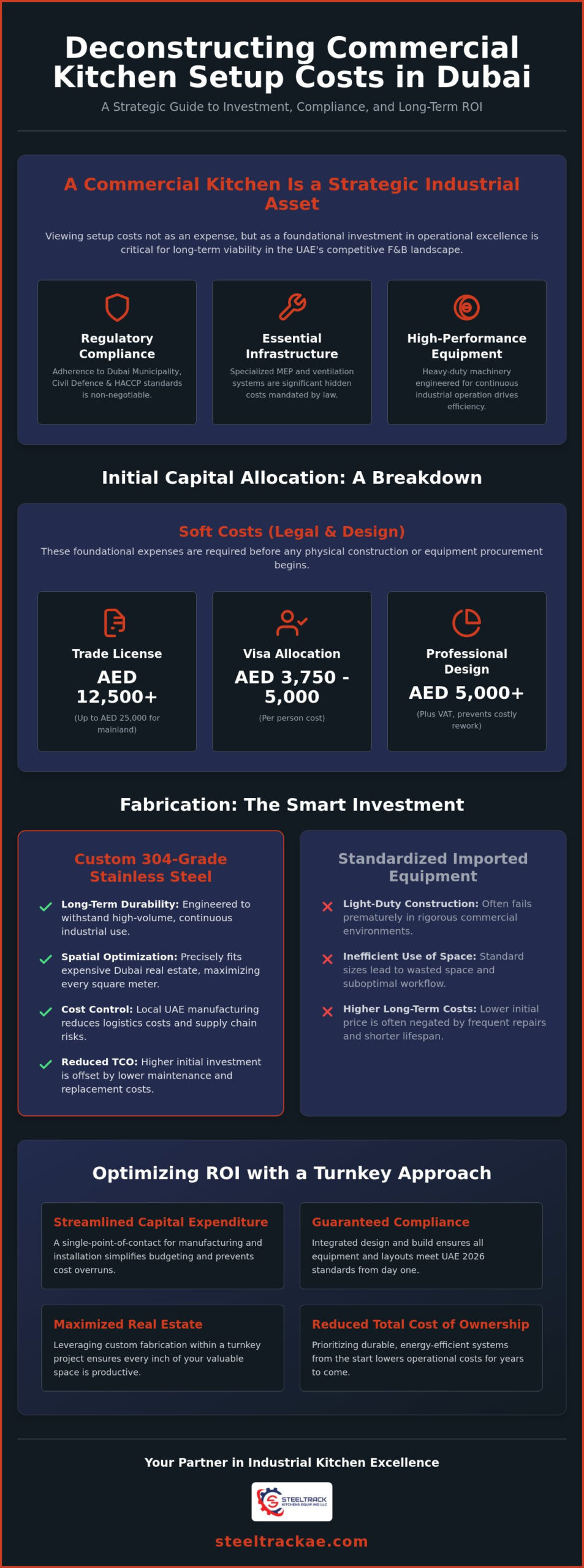
Investors must distinguish between the “soft costs” of legal preparation and the “hard costs” of physical assets. Based on 2026 data, a trade license for a cloud kitchen in a Dubai free zone begins at AED 12,500, while mainland licenses range from AED 16,000 to AED 25,000. These figures are supplemented by visa allocation costs, typically between AED 3,750 and AED 5,000 per person. Beyond these legal fees, professional design packages that meet municipal standards generally require an allocation of AED 5,000 plus VAT. Investing in professional design early is a critical strategy to prevent costly mid-construction alterations that often arise from non-compliance with Civil Defence or FoodWatch requirements.
Market Variables Influencing Setup Expenditure
The complexity of the intended menu dictates the density and performance grade of the required equipment. A menu requiring diverse cooking techniques will necessitate a higher concentration of specialized units, such as high-performance combi ovens or specialized Indian cooking ranges, compared to a simplified quick-service model. Choosing between standard-duty and high-performance appliances is a pivotal decision that impacts both the initial commercial kitchen setup cost Dubai and long-term viability.
Total Cost of Ownership in the context of UAE kitchen equipment is the aggregate of the initial purchase price, operational energy efficiency, and the long-term maintenance expenses required to sustain peak performance in high-demand industrial environments. By prioritizing durability and energy-efficient systems, operators can offset higher initial capital with reduced operational overhead. For those seeking to optimize this balance, exploring professional kitchen solutions and fabrication services ensures that equipment is tailored to the specific rigors of the Middle Eastern market.
Core Equipment Expenditure: Heavy-Duty Ranges to Industrial Refrigeration
The procurement of core hardware represents the most significant portion of the commercial kitchen setup cost Dubai investors must manage. Unlike residential appliances, industrial-grade machinery is engineered for continuous operation, heat resilience, and rigorous hygiene compliance. High-volume environments, such as hotel catering or large-scale production facilities, require a strategic selection of heavy-duty cooking ranges and high-performance combi ovens to ensure operational stability and consistent output quality.
The Hot Kitchen: Cooking Ranges and Thermal Processing
The “hot line” serves as the engine of any food service facility. Prioritizing the performance of industrial gas ranges and deep fryers is essential for maintaining throughput during peak periods. While specialized equipment like pizza ovens or stainless steel tandoors require dedicated budget lines, their inclusion is often non-negotiable for specific culinary concepts. Multi-functional units, specifically the Rational Combi oven, offer a compelling financial logic; they consolidate multiple cooking processes into a single footprint, which reduces the required square footage and associated labor costs. Adhering to the Dubai Municipality’s Food Code ensures these thermal processing units are installed with appropriate fire suppression and ventilation systems to protect your investment.
Key thermal equipment for industrial configurations includes:
- High-performance stainless steel Indian and Chinese gas ranges
- Advanced Rational Combi ovens for precision thermal control
- Heavy-duty deep fryers and specialized pizza ovens
- Table top foodwarmers for maintaining serving temperatures
Cold Chain Integrity: Refrigeration and Storage
Maintaining the cold chain in the demanding UAE climate is a critical technical challenge that directly impacts food safety and waste reduction. For larger operations, walk-in cold rooms are the standard for bulk storage, offering superior thermal stability compared to individual units. However, specific prep stations often rely on counter-top chillers, salad bar chillers, or chef bases refrigerators to maintain workflow efficiency without constant movement to main storage areas. Precise planning for ice production is equally vital, as industrial ice machines must meet the consistent demand of the hospitality sector without compromising energy efficiency or hygiene standards.
Warewashing and Hygiene Infrastructure
Hygiene infrastructure is a cornerstone of regulatory compliance and operational longevity. High-volume throughput requires the efficiency of hood-type dishwashers, which significantly outperform manual processes and ensure sanitization levels meet municipal mandates. Integrating essential components like stainless steel mop sinks, 3-bowl sinks, and grease traps is mandatory to meet the strict hygiene standards of the region. These elements form the backbone of a compliant facility. You can explore our full range of commercial kitchen services to understand how these components integrate into a cohesive, high-performance layout.
If you’re currently evaluating equipment specifications for a high-capacity project, we invite you to consult with our technical specialists to ensure your procurement strategy aligns with the latest regional standards and operational requirements.
Custom Stainless Steel Fabrication vs. Standardised Equipment Costs
Selecting the appropriate structural components is a pivotal phase in defining the commercial kitchen setup cost Dubai profile for any enterprise. While standardized, mass-produced units may appear financially attractive during the initial procurement phase, they frequently lack the structural integrity and spatial adaptability required for intensive industrial use. Custom stainless steel fabrication ensures that every square metre of expensive Dubai real estate is utilized effectively, transforming architectural constraints into operational advantages. Precision is mandatory in this environment.
The Case for Custom Fabrication
Bespoke engineering allows for the creation of ergonomic workstations through custom stainless steel work tables and base cabinets with doors and drawers, tailored to the specific workflow of your culinary team. Vertical storage is equally critical for maintaining an organized environment. Custom stainless steel wall cabinets and wall shelves maximize storage capacity without encroaching on essential floor space. Additionally, the seamless integration of stainless steel 3-bowl sinks and floor gratings is not merely a design preference but a requirement for maintaining the highest hygiene standards. These custom elements eliminate the crevices where bacteria proliferate, facilitating easier sanitization and ensuring long-term durability under heavy use. For those managing high-volume logistics, custom stainless steel bakery and kitchen trolleys or specialized smasala trolleys provide the necessary mobility for efficient material handling.
Analysing the Cost-Benefit of Material Grades
The choice of material grade significantly influences the frequency of equipment replacement and the success of regulatory inspections. Investing in high-grade 304 stainless steel is a non-negotiable standard for food-grade environments, as it offers superior resistance to corrosion and chemical damage. This quality is vital for HACCP compliance, as porous or damaged surfaces can lead to immediate inspection failure. Custom stainless steel exhaust hoods must also be engineered to meet the specific fire safety standards of the UAE Civil Defence, a task often impossible with standardized units. Locally fabricated 304-grade stainless steel provides exceptional resistance to the oxidative stress caused by the high-humidity UAE environment, ensuring that your structural investment remains intact for decades.
High-grade fabrication reduces the total cost of ownership by extending the lifecycle of the kitchen’s physical infrastructure. While the upfront expenditure for custom tables, trolleys, and cabinets might be higher than imported alternatives, the avoidance of premature failure and the streamlining of workflow provide a measurable return on investment. You can review our specialized stainless steel fabrication services to see how custom engineering supports long-term operational stability.
Infrastructure, MEP, and Ventilation: The Hidden Setup Costs
While equipment and fabrication are the most visible assets of a facility, the technical infrastructure comprising Mechanical, Electrical, and Plumbing (MEP) systems serves as the invisible backbone of the operation. These systems often represent a significant portion of the total commercial kitchen setup cost Dubai investors must account for, as they must be engineered to withstand the extreme thermal loads of the region while adhering to strict safety codes. Precision in these “hidden” installations is what separates a high-performance industrial kitchen from one prone to frequent operational failures or regulatory penalties.
Ventilation and Exhaust System Engineering
In the demanding UAE climate, heat management is a complex engineering challenge rather than a simple extraction requirement. High-performance stainless steel exhaust hoods are not merely tools for smoke removal; they’re integrated fire-safety components. UAE Civil Defence regulations mandate that these hoods are fire-rated and equipped with automatic suppression systems. Furthermore, effective ventilation requires sophisticated air make-up systems. These systems replace the high volume of extracted air with cooled, filtered air, maintaining a pressurized and temperature-controlled environment that is essential for both staff welfare and the longevity of sensitive electronics in modern appliances.
Key ventilation requirements for compliance include:
- Fire-rated stainless steel exhaust hoods with integrated suppression
- High-capacity ducting engineered for minimal grease accumulation
- Air make-up units to maintain kitchen ambient temperatures
- Emergency shut-off integration with the building’s central fire alarm system
Technical Utilities: Gas, Power, and Water
The installation of specialized gas manifolds and LPG or natural gas connections is a critical safety investment that requires certified expertise for Civil Defence approval. Every connection point must feature accessible emergency shut-off valves and leak detection sensors to meet modern safety protocols. Similarly, electrical load requirements must be meticulously calculated. High-powered hardware, such as Rational Combi ovens and hood-type dishwashers, demands dedicated circuits and stable power delivery to prevent the costly downtime associated with tripped breakers or electrical surges.
Plumbing considerations extend far beyond simple water supply. Industrial sinks and high-capacity warewashing stations require specialized drainage solutions. Integrating high-grade stainless steel grease traps is mandatory to meet Dubai Municipality environmental standards, preventing fats, oils, and grease from entering the public sewage system. These traps, often paired with dosing pumps for biological treatment, ensure your facility remains compliant with the latest sustainability mandates. For a detailed technical assessment of your facility’s utility requirements, you can request a professional infrastructure consultation with our engineering team.
Optimising ROI with Steeltrack’s Turnkey Kitchen Solutions
Achieving a sustainable return on investment in the UAE’s competitive food and beverage sector requires more than just procurement; it demands a unified approach to engineering and project management. When investors treat the commercial kitchen setup cost Dubai as a series of isolated purchases, they often encounter fragmented logistics and unforeseen integration expenses. A turnkey solution consolidates design, manufacturing, and installation under a single point of accountability, ensuring that every industrial asset performs at its peak from the first day of operation. This systematic methodology eliminates the coordination gaps that typically lead to project delays and budget overruns.
The Turnkey Advantage for Commercial Operations
Partnering with a single-source manufacturer and installer provides a distinct financial advantage by removing the markups associated with third-party intermediaries. This streamlined model allows for a more efficient allocation of capital toward high-performance hardware, such as Rational Combi ovens or specialized Indian cooking ranges. By coordinating equipment supply with onsite installation, we ensure that technical utilities and MEP connections are perfectly aligned with the machinery’s specifications. This precision is particularly vital when integrating complex thermal processing units. For a deeper technical analysis of equipment selection, you may refer to our Heavy-Duty Cooking Range UAE: The Definitive B2B Procurement Guide.
Local UAE production further enhances this advantage by significantly reducing lead times. In an environment where securing permits from the Dubai Municipality and Civil Defence can take 15 to 30 working days, having a local fabrication partner ensures that custom stainless steel work tables, sinks, and exhaust hoods are ready for immediate installation once approvals are granted. This agility is essential for minimizing the pre-opening phase and accelerating the path to revenue generation.
Securing Long-Term Performance
The longevity of an industrial kitchen is fundamentally tied to the quality of its installation and the grade of its engineering. Professional installation by the manufacturer ensures that equipment warranties remain intact and that systems operate within their designed parameters. For example, a heavy-duty cooking range or a walk-in cold room installed with precision will experience fewer mechanical failures and maintain higher energy efficiency over its lifecycle. This operational reliability is the cornerstone of a high-volume ROI.
Custom fabrication plays a critical role in maximizing the utility of expensive UAE real estate. By engineering bespoke stainless steel wall cabinets, shelving, and preparation tables, we ensure that no square metre of floor space is wasted. This spatial optimization allows for higher production capacity within a smaller footprint, directly lowering the effective commercial kitchen setup cost Dubai per unit of output. Our commitment to industrial-grade engineering means that every component, from floor gratings to grease traps, is built to withstand the rigors of a high-demand environment.
We invite you to consult with our engineering team for a precise technical assessment of your upcoming project. Let us help you transform your culinary vision into a high-performance industrial reality through methodical planning and superior fabrication.
Securing Your Industrial Asset for the Future of UAE Hospitality
Mastering the commercial kitchen setup cost Dubai requires a shift from viewing procurement as a series of transactions to treating it as a strategic engineering project. Success in this high-stakes market depends on prioritizing high-performance thermal processing units and durable 304-grade stainless steel fabrication that can withstand the unique environmental demands of the region. By integrating Mechanical, Electrical, and Plumbing systems with precision from the outset, you prevent the operational bottlenecks and regulatory hurdles that often compromise long-term profitability.
As a premier UAE-based manufacturer of stainless steel solutions, we specialize in the production of heavy-duty cooking ranges and industrial refrigeration systems designed for high-volume environments. Our team maintains deep expertise in UAE Civil Defence and Municipality compliance standards, ensuring that every layout is both efficient and legally sound. We invite you to Request a Technical Consultation for Your Commercial Kitchen Project to align your facility with the highest industrial standards. Investing in methodical planning and superior fabrication today ensures your operation remains a stable, high-performing leader for years to come.
Frequently Asked Questions
What is the average cost of a commercial kitchen setup in the UAE?
The total setup cost for a cloud kitchen in Dubai typically ranges from AED 75,000 to AED 100,000, covering licensing and initial infrastructure. For full-service industrial facilities, the commercial kitchen setup cost Dubai investors face will vary based on equipment density and custom fabrication requirements. These figures represent the baseline for regulatory compliance and essential hardware procurement in the current 2026 market.
Do I need specific approvals for kitchen exhaust systems in Dubai?
Yes, all kitchen exhaust systems must receive explicit approval from both the Dubai Municipality and the Dubai Civil Defence. These authorities ensure that stainless steel exhaust hoods and ducting meet specific fire-rating standards and are equipped with mandatory suppression systems. Non-compliance with these safety codes can lead to significant delays in securing your final operational permits and may result in immediate financial penalties.
Why is custom stainless steel fabrication preferred over imported equipment?
Custom stainless steel fabrication is preferred because it utilizes 304-grade material that’s specifically engineered to resist the high-humidity environment of the UAE. Unlike standardized imported units, custom work tables and cabinets are designed to fit the exact architectural dimensions of a facility. This approach maximizes operational efficiency and ensures that surfaces remain seamless, meeting the rigorous hygiene standards required for long-term HACCP compliance.
What are the MEP requirements for an industrial kitchen?
MEP requirements encompass a high-capacity electrical load for industrial ovens, specialized gas manifold installations, and advanced drainage systems. Every facility must integrate high-grade grease traps to meet municipal environmental standards and ensure that drainage remains clear of fats and oils. Additionally, the mechanical component must include sophisticated air make-up systems to maintain a pressurized, temperature-controlled environment suitable for continuous industrial operation.
How long does a full commercial kitchen installation typically take?
A full installation typically requires several weeks, though securing necessary permits from the Dubai Municipality and Civil Defence generally takes 15 to 30 working days. The physical assembly of custom fabrication and equipment happens systematically once these approvals are granted. Coordinating with a single-source provider often reduces these lead times by ensuring that manufacturing and onsite preparation occur in a synchronized, methodical manner.
What is the difference between HACCP and UAE Civil Defence requirements?
HACCP focuses on biological, chemical, and physical food safety risks, while UAE Civil Defence requirements prioritize fire safety and life protection within the facility. While HACCP mandates seamless surfaces and proper refrigeration to prevent contamination, Civil Defence ensures that gas lines and exhaust systems feature automatic shut-offs and suppression hardware. Both frameworks are essential for a compliant facility, though they address distinct operational risks.
Can I save costs by using residential-grade appliances in a commercial kitchen?
No, residential-grade appliances are strictly prohibited in commercial environments due to their inability to meet the Dubai Food Code’s safety and durability standards. Commercial-grade machinery is engineered for continuous use and features the structural integrity required to survive high-volume production. Utilizing residential units not only risks immediate inspection failure but also leads to high maintenance costs and premature equipment failure under industrial stress.
How does kitchen ventilation impact the total setup cost?
Kitchen ventilation is a primary driver of the commercial kitchen setup cost Dubai due to the technical complexity of heat management in the Middle East. High-performance extraction systems require heavy-duty ducting, fire-rated hoods, and air make-up units to replace exhausted air with cooled, filtered air. These systems are essential for maintaining staff welfare and protecting sensitive electronic components in modern cooking ranges and combi ovens.