
Will your commercial kitchen layout withstand the scrutiny of a 2026 Dubai Municipality inspection, or will minor fabrication errors result in costly retrofitting? For many operators, the challenge of synchronizing Department of Economy and Tourism licensing with stringent food safety regulations creates a significant barrier to entry. It’s common to feel overwhelmed by the technical complexities of these dual-track approvals, especially when non-compliant equipment can lead to fines reaching AED 100,000 under the latest FoodWatch enforcement protocols. Understanding the precise engineering requirements is the only way to mitigate these risks and ensure a seamless launch.
This guide serves as a comprehensive technical roadmap on how to get Dubai Municipality kitchen approval without the typical setbacks associated with regulatory non-compliance. We’ll provide a systematic checklist covering everything from mandatory HACCP documentation to the specific 82°C final rinse temperatures required for commercial dishwashers. You’ll gain a clear perspective on the technical infrastructure necessary for a compliant facility, including the importance of ZAD-registered equipment and optimized ventilation systems. We’ve structured this overview to ensure your project moves from initial design to final certification with methodical precision and professional confidence.
Key Takeaways
- Grasp the distinction between the Department of Economy and Tourism trade license and the Dubai Municipality operational permit. It’s essential for a synchronized application process.
- Master the precise technical standards required for how to get Dubai Municipality kitchen approval, focusing on ZAD-registered equipment and high-grade stainless steel fabrication.
- Identify specific infrastructure benchmarks for heavy-duty cooking ranges and exhaust hoods that meet the latest 2026 safety and ventilation standards.
- Learn to avoid common inspection failures by implementing rigorous drainage protocols and ensuring lighting levels meet precise regulatory requirements in all preparation zones.
- Discover how a turnkey fabrication strategy minimizes the risk of costly retrofitting and guarantees long-term compliance through methodical precision engineering.
The Dual-Track Regulatory Framework for UAE Food Businesses
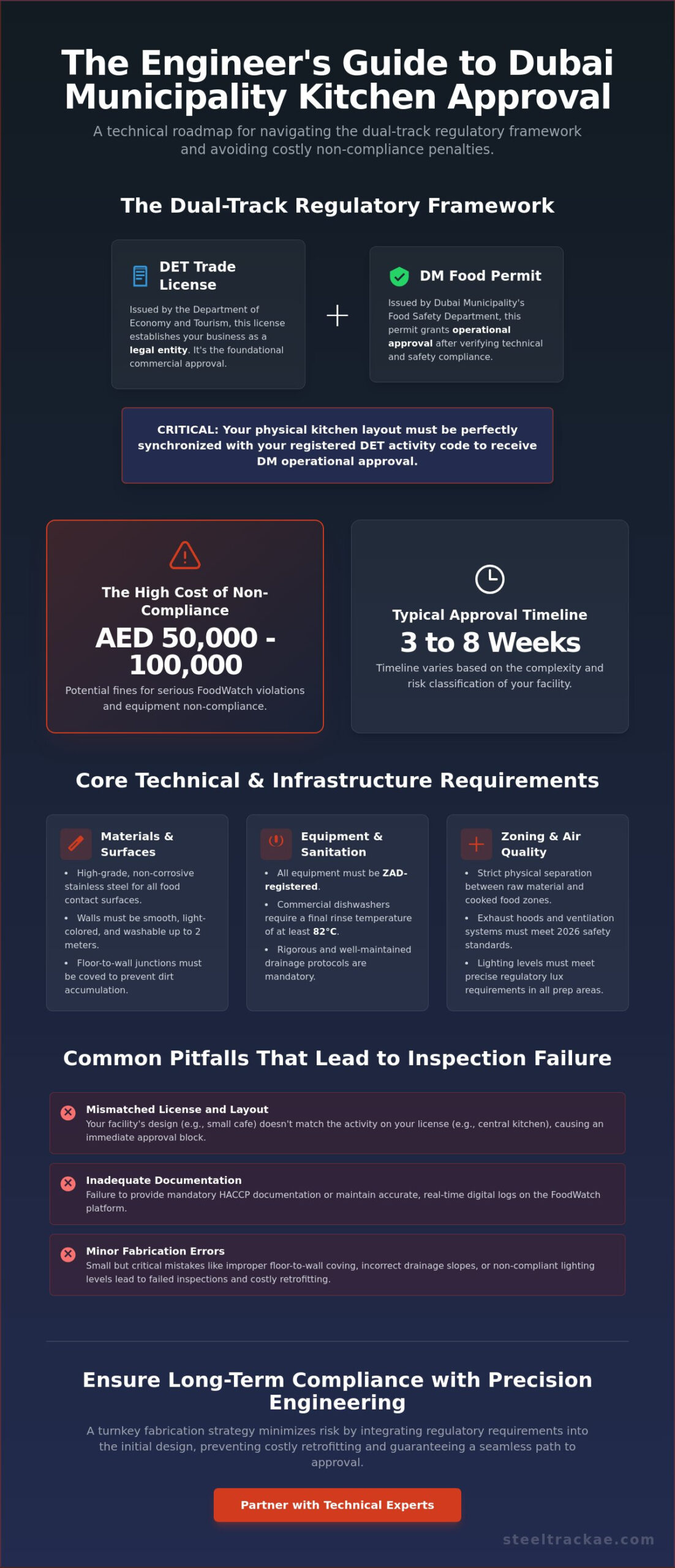
Launching a commercial food operation in Dubai necessitates a sophisticated understanding of two distinct regulatory bodies. The Department of Economy and Tourism (DET) provides the foundational commercial trade license, establishing your business as a legal entity. However, this license remains dormant for operational purposes until the Dubai Municipality (DM) Food Safety Department issues a specific food establishment permit. This dual-track system ensures that every facility contributing to the national food security strategy adheres to the highest standards of public health and industrial safety.
Securing the DET license is merely the initial phase. The real technical challenge lies in aligning your physical infrastructure with your registered commercial activity. If your activity code specifies a high-volume central kitchen but your layout reflects a small cafe, the DM will withhold operational approval. This legal necessity for alignment is why many investors seek professional technical services early in the planning phase. Learning how to get Dubai Municipality kitchen approval requires a methodical approach where your business license and engineering drawings are developed in tandem.
Understanding the Food Safety Department Mandate
The Food Safety Department operates under a mandate to eliminate biological, chemical, and physical hazards from the food supply chain. They apply international HACCP principles to local conditions, requiring all cooking operations to maintain detailed documentation of their safety protocols. Today, this oversight is digitized through the FoodWatch portal. This platform tracks real-time data, and failure to maintain accurate digital logs can result in severe penalties, including fines ranging from AED 50,000 to AED 100,000 for serious violations.
Classifying Your Food Establishment Type
Your business classification determines the depth of the technical inspection and the complexity of the required infrastructure. A central kitchen preparing high-risk items like raw meats or dairy faces more rigorous scrutiny than a foodstuff trading warehouse. High-risk operations often require more elaborate drainage, specialized refrigeration like walk-in cold rooms, and sophisticated ventilation. These factors directly influence your approval timeline, which typically spans between 3 to 8 weeks. Understanding these variables is a critical step in mastering how to get Dubai Municipality kitchen approval efficiently.
Technical Infrastructure Requirements for Kitchen Approval
Securing operational status requires more than just administrative filing; it demands a rigorous adherence to industrial engineering standards. The physical environment of a commercial facility must be designed to eliminate cross-contamination and withstand the high-intensity demands of professional food production. When considering how to get Dubai Municipality kitchen approval, the focus shifts from legal documentation to the technical integrity of your hardware and layout. Every surface that comes into contact with food must be constructed from materials that resist corrosion and facilitate rigorous sanitization protocols. Precision in the physical environment is non-negotiable.
Zoning is a fundamental pillar of this technical compliance. Inspectors require a clear, physical separation between raw material handling and cooked food processing areas to prevent biological hazards. This spatial logic extends to the finishes of the facility itself. Kitchen walls must be smooth, light-colored, and washable up to a minimum height of 2 meters, while floor-to-wall junctions must be coved to prevent dirt accumulation. These requirements, detailed extensively in the Dubai Municipality Food Code, ensure that the infrastructure supports a hygienic workflow. Integrating custom stainless steel fabrication UAE allows operators to adapt these rigid standards to unique site dimensions without compromising on safety.
Stainless Steel Fabrication and Equipment Standards
The industry standard for UAE commercial kitchens is 304-grade stainless steel. This material is essential for stainless steel work tables and sinks because it’s non-porous and highly resistant to the chemical cleaners used in industrial environments. Beyond preparation surfaces, the cold chain must be secured through high-performance units such as walk-in cold rooms and chef bases refrigerators. Every piece of equipment, from deep fryers to ice machines, must be HACCP-compliant and registered on the ZAD portal to pass inspection.
Ventilation and Heat Management Systems
Engineering standards for stainless steel exhaust hoods have become increasingly stringent. Modern extraction systems must meet specific airflow velocity limits to manage heat and smoke effectively, especially over high-capacity cooking ranges. Compliance also involves the installation of a stainless steel grease trap and smart fire suppression monitoring systems. Proper heat management isn’t just a safety requirement; it’s a prerequisite for maintaining the ambient temperatures necessary for food stability. To ensure your facility meets these exacting specifications, you may wish to consult with an engineering specialist regarding your current layout.
Step-by-Step Guide to the Dubai Municipality Approval Process
Navigating the procedural landscape for a food establishment requires a systematic approach that aligns administrative filing with technical milestones. The process begins with obtaining initial approval from the Department of Economy and Tourism (DET), which serves as the formal authorization to proceed with site selection and lease negotiations. Once the location is secured, the focus shifts to the Dubai Municipality (DM) for the technical vetting of your facility. It’s during this phase that operators must demonstrate a comprehensive understanding of how to get Dubai Municipality kitchen approval by submitting detailed engineering plans for review.
After the DM approves your technical drawings, the physical fit-out commences. This stage involves the installation of industrial assets such as walk-in cold rooms, deep fryers, and specialized stainless steel work tables. Upon completion of the construction and equipment installation, the establishment must be registered on the FoodWatch digital portal. This integration is a non-negotiable requirement in 2026, as it facilitates real-time monitoring of food safety logs and corrective actions. The final step is the onsite inspection, where a DM official verifies that the physical facility matches the approved blueprints and meets all sanitary benchmarks before issuing the operational permit.
Developing a Compliant Kitchen Layout Plan
A professional technical drawing is the foundation of a successful application. These blueprints must clearly illustrate the “unidirectional flow” of operations, ensuring that raw ingredients move toward the final plating area without any backtracking that could cause cross-contamination. Every element, from the placement of stainless steel sinks to the positioning of stainless steel exhaust hoods, must be accounted for with precision. Inspectors look for a logical progression that minimizes human error and maximizes hygiene, making the initial design phase the most critical technical hurdle.
Mandatory Certifications and Training
Technical compliance extends beyond the physical hardware to include the competency of your personnel. Every establishment must appoint a certified Person in Charge (PIC) for every operational shift to oversee safety protocols. Furthermore, the implementation of new and uniform standards across the emirate requires all kitchen staff to complete Basic Food Hygiene (BFH) training. Securing Occupational Health Cards through authorized medical centers is the final human-resource requirement. These certifications ensure that your team is prepared to maintain the high standards required for how to get Dubai Municipality kitchen approval and sustain it during subsequent inspections.
Common Technical Pitfalls That Lead to Inspection Failure
Failing a final inspection often stems from subtle engineering oversights rather than a lack of administrative intent. While the regulatory path is documented, the technical execution of a facility must withstand the methodical scrutiny of a Dubai Municipality official. Inadequate lighting in food preparation zones, for example, is a frequent point of failure. Inspectors require high-visibility environments, typically measured in lux, to ensure hygiene standards are maintained during every shift. Similarly, the use of non-industrial grade materials for shelving, such as wood or porous plastics, is strictly prohibited. These materials harbor bacteria and are impossible to sanitize to the required standards, making high-grade stainless steel the only viable option for long-term compliance.
Understanding how to get Dubai Municipality kitchen approval requires a proactive approach to troubleshooting these common hardware errors before the inspector arrives. Poorly designed ventilation is another significant hurdle; if an extraction system fails to manage heat and humidity, it can lead to condensation and mold growth, which are grounds for immediate failure. Every component, from the placement of stainless steel sinks to the height of your wall cabinets, must be engineered to facilitate deep cleaning and prevent the accumulation of debris. Precision in these technical details is what separates a successful launch from a costly delay.
Drainage and Waste Management Compliance
Technical requirements for kitchen drainage are exceptionally rigid. Facilities must utilize specialized floor gratings and stainless steel floor grating systems that prevent blockages and facilitate easy cleaning. A critical error is the undersizing of the stainless steel grease trap; it must be calibrated to handle the specific waste volume produced by your cooking ranges. Furthermore, your physical structure must integrate pest control measures, such as air curtains and sealed entry points, which are audited alongside your mandatory pest control contracts and FoodWatch digital logs.
Thermal Management and Refrigeration Integrity
Temperature fluctuations in walk-in cold rooms are often caused by improper insulation or poor placement near heat-generating equipment. Refrigeration units and ice machines require adequate clearance for airflow to function at peak efficiency. Additionally, the installation of a heavy duty cooking range UAE must adhere to strict gas connection standards and fire safety protocols updated in 2026. To avoid these common pitfalls and ensure your facility meets every technical benchmark, request a comprehensive technical audit from our engineering team to secure your how to get Dubai Municipality kitchen approval with total confidence.
Partnering for Success: Technical Support and Installation
Achieving operational status isn’t just about passing a single inspection; it’s about establishing a facility that maintains compliance throughout its lifecycle. When considering how to get Dubai Municipality kitchen approval, many operators overlook the long-term value of industrial-grade technical support. A strategic partnership provides more than just equipment; it offers a comprehensive engineering roadmap that mitigates risk. By aligning with a technical expert, businesses ensure their infrastructure meets the rigorous standards of the Food Control Department from day one, avoiding the common pitfalls of technical non-compliance.
Choosing a turnkey solution for design, fabrication, and installation simplifies the complex dual-track licensing process discussed in previous sections. This methodical approach ensures that every component, from heavy-duty cooking ranges to walk-in cold rooms, is positioned according to the approved unidirectional flow. Professional installation doesn’t just satisfy inspectors; it protects your capital investment by ensuring equipment longevity and operational efficiency in high-volume environments. When fabrication and installation are handled with industrial precision, the path to certification becomes a predictable business milestone rather than a regulatory hurdle.
Custom Fabrication for Optimized Workflows
Bespoke stainless steel solutions are essential for maximizing the utility of available kitchen space while adhering to strict hygiene zones. Precision-engineered stainless steel sinks and work tables, fabricated to exact site dimensions, eliminate the gaps and crevices where bacteria can accumulate. Leveraging this industrial expertise allows operators to avoid the prohibitive costs of retrofitting non-compliant layouts after an inspection failure. Every weld and finish must reflect the precision required by regional safety mandates, ensuring that your facility remains a benchmark for industrial excellence.
Ensuring Operational Readiness
Before the final DM visit, a pre-inspection audit is a critical step in identifying potential compliance gaps. This process involves a thorough review of technical infrastructure, including the integrity of stainless steel exhaust hoods and the functionality of grease traps. Professional installation of these systems ensures that your facility is ready for the digital logging requirements of the FoodWatch portal and the strict temperature controls mandated for 2026. If you’re planning a new facility or upgrading an existing one, consult with our technical experts to master how to get Dubai Municipality kitchen approval through methodical engineering and superior fabrication.
Securing Your Operational Future Through Engineering Excellence
Mastering the technical nuances of the Dubai Food Code is the definitive path to operational readiness. We’ve explored the necessity of aligning your commercial activity with precise kitchen layouts and the critical role of 304-grade stainless steel in maintaining hygiene standards. Understanding how to get Dubai Municipality kitchen approval ensures that your facility avoids the costly delays of retrofitting and moves seamlessly toward certification. By prioritizing unidirectional workflows and high-performance ventilation from the design phase, you establish a foundation of reliability that satisfies both inspectors and long-term business goals.
As a premier UAE manufacturer of commercial stainless steel equipment, we bring authoritative expertise to every turnkey industrial kitchen setup. Our team specializes in heavy-duty cooking ranges and sophisticated refrigeration systems designed to meet the most stringent regional safety standards. We invite you to Explore Professional Kitchen Solutions and Compliance Support to ensure your next project is engineered for success. Your vision for a world-class food establishment deserves a partner committed to technical mastery and methodical progress.
Frequently Asked Questions
How long does the Dubai Municipality kitchen approval process take?
The estimated timeline for securing all necessary permits, including those from Dubai Civil Defense and the Dubai Municipality, ranges from 3 to 8 weeks. This duration assumes that all technical submissions are made in parallel and the layout adheres to the Food Code. Understanding how to get Dubai Municipality kitchen approval efficiently requires methodical planning; delays often occur if initial engineering drawings require revision or if the physical fit-out doesn’t match the approved blueprints.
What is the cost of a commercial food license in Dubai?
A commercial food establishment license in Dubai typically costs between AED 10,000 and AED 30,000. This estimate encompasses trade name registration, initial approval fees, and the main license fee, which varies based on the specific business activity. Food safety inspection fees are separate, generally ranging from AED 100 to AED 300 per visit. These figures represent government fees and exclude the costs of technical equipment, fabrication, or professional consultancy services required for the facility setup.
Is HACCP certification mandatory for all food businesses in the UAE?
All food establishments with active cooking operations must maintain a documented Hazard Analysis and Critical Control Points (HACCP) plan. Existing businesses are required to update these documents before their next annual trade license renewal inspection. While smaller trading entities may have simplified requirements, any facility involved in food preparation must demonstrate a proactive approach to hazard management. This documentation is essential to secure and maintain operational status under the current regulatory framework.
Can I use residential-grade appliances in a commercial kitchen?
Residential-grade equipment is strictly prohibited in commercial kitchen environments. All hardware must be HACCP-compliant and registered on the ZAD portal to ensure it can withstand industrial use and maintain precise temperature controls. For example, refrigeration units must be industrial-grade to consistently hold temperatures at 4°C or below. Domestic appliances cannot reliably guarantee these standards under the high-frequency usage typical of professional facilities, leading to immediate inspection failure and potential public health risks.
What is the “Person in Charge” (PIC) requirement for Dubai kitchens?
Every food establishment must appoint at least one certified Person in Charge (PIC) per operational shift. This individual is responsible for overseeing food safety protocols and ensuring that all staff members adhere to the Dubai Food Code. The PIC must undergo specific training and certification to demonstrate their competency in identifying and mitigating biological, chemical, and physical hazards. It’s a critical role that bridges the gap between technical infrastructure and daily operational safety standards.
How do I register my business on the FoodWatch platform?
Registration on the FoodWatch platform is a mandatory digital requirement for all food businesses in Dubai. Operators must create an account on the official portal and link their commercial trade license to the system. This platform is used for real-time digital logging of food safety procedures, including temperature logs and pest control entries. Mastering this interface is a critical component of how to get Dubai Municipality kitchen approval and avoiding substantial fines for incomplete records.
What are the specific requirements for kitchen ventilation and exhaust hoods?
Technical standards for ventilation require stainless steel exhaust hoods that meet updated 2026 airflow velocity limits. These systems must be integrated with smart fire suppression monitoring as mandated by the Dubai Civil Defense. Proper extraction is essential for managing heat and smoke, ensuring that the ambient temperature remains within safe limits. Non-compliant ventilation is a frequent cause of inspection failure, often requiring expensive retrofitting of the entire extraction network to meet industrial engineering benchmarks.
Can I get a food license for a home-based business in a residential area?
Professional food operations generally require dedicated commercial premises that meet all industrial engineering and zoning benchmarks. While specific micro-business initiatives exist for UAE nationals, most commercial licenses necessitate a facility that adheres to strict Dubai Municipality technical standards. Businesses like cloud kitchens or delivery-only models must also secure specific commercial activity codes from the Department of Economy and Tourism. Operating from a residential area without these specific approvals and infrastructure is not permitted for standard commercial entities.