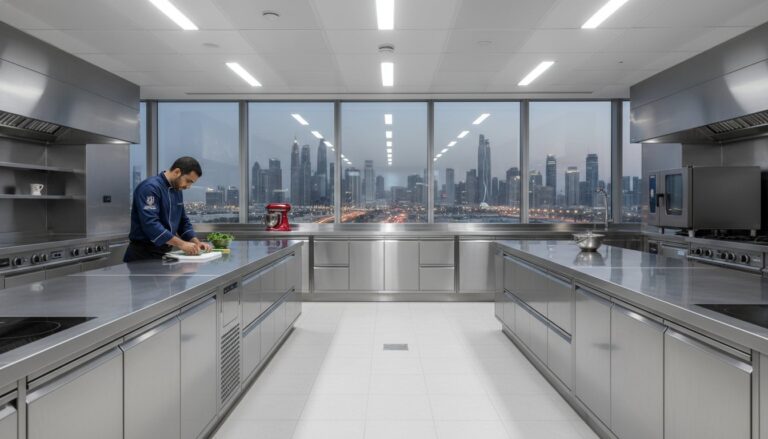
Industrial cabinetry is not merely a storage solution; it’s a critical infrastructure component that must be engineered for thermal resilience and biological safety to survive the rigors of a professional environment. In an industry where the UAE catering services market is projected to reach USD 6.25 billion by 2032, the pressure to maintain operational excellence has never been higher. You likely recognize that high humidity and relentless service cycles quickly expose the vulnerabilities of inferior materials, leading to premature structural failure and non-compliance with the Dubai Municipality Food Code. Selecting the right stainless steel kitchen cabinets dubai requires a methodical approach to engineering and material science rather than a simple procurement checklist.
This comprehensive technical guide provides the expertise needed to specify, design, and procure industrial-grade cabinetry that withstands the most demanding commercial conditions. You’ll gain the insights necessary to identify the correct stainless steel grades for your specific application, ensuring full HACCP compliance and a superior return on investment through build quality. We will examine the essential role of 304-grade steel, the transition toward unified national oversight by the Ministry of Climate Change and Environment, and the structural requirements that separate professional equipment from standard alternatives.
Key Takeaways
- Understand why non-porous surfaces are the mandatory industry standard for maintaining national health and safety compliance within the UAE’s evolving regulatory framework.
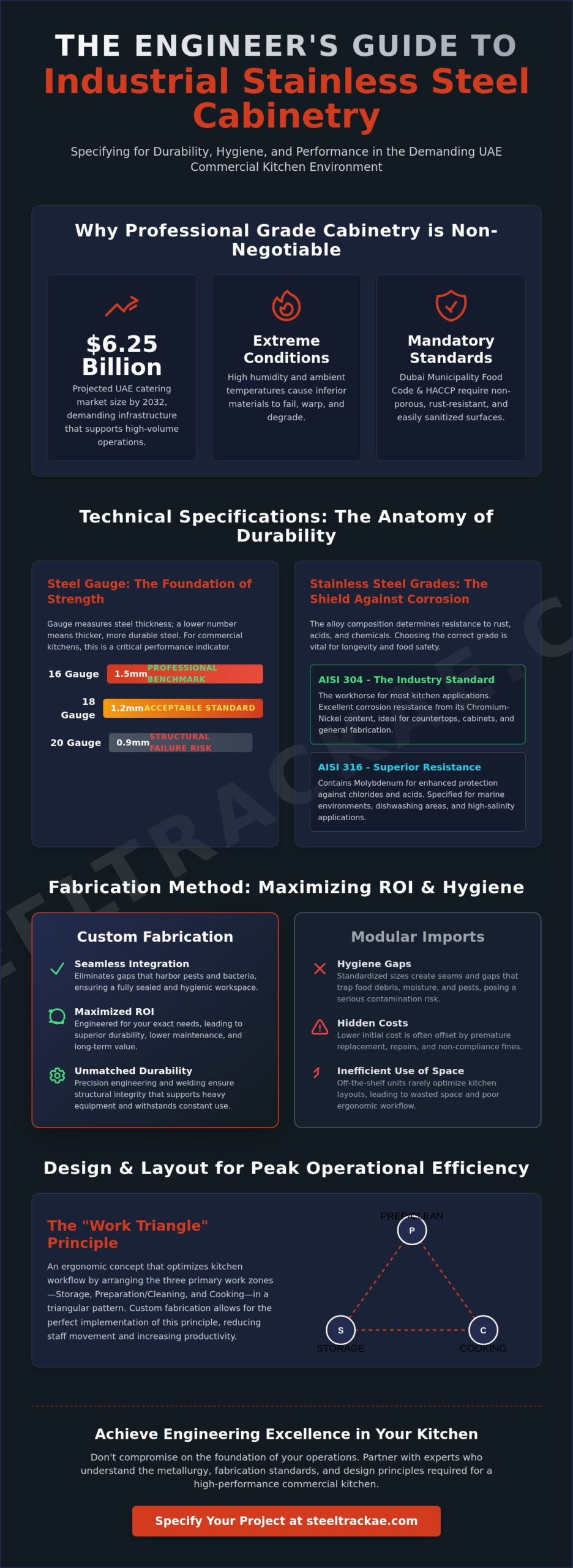
- Learn to differentiate between AISI 304 and 316 grades and why 16 or 18-gauge steel is the technical benchmark for high-performance stainless steel kitchen cabinets dubai.
- Discover how custom-fabricated cabinetry maximizes long-term ROI by eliminating gaps that harbor pests and debris, ensuring a higher hygiene standard than mass-produced modular imports.
- Optimize operational efficiency by applying the “Work Triangle” concept to your kitchen layout, focusing on ergonomic drawer accessibility and prep station design.
- Identify the engineering standards required for precision fabrication to ensure your kitchen infrastructure supports high-volume commercial throughput without structural failure.
The Strategic Importance of Stainless Steel Cabinetry in UAE Commercial Kitchens
In the context of the UAE’s rapidly expanding hospitality sector, the selection of stainless steel kitchen cabinets dubai represents a strategic imperative rather than a mere aesthetic choice. As the regional market moves toward a projected valuation of USD 6.25 billion by 2032, the demand for industrial-grade infrastructure has intensified. The Dubai Municipality Food Code establishes clear mandates for non-absorbent, rust-resistant surfaces. This ensures that every food establishment maintains a rigorous defense against cross-contamination. Unlike residential alternatives, industrial cabinetry must function as a durable platform for heavy-duty equipment such as combi ovens and cooking ranges.
High ambient temperatures in the Middle East place unique stresses on kitchen furniture. Standard materials often succumb to thermal expansion or moisture-induced degradation in high-humidity environments. Engineering solutions must prioritize various stainless steel grades to ensure long-term stability and structural integrity. This transition from residential aesthetics to industrial performance reflects a broader commitment to operational excellence and systematic safety. It’s no longer sufficient for a kitchen to simply look professional; it must be built to withstand the rigors of high-volume service cycles.
Hygiene and Biological Safety Standards
The non-porous nature of high-grade steel is fundamental to biological safety. In high-volume environments, surfaces must withstand constant contact with raw proteins and acidic ingredients without pitting or corroding. This material choice supports the responsibilities of the certified Person in Charge (PIC) by simplifying sanitation protocols. A sterile environment isn’t optional. It’s a legal requirement enforced through the Food Watch digital platform, which tracks the entire food supply chain. High-quality cabinetry prevents the accumulation of organic matter, significantly reducing the risk of bacterial growth.
Durability in Extreme Industrial Environments
Industrial kitchens utilize aggressive chemical cleaners to maintain hygiene standards. Stainless steel provides the necessary resistance to these detergents, preventing surface degradation over years of service. Its structural integrity is equally vital. Base cabinets must support the weight of heavy appliances while remaining thermally stable near high-heat zones like pizza ovens and tandoors. Specifying stainless steel kitchen cabinets dubai ensures that the physical foundation of the kitchen meets the same high standards as the culinary output. This level of engineering ensures the cabinetry remains a permanent asset rather than a recurring expense.
Technical Specifications: Material Grades and Fabrication Standards
Every professional installation of stainless steel kitchen cabinets dubai relies on a foundation of rigorous metallurgical standards. The structural integrity and longevity of these units aren’t accidental; they result from precise material selection and fabrication techniques. Chromium and nickel are the primary alloying elements responsible for forming the passive oxide layer that prevents oxidation. While chromium provides the basic corrosion resistance, nickel enhances the ductility and toughness of the material, ensuring it can withstand the physical impacts common in high-volume kitchens. Understanding these technical nuances is essential for any operator aiming to secure long-term value from their infrastructure.
Steel gauge is a critical factor in performance. Industrial benchmarks typically require 16 or 18 gauge thickness. A 16-gauge sheet is approximately 1.5mm thick, providing superior rigidity for heavy-duty work tables and base cabinets. Thinner 20-gauge alternatives often found in residential settings fail under the weight of commercial equipment like ice machines or chef bases refrigerators. Furthermore, regarding surface aesthetics and utility, a No. 4 brushed finish is the industry preference. Unlike a mirror finish, which highlights every fingerprint and minor scratch, the brushed texture effectively masks wear while remaining easy to sanitize.
AISI 304 vs. AISI 316: The Corrosion Debate
The choice between AISI 304 and AISI 316 often dictates the lifecycle of the kitchen. AISI 304 is the standard grade due to its excellent balance of cost and corrosion resistance. However, AISI 316 contains molybdenum, which significantly improves resistance to chloride-induced pitting. This makes 316 mandatory for seafood preparation areas or facilities located near the coastline where salt-laden air is prevalent. Adhering to established Commercial kitchen design standards ensures that material selection aligns with the environmental stressors of the specific site. Selecting the wrong grade can lead to premature surface degradation and potential health code violations.
Welding and Joint Integrity
Fabrication quality is as important as the raw material. Tungsten Inert Gas (TIG) welding is the superior method for creating seamless, hygienic joints. This process eliminates “dead zones” where moisture and food particles might accumulate, preventing bacterial niches from forming. After welding, the steel should undergo passivation. This chemical treatment removes free iron from the surface and restores the protective oxide layer, ensuring the unit remains rust-resistant throughout its operational life. For technical guidance on selecting the optimal grade for your facility, you may consult with our engineering team to discuss your specific site requirements.
Custom Fabrication vs. Modular Units: Maximizing ROI and Durability
The decision between custom-fabricated equipment and mass-produced modular imports often determines the long-term viability of a professional facility. While modular units offer a lower entry cost, they frequently utilize lower-gauge materials and standard dimensions that don’t account for the unique architectural constraints of a specific site. Professional stainless steel kitchen cabinets dubai must be engineered to fit the exact footprint of the kitchen to eliminate “dead spaces.” These gaps between modular units inevitably harbor moisture, food debris, and pests, creating significant hygiene risks that can compromise the safety of the entire operation. A custom-fabricated approach treats the cabinetry as a monolithic system, seamlessly integrating sinks, drawers, and shelving into a single, continuous structure.
Investing in custom solutions significantly reduces the Total Cost of Ownership (TCO) over the facility’s lifecycle. High-volume environments subject equipment to relentless physical stress and aggressive cleaning protocols. Modular units often suffer from premature structural failure at the joints or hardware attachment points. In contrast, custom units are built with superior welding techniques and reinforced frames designed for industrial throughput. Adhering to Dubai Municipality mandates requires surfaces that aren’t only rust-resistant but also designed to prevent the accumulation of debris. Custom fabrication ensures that every corner and backsplash is radiused and sealed, meeting these stringent biological safety standards while providing a service life that often triples that of pre-fabricated alternatives.
Bespoke Engineering for Specific Workflows
Precision engineering allows for the integration of cabinetry around existing plumbing and electrical infrastructure, ensuring that utility access points remain accessible without compromising the cabinet’s structural integrity. This level of detail is essential when installing heavy-duty appliances like combi ovens or pizza ovens, which require reinforced tops and specialized ventilation clearance. Our Steeltrack services provide the technical precision required for these complex integrations, ensuring that every base cabinet and wall shelf contributes to a streamlined, ergonomic workflow that reduces staff fatigue and increases output.
Structural Reinforcement and Load Capacity
Industrial-grade cabinetry must support significant weight, particularly in high-density storage environments. Custom fabrication utilizes “hat channels” to provide under-shelf reinforcement, preventing the steel from bowing under heavy loads. These channels also serve as sound-deadening components, reducing the metallic noise levels in a busy kitchen. Unlike modular shelving that may have limited weight-bearing capacities, custom upright storage units undergo rigorous load testing to ensure they can safely hold bulk ingredients and heavy cookware. This methodical approach to construction ensures that your kitchen infrastructure remains stable and safe even during peak operational hours.
Design and Layout Optimization for Operational Efficiency
Operational efficiency in a high-volume environment depends on a methodical layout that prioritizes staff movement and safety. Integrating high-performance stainless steel kitchen cabinets dubai into a logical workflow reduces unnecessary steps and minimizes the risk of accidents during peak service hours. The “Work Triangle” concept, adapted for industrial scales, positions prep tables, sinks, and cooking ranges to facilitate a seamless transition between storage, preparation, and plating. When cabinetry is engineered to support this flow, it doesn’t just store items; it actively enhances the speed of service and the safety of the culinary team.
Ergonomic design is a non-negotiable requirement for modern facilities. Base cabinets with doors and drawers must be positioned at heights that prevent repetitive strain while ensuring immediate access to critical tools. HACCP-compliant layouts further demand clear separation between sanitation and preparation zones. This involves the strategic placement of stainless steel grease traps and mop sinks to isolate waste management from food handling areas. Additionally, integrating stainless steel exhaust hoods with wall-mounted storage ensures that ventilation doesn’t obstruct the reach or visibility of the staff, maintaining a clean and breathable environment.
Maximizing Vertical Storage in Compact Kitchens
In the compact footprints often found in urban hospitality zones, vertical space is a vital asset for maintaining an organized workspace. Wall shelves and wall cabinets with doors provide essential storage capacity without occupying valuable floor area. Safety protocols require that heavy items are stored at waist height, while lighter, frequently used items are placed on higher shelving to prevent injuries. This systematic approach to verticality is particularly effective when designing integrated zones featuring a heavy-duty cooking range UAE, where heat management and tool accessibility must be perfectly balanced.
Mobile vs. Fixed Cabinetry
Agile operations often require a mix of fixed and mobile infrastructure. Mobile units, such as stainless steel bakery and kitchen trolleys, offer the flexibility needed to reconfigure the space for different shifts or menu requirements. However, heavy-duty prep tables and base cabinets require fixed stability to handle the weight and vibrations of commercial machinery. Maintenance access is a critical consideration during the design phase. Ensuring that fixed units have sufficient floor clearance or are mounted on high-quality casters allows for thorough cleaning beneath the equipment, satisfying the most rigorous Dubai Municipality hygiene inspections. To optimize your facility’s floor plan for maximum throughput, you may request a technical layout review from our engineering team.
Engineering Excellence: The Steeltrack Approach to Stainless Steel Solutions
Steeltrack positions itself at the critical intersection of metallurgical science and operational design. Our industrial heritage in the UAE allows us to serve as a strategic partner for large-scale commercial entities rather than a simple equipment vendor. We understand that the procurement of stainless steel kitchen cabinets dubai represents a significant capital investment. Therefore, our manufacturing processes prioritize precision, reliability, and institutional strength. Every project begins with a methodical assessment of the client’s specific operational requirements, ensuring that the resulting infrastructure supports high-volume throughput without compromise.
Our commitment to excellence extends through a comprehensive turnkey model. This systematic approach encompasses everything from initial engineering design to professional installation on-site. We utilize high-grade materials to fabricate a wide array of essential components, including stainless steel work tables, sinks, and exhaust hoods. By maintaining total control over the fabrication cycle, we ensure that every base cabinet and wall shelf meets our rigorous internal standards. Regional hospitality leaders trust this methodical execution for their most complex, large-scale setups because it guarantees a level of durability that mass-produced alternatives cannot replicate.
Quality Control and Industrial Standards
Rigorous testing protocols are fundamental to our manufacturing philosophy. Every fabricated unit undergoes a series of inspections to verify structural integrity and weld quality before it leaves our facility. We ensure full compliance with international food safety and engineering benchmarks, providing our clients with the documentation necessary for municipal approvals. Precision is particularly vital when integrating cabinetry with specialized equipment like combi ovens and walk-in cold rooms. Whether the application is a high-pressure commercial kitchen or an industrial laundry environment, our engineering team ensures that every joint and surface is optimized for both hygiene and mechanical longevity.
Partnering for Strategic Growth
Our technical expertise is designed to support your operational scalability. As the UAE hospitality market continues its rapid expansion, having a stable and sophisticated partner for kitchen infrastructure becomes a competitive advantage. We provide dedicated support for national hospitality and industrial projects, ensuring that your facility remains compliant with the latest regulatory changes from the Ministry of Climate Change and Environment. This proactive approach to engineering allows our clients to focus on their core business while we handle the complexities of technical fabrication. To begin the process of optimizing your facility, you may consult with our engineering team for your next project to discuss your specific technical requirements.
Securing Long-Term Excellence in Professional Kitchen Infrastructure
The successful execution of a high-performance commercial facility depends on the seamless integration of engineering precision and operational efficiency. By prioritizing technical specifications like AISI 304 and 316 stainless steel grades, and choosing custom-fabricated solutions over modular alternatives, you ensure that your infrastructure survives the rigors of industrial throughput. We’ve addressed the strategic necessity of methodical layout design and the critical role of stainless steel kitchen cabinets dubai in maintaining full compliance with the Dubai Municipality Food Code. These elements are not merely functional requirements; they’re the physical foundation of a successful, scalable hospitality operation.
Steeltrack provides a proven track record across the UAE hospitality and industrial sectors, offering a comprehensive suite of services that includes design, manufacturing, and installation. Our expert fabrication ensures that every component is built to the highest industrial standards. We invite you to Request a Technical Consultation for Your Industrial Kitchen Setup to discuss your specific project requirements. We look forward to providing the technical expertise and industrial-grade solutions your facility requires for sustained growth and operational safety.
Frequently Asked Questions
What is the best grade of stainless steel for commercial kitchen cabinets?
AISI 304 is the industry standard for most professional environments due to its excellent balance of durability and corrosion resistance. Facilities exposed to high salinity or aggressive chemical environments should utilize AISI 316, which contains molybdenum for enhanced pitting resistance. Selecting the appropriate grade ensures that stainless steel kitchen cabinets dubai remain compliant with local health regulations throughout their operational lifespan.
How do I maintain and clean industrial stainless steel cabinets to prevent corrosion?
Regular sanitation requires the use of non-abrasive, pH-neutral detergents and warm water applied with a microfiber cloth. It’s essential to wipe in the direction of the grain to preserve the No. 4 brushed finish and prevent surface scratching. Operators should avoid chloride-based cleaners or steel wool, as these can compromise the protective oxide layer and initiate localized oxidation.
Is custom fabrication more expensive than modular stainless steel units?
Custom fabrication typically involves a higher initial investment compared to modular units, but it offers a significantly lower total cost of ownership. Bespoke units eliminate the gaps and dead spaces where debris accumulates, reducing labor costs for cleaning and preventing pest infestations. This precision engineering ensures the equipment fits the specific architectural footprint of your facility, maximizing every square meter of operational space.
What is the standard gauge for heavy-duty commercial kitchen equipment?
The industrial benchmark for heavy-duty commercial equipment is 16 or 18 gauge steel. A 16-gauge thickness provides the necessary rigidity to support heavy machinery without bowing or vibrating during operation. While lighter 20-gauge steel is common in residential settings, it lacks the structural integrity required for high-volume commercial throughput.
How does stainless steel cabinetry contribute to HACCP compliance?
Stainless steel’s non-porous surface is fundamental to Hazard Analysis and Critical Control Points (HACCP) compliance by preventing bacterial colonization. Professional fabrication techniques, such as radiused internal corners and seamless joints, eliminate niches where organic matter can hide. This structural hygiene facilitates easier sterilization, ensuring that your facility meets the rigorous standards mandated by the Dubai Municipality.
Can stainless steel cabinets be integrated with refrigeration units?
Professional cabinetry is frequently designed to integrate seamlessly with specialized cooling equipment like chef bases refrigerators and counter top chillers. This integration creates a continuous, hygienic work surface that optimizes the transition between cold storage and food preparation. Such designs are essential for maintaining the cold chain while maximizing the ergonomic efficiency of the kitchen staff.
What are the benefits of TIG welding in kitchen equipment fabrication?
Tungsten Inert Gas (TIG) welding produces the most hygienic and aesthetically superior joints in industrial fabrication. This process creates a seamless bond that is free from the pits or cracks found in lower-quality welding methods. These smooth transitions are vital for preventing cross-contamination and ensuring that the equipment can withstand the physical stresses of a professional environment.
How long does the custom fabrication process typically take?
The timeline for custom fabrication varies based on the technical complexity and scale of the project. A standard installation typically progresses from final design approval to site-ready units within a few weeks. It’s advisable to factor in the time required for municipal approvals and utility integration during the early planning stages of your facility’s setup.