With fines for severe food code violations in Dubai reaching as high as AED 100,000, the margin for error in industrial kitchen management has effectively vanished. You’ve likely found that while basic hygiene is manageable, the complex distinction between daily cleaning and the rigorous structural demands of a certified facility remains a significant challenge. It’s a common frustration to realize that high-volume operations require more than just diligent staff; they necessitate an uncompromising physical infrastructure designed to mitigate cross-contamination at the source.
This article serves as a definitive HACCP compliance checklist for commercial kitchens, providing a methodical guide to aligning your industrial kitchen infrastructure and operational protocols with international food safety standards. We’ll examine the critical role of precision-engineered equipment, such as stainless steel grease traps and specialized walk-in cold rooms, while establishing a structural framework that ensures your facility meets the stringent requirements of the Dubai Food Code 2.0 and the FoodWatch platform. By the end of this guide, you’ll possess a clear roadmap for equipment procurement and a layout strategy that reduces the risk of foodborne illness outbreaks.
Key Takeaways
- Understand the systematic transition from general hygiene to a robust Food Safety Management System (FSMS) required for regulatory approval in the UAE.
- Implement a rigorous HACCP compliance checklist for commercial kitchens that focuses on the structural integrity of stainless steel work tables and prep stations.
- Define Critical Control Points (CCPs) for thermal processing and cold storage, ensuring your cooking ranges and walk-in cold rooms meet international safety limits.
- Optimize kitchen sanitation through high-performance ventilation and hood-type dishwashers designed to maintain a contaminant-free industrial environment.
- Discover how custom equipment fabrication and methodical layout planning can resolve specific operational hurdles and streamline municipality inspections.
Understanding the HACCP Framework in Industrial Food Environments
The implementation of a Hazard Analysis and Critical Control Points (HACCP) system represents the gold standard for food safety in the UAE’s competitive hospitality sector. While basic hygiene focuses on general cleanliness, a systematic Food Safety Management System (FSMS) prioritizes the prevention of biological, chemical, and physical hazards through rigorous data and structural control. In the UAE, where the food service market is projected to reach USD 15.8 billion by 2025, compliance isn’t merely a legal obligation; it’s a foundational pillar of operational excellence and industrial reliability.
A robust HACCP compliance checklist for commercial kitchens starts with the physical environment. You can’t maintain sterile conditions on porous or poorly fabricated surfaces. Structural compliance, involving the strategic placement of stainless steel work tables and the installation of high-performance stainless steel exhaust hoods, serves as the prerequisite for all seven HACCP principles. Local municipality standards, particularly the Dubai Food Code 2.0, require that facilities are designed to prevent cross-contamination before the first ingredient even enters the premises. This proactive approach ensures that the kitchen layout itself acts as a barrier against foodborne illness.
The 7 Principles of HACCP for Kitchen Managers
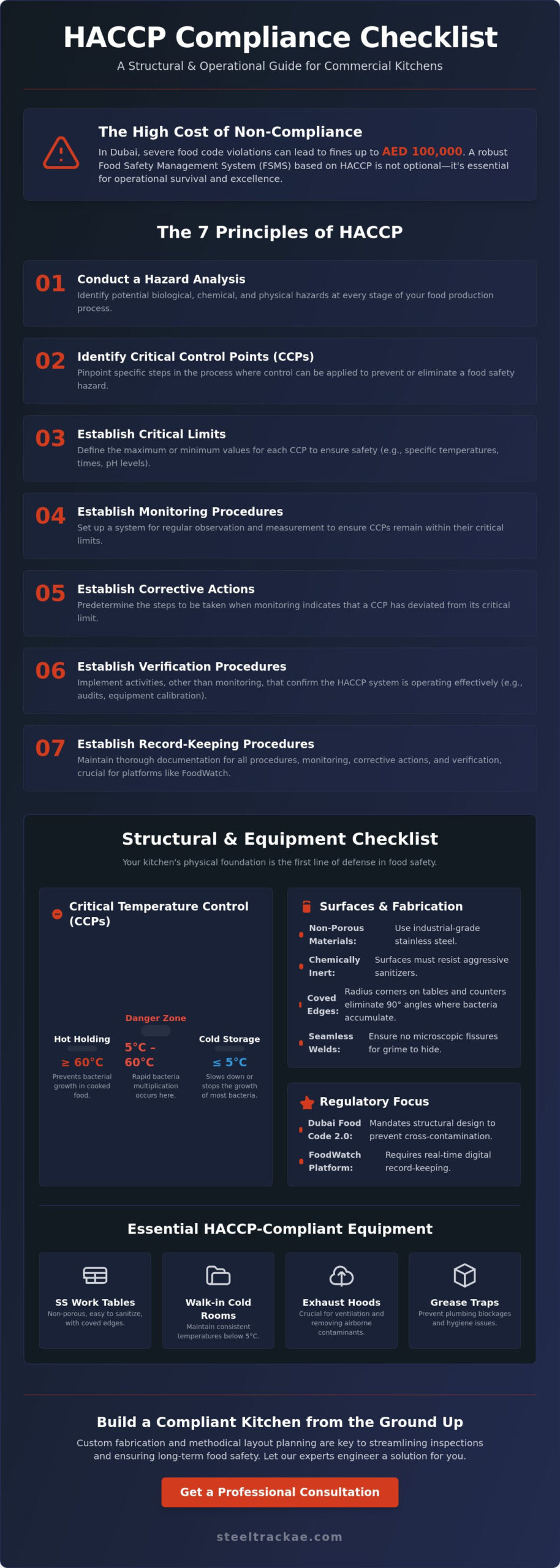
Effective management begins with a comprehensive hazard analysis across the entire food production flow. Managers must identify Critical Control Points (CCPs) where hazards can be prevented, eliminated, or reduced to acceptable levels. In high-volume catering, this often involves monitoring thermal processing in cooking ranges or ensuring the integrity of the cold chain within walk-in cold rooms. Establishing critical limits is essential for safety. For instance, hot-held food must remain at a minimum of 60°C, while perishable chilled items require storage at a maximum of 5°C to satisfy UAE regulatory mandates. Regular monitoring and corrective actions ensure these limits are never breached during peak operational hours.
Regulatory Significance in the UAE Hospitality Sector
Alignment with international standards like ISO 22000 and local codes is vital for brand reputation and the retention of operational licenses. The mandatory use of the FoodWatch platform in Dubai has transitioned compliance into a real-time digital discipline, making accurate record-keeping more critical than ever. This shift underscores why custom-fabricated solutions are increasingly preferred over generic equipment. Precision engineering in items like stainless steel grease traps and specialized drainage ensures that a facility can withstand third-party audits and rigorous municipality inspections. For enterprises seeking to integrate these standards into their core operations, professional fabrication and installation services provide the necessary technical foundation for long-term compliance and systematic growth.
The Structural HACCP Checklist: Equipment and Fabrication Standards
While operational monitoring is vital, the physical foundation of a facility determines the success of any food safety program. A comprehensive HACCP compliance checklist for commercial kitchens must prioritize the procurement of non-porous, industrial-grade equipment. It’s a common misconception that digital monitoring alone guarantees safety. If your surfaces harbor microscopic fissures, bacteria will proliferate regardless of your temperature logs. High-performance kitchen environments require surfaces that are chemically inert and resistant to the aggressive sanitization protocols typical of large-scale operations.
The structural integrity of stainless steel work tables and prep stations is a primary concern for municipality inspectors. Compliance requires more than just the presence of metal; it demands specific fabrication standards. Custom-fabricated solutions often incorporate radius, or coved, edges. These curved transitions between surfaces eliminate the sharp 90-degree angles where organic matter and moisture typically accumulate. By removing these “dead zones,” facilities can ensure that every square inch of the preparation area is accessible for deep cleaning. For operators establishing new facilities, seeking professional kitchen installation services ensures that these engineering nuances are integrated into the initial layout.
Stainless Steel Fabrication for Hygiene
Specifying Grade 304 stainless steel is the industry standard for UAE commercial kitchens due to its superior corrosion resistance and ability to withstand high-heat sanitization. Fabrication must focus on seamless welding to prevent the development of crevices. This rigorous standard extends to mobile equipment as well. Utilizing heavy-duty stainless steel bakery and kitchen trolleys or specialized smasala trolleys allows for a fluid, clean food flow while maintaining the same non-porous standards as stationary units. Proper fabrication ensures that equipment doesn’t just look professional; it functions as a sterile component of your food safety management system.
Sinks and Warewashing Infrastructure
Cross-contamination prevention necessitates a clear physical separation between different washing activities. A compliant kitchen must feature dedicated stainless steel mop sinks, separate hand-washing stations, and specialized food-prep sinks. For heavy-duty cleaning, a stainless steel 3 bowl sink provides the necessary stages for washing, rinsing, and sanitizing large utensils. This infrastructure should align with the FDA HACCP Principles & Application Guidelines, which emphasize the importance of controlled sanitation environments. Additionally, the integration of a stainless steel grease trap is a mandatory environmental standard to prevent drainage blockages and maintain a hygienic workspace. If you’re currently auditing your facility’s structural readiness, consider discussing your facility requirements with a technical consultant to identify potential gaps in your fabrication strategy.
Managing CCPs in Thermal Processing and Cold Chains
Maintaining stringent control over thermal processing and cold chain logistics is the core of any HACCP compliance checklist for commercial kitchens. While the structural foundation establishes the environment, the mechanical reliability of your infrastructure determines your ability to meet critical limits. Under the Dubai Food Code 2.0, all hot-held, ready-to-eat food must be maintained at a minimum of 60°C. Conversely, perishable chilled food requires storage at a maximum of 5°C, and frozen inventory must remain at -18°C or below. These aren’t merely guidelines; they’re rigid parameters that demand high-performance equipment capable of sustained precision under industrial loads.
The transition from delivery to storage and finally to service represents a series of Critical Control Points (CCPs) where the risk of pathogen proliferation is at its highest. It’s not enough to simply monitor these points via the FoodWatch platform. You must ensure your equipment possesses the thermal mass and recovery speed to maintain these temperatures despite frequent door openings and high-volume throughput. Precision in these areas reduces the risk of foodborne illness outbreaks and secures your operational standing during municipality inspections.
High-Performance Cooking and Thermal Safety
Ensuring consistent heat distribution is paramount for effective pathogen reduction. Operators should prioritize a heavy duty cooking range UAE professionals trust for its thermal stability and durability. For large-scale liquid processing, utilizing tilting boiling pans provides safe, uniform heating that prevents cold spots where bacteria might survive. Modern Rational Combi ovens further enhance safety by using integrated core temperature probes. These tools provide the documented validation required for HACCP audits, ensuring that every batch of protein reaches its specific safety threshold before service.
Cold Storage and Refrigeration Standards
The integrity of your cold chain relies on the structural and mechanical health of your refrigeration units. Walk-in cold rooms must feature air-tight seals and high-density thermal insulation to prevent temperature fluctuations. The International HACCP Alliance emphasizes that monitoring is only as effective as the equipment’s ability to respond to data. This includes maintaining upright chillers and reach-in refrigerators to ensure they don’t exceed the 5°C limit during peak hours. Hygiene standards also extend to ice machines, where preventing biofilm accumulation is essential for serving safe beverages. Regular audits of your bottle coolers and chef base refrigerators should be a mandatory component of your technical maintenance schedule.
Sanitation, Ventilation, and Maintenance Protocols
Operational hygiene extends far beyond the surface level of a prep table. A comprehensive HACCP compliance checklist for commercial kitchens must integrate the invisible factors of air quality and drainage management to prevent the accumulation of airborne contaminants. While previous sections established the importance of structural fabrication, the ongoing maintenance of extraction systems and warewashing infrastructure serves as the primary defense against biological hazards. In high-volume industrial environments, the failure of a single sanitation protocol can compromise the entire food safety management system.
Effective waste management and drainage are equally critical for maintaining a sterile workspace. The installation of high-quality stainless steel floor grating ensures that liquids are efficiently channeled away from preparation zones, preventing the pooling of stagnant water. This infrastructure works in tandem with the stainless steel grease traps discussed earlier, requiring a rigorous inspection schedule to avoid blockages that could lead to backflow and contamination. Maintaining these systems is a technical necessity that ensures your facility remains aligned with the Dubai Food Code 2.0.
Ventilation and Air Quality as a Safety Barrier
Airborne grease and moisture represent significant risks to food safety. High-performance stainless steel exhaust hoods are designed to extract these byproducts before they can settle on clean surfaces or ingredients. Without effective extraction, condensation can lead to mould growth on ceilings and walls, which is a critical violation during municipality audits. Regular filter cleaning schedules are mandatory, not only for fire safety but to ensure the extraction rate remains sufficient to maintain a negative pressure environment. This prevents the migration of heat and odors into temperature-controlled storage areas.
Warewashing and Chemical Safety
Sanitization of equipment and utensils requires precision in both temperature and chemical application. Industrial hood-type dishwashers must be calibrated to achieve a final rinse temperature of 82°C to ensure the total elimination of pathogenic bacteria. This thermal sanitization should be verified daily and recorded as part of your HACCP documentation. Additionally, all cleaning chemicals must be stored in dedicated stainless steel wall cabinets or base cabinets located away from food preparation zones to prevent accidental chemical contamination. Implementing a master cleaning schedule for all stainless steel surfaces ensures that every component of the kitchen, from the shelving to the floor grating, is systematically sanitized. If you require a technical audit of your current extraction or sanitation layout, contact our engineering team for a professional facility assessment.
Implementing Your HACCP Plan with STEELTRACK KITCHEN EQUIPMENT IND LLC
Transforming a theoretical HACCP compliance checklist for commercial kitchens into a functioning operational reality requires more than the mere procurement of industrial equipment. It demands a strategic integration of engineering precision and food safety principles. For large-scale enterprises in the UAE, the transition from a conceptual framework to a turnkey kitchen design involves a meticulous alignment of physical assets with the rigorous demands of the local regulatory environment. This methodical approach ensures that every component, from the placement of stainless steel work tables to the extraction capacity of exhaust hoods, serves as a proactive barrier against contamination.
The advantage of custom fabrication becomes evident when addressing specific regulatory hurdles or unique architectural constraints. Standard, off-the-shelf units often leave gaps or “dead zones” where organic matter can accumulate, creating significant risks during municipality inspections. By utilizing bespoke solutions from STEELTRACK KITCHEN EQUIPMENT IND LLC, operators can eliminate these vulnerabilities, ensuring that the facility remains in a constant state of audit readiness. Investing in high-performance, durable assets provides a superior long-term ROI, as these materials withstand the aggressive sanitization protocols necessary for maintaining a compliant environment.
Custom Design and Fabrication Services
Success in the industrial food sector begins with a consultative approach to kitchen layouts. Every facility presents unique challenges, whether it’s a high-rise hotel kitchen or a centralized production unit. Fabrication must be tailored to these specific architectural footprints while ensuring the seamless integration of cooking, refrigeration, and ventilation systems. This level of customization allows for a logical food flow, physically separating raw processing from high-risk prep zones. By incorporating specialized items such as stainless steel floor grating and custom-sized walk-in cold rooms, the design itself facilitates compliance, reducing the burden on staff to manage structural deficiencies manually.
Professional Installation and Certification Support
Technical mastery extends beyond the manufacturing floor into the final installation phase. To meet industrial safety standards, equipment must be installed with precision, ensuring that gas lines, drainage, and electrical connections are secure and hygienic. STEELTRACK KITCHEN EQUIPMENT IND LLC provides the professional oversight vital for generating the comprehensive documentation required for HACCP audits, including detailed equipment specifications and technical data sheets. Maintaining this infrastructure through scheduled technical support ensures that your facility remains a stable, high-standard environment capable of handling complex, large-scale projects. To begin the transition from planning to execution, consult with STEELTRACK KITCHEN EQUIPMENT IND LLC for your HACCP-compliant kitchen setup and secure your facility’s operational future.
Securing Your Operational Future through Technical Excellence
Achieving absolute compliance in the UAE’s sophisticated regulatory environment requires a transition from general oversight to methodical engineering. We’ve established that the physical layout and the quality of your fabrication are the primary determinants of food safety success. Utilizing a comprehensive HACCP compliance checklist for commercial kitchens ensures that every Critical Control Point is fortified by high-performance equipment designed for industrial rigor. It’s not just about passing a single inspection; it’s about building an institutional foundation of reliability and safety.
As a premier UAE manufacturer of stainless steel solutions, STEELTRACK KITCHEN EQUIPMENT IND LLC brings specialized expertise to heavy-duty industrial cooking ranges and turnkey commercial kitchen and laundry installations. Our consultative approach ensures that your facility is optimized for both safety and operational efficiency. Request a Technical Consultation for Your Compliant Kitchen Layout to begin aligning your infrastructure with the highest international standards. With a dedicated technical partner, you can navigate the complexities of modern food safety with absolute confidence and professional pride.
Frequently Asked Questions
Is HACCP compliance mandatory for all commercial kitchens in the UAE?
Yes, HACCP compliance is a mandatory requirement for all food establishments operating within the UAE. Regulatory frameworks such as the Dubai Food Code 2.0 and the mandatory FoodWatch platform require businesses to implement a robust Food Safety Management System. This mandate is part of a broader national initiative to standardize safety protocols across all Emirates under the National Food Security Strategy 2051.
What is the difference between Grade 304 and Grade 430 stainless steel for HACCP?
Grade 304 stainless steel is the industrial standard for food contact surfaces because its high nickel and chromium content provides superior resistance to corrosion and oxidation. Grade 430 is a lower-cost alternative that lacks the same durability when exposed to the aggressive sanitization chemicals and high humidity levels typical of high-volume kitchens. Utilizing Grade 304 ensures that equipment remains non-porous and easy to sanitize over long-term use.
How often should a commercial exhaust hood be cleaned for compliance?
Professional deep cleaning of the entire extraction system should occur at least every three to six months depending on the volume of grease production. However, grease filters require daily or weekly cleaning as part of your internal HACCP compliance checklist for commercial kitchens to ensure optimal air extraction. Maintaining these schedules is vital for preventing airborne contamination and adhering to municipality fire safety standards.
What are the critical temperature limits for hot-holding food in a catering environment?
All hot-held, ready-to-eat food must be maintained at a minimum temperature of 60°C to satisfy UAE food safety regulations. This critical limit prevents food from entering the “danger zone” where pathogenic bacteria can proliferate at an accelerated rate. Consistent monitoring and documented verification of these temperatures are essential components of any successful HACCP audit.
Can a custom-fabricated kitchen layout improve my HACCP audit score?
A custom-fabricated layout improves audit scores by physically separating raw and cooked food zones to eliminate the risk of cross-contamination. Bespoke designs allow for the removal of “dead spaces” and the integration of coved edges on stainless steel work tables, making deep cleaning more effective. Demonstrating that your kitchen’s physical structure proactively supports hygiene protocols is a significant advantage during inspections.
What documentation is required to prove equipment compliance during an inspection?
Inspectors require technical data sheets, material grade certifications, and comprehensive maintenance logs for all industrial assets. You must also provide calibration records for equipment with integrated monitoring, such as the probes in combi ovens or digital displays in walk-in cold rooms. This documentation proves that your infrastructure is capable of maintaining the critical limits defined in your safety plan.
How do walk-in cold rooms contribute to the HACCP cold chain principle?
Walk-in cold rooms provide the high-density insulation and air-tight seals necessary to maintain perishable items at the mandatory maximum of 5°C. Their superior thermal recovery speed after frequent door openings ensures the integrity of the cold chain remains uncompromised. This mechanical reliability is a fundamental requirement of a HACCP compliance checklist for commercial kitchens focused on high-volume storage.
Why is a separate hand-washing sink required by HACCP standards?
Dedicated hand-washing sinks are required to prevent the transfer of pathogens from staff hands to food preparation surfaces or clean utensils. These stations must be used exclusively for hand hygiene and should ideally feature non-hand-operated taps to minimize recontamination risks. Providing separate, accessible stations is a non-negotiable requirement for satisfying the sanitation standards of local municipalities.