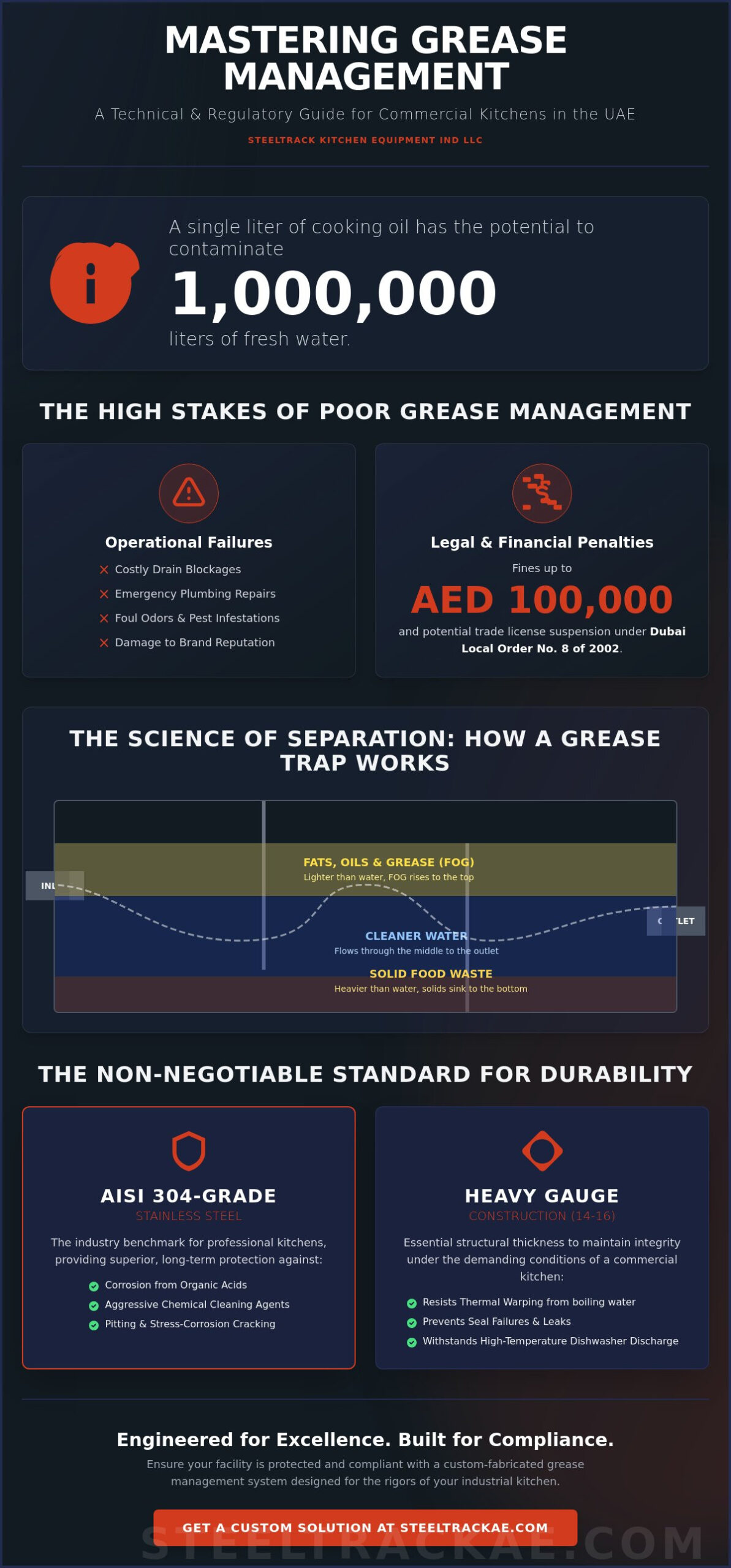
Did you know that a single liter of cooking oil possesses the potential to contaminate one million liters of water? This staggering environmental risk is precisely why municipal authorities have established such rigorous standards for the commercial kitchen grease trap UAE operators must integrate into their facilities. You’re likely aware that managing a high-volume culinary establishment requires more than just operational efficiency; it demands an unwavering commitment to infrastructure integrity. Frequent drain blockages and the persistent threat of municipal fines, which can reach up to AED 100,000 in Dubai, represent significant risks that no professional enterprise can afford to ignore.
This guide provides the technical and regulatory clarity you need to master grease management, ensuring your facility remains fully compliant with Local Order No. 8 of 2002 while protecting your drainage systems from the corrosive effects of industrial usage. We’ll examine the specific procurement standards for high-grade stainless steel interceptors, the mandatory maintenance schedules required by local municipalities, and the strategic selection of durable hardware that survives the high-temperature demands of a modern commercial kitchen environment.
Key Takeaways
- Identify the precise regulatory standards and municipality requirements necessary to maintain a compliant commercial kitchen grease trap UAE facility.
- Recognize why AISI 304-grade stainless steel and industrial-grade gauges are the non-negotiable benchmarks for long-term durability and corrosion resistance.
- Evaluate the performance differences between manual and automatic systems to select an engineered solution that matches your facility’s specific wastewater volume.
- Master the procurement and installation lifecycle, focusing on MEP alignment and drainage gradients to ensure successful municipality inspections.
- Learn how custom fabrication allows for the seamless integration of grease management systems with industrial stainless steel sinks and work tables.
The Strategic Role of Grease Management in UAE Commercial Kitchens
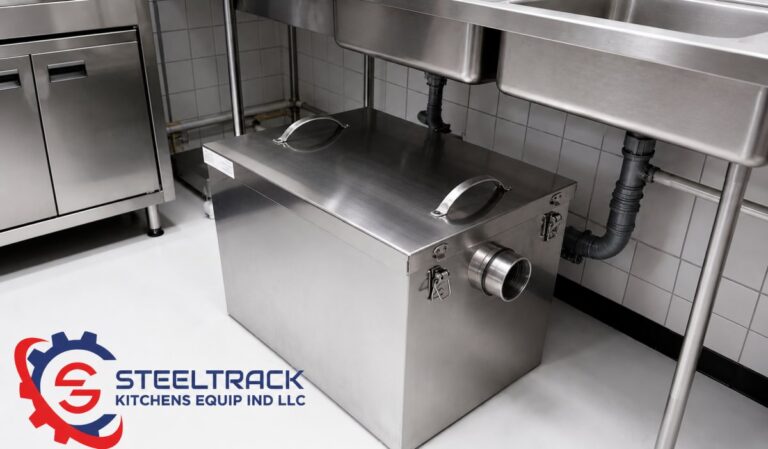
A grease trap, or interceptor, acts as a primary defense mechanism for industrial plumbing. It is an engineered stainless steel vessel specifically designed to isolate fats, oils, and grease (FOG) from wastewater before it enters the public sewer lines. For those seeking a technical Grease trap overview, these devices operate on the principle that FOG is lighter than water. This density difference allows grease to rise and be trapped within the unit while cleaner water passes through the outlet. In the context of a commercial kitchen grease trap UAE installation, this equipment isn’t merely a plumbing accessory; it’s a vital component of the nation’s environmental and public health infrastructure.
FOG management remains critical because untreated grease solidifies rapidly within the drainage network. This accumulation restricts flow, causes back-ups, and creates severe hygiene risks within the kitchen environment. The primary functions of these units include density-based separation, the retention of intercepted grease, and the filtration of solid food waste through internal baffle systems. By preventing these substances from reaching the national sewage systems, facilities maintain the high hygiene standards expected in the UAE hospitality sector.
Regulatory Compliance and National Standards
Operating a food service establishment in the Emirates requires strict adherence to municipal mandates. In Dubai, Local Order No. 8 of 2002 explicitly requires grease interceptors in all commercial kitchens, restaurants, and food factories. These regulations are enforced through regular municipality inspections that verify the installation and maintenance of approved units. Maintaining a compliant system is essential to avoid substantial fines, which can range from AED 5,000 to AED 100,000, or the potential suspension of trade licenses. Effective grease management is also a cornerstone of HACCP alignment. It prevents the cross-contamination and sanitary failures that threaten international food safety certifications, ensuring that the facility meets global benchmarks for excellence.
The Economic Impact of Poor Grease Interception
The financial consequences of inadequate grease interception often remain hidden until a catastrophic system failure occurs. Emergency plumbing repairs and high-pressure drain jetting represent significant unbudgeted expenses that disrupt daily operations. Beyond mechanical failure, poorly designed traps contribute to foul odors and pest infestations, which damage a brand’s reputation and lead to costly remediation. Investing in industrial-grade stainless steel units offers a superior long-term ROI compared to low-quality alternatives. These robust systems, which can be integrated with custom stainless steel sinks and work tables, provide the structural integrity needed to withstand high-temperature wastewater and chemical cleaning agents over years of intensive industrial use.
Technical Specifications: Material Integrity and Flow Capacity
Material integrity is the primary factor determining the operational lifespan of any commercial kitchen grease trap UAE facility managers procure. While various materials exist in the market, AISI 304-grade stainless steel remains the non-negotiable industry standard for professional environments. This specific alloy provides superior resistance to the organic acids found in decomposing food waste and the aggressive chemical agents used in industrial sanitation. Selecting a high-grade steel ensures that the vessel remains impervious to pitting and stress-corrosion cracking over decades of service.
The structural thickness, or steel gauge, plays a critical role in maintaining the unit’s geometry under stress. Utilizing a heavy 14-gauge or 16-gauge construction is essential for resisting thermal expansion. In a busy kitchen, grease traps are frequently subjected to rapid temperature fluctuations as boiling water from pasta cookers or high-temperature discharge from hood-type dishwashers enters the system. Thinner, lower-quality steels often warp under these conditions, leading to seal failures and eventual leaks. Precision-engineered internal baffle systems complement this structural strength by slowing the velocity of incoming wastewater. This reduction in turbulence is necessary to allow the laws of physics to work, ensuring that FOG has sufficient time to separate and rise to the surface for retention.
Calculating Required Capacity for Your Operation
Determining the correct capacity involves a methodical calculation of the total potential drainage volume from all connected fixtures. A standard sizing formula begins by calculating the volume of the primary stainless steel sinks (Length x Width x Depth) in cubic inches and converting that figure into gallons or liters. This total is then adjusted by a displacement factor, typically 75 percent, to account for the fact that sinks are rarely filled to the absolute brim. The resulting figure must align with a specific ‘Retention Time,’ which is the interval required for fats to cool, solidify, and rise. High-volume operations utilizing combi ovens and industrial dishwashers must factor in simultaneous discharge rates to prevent the trap from being overwhelmed during peak service hours.
Durability and Fabrication Standards
Fabrication quality is just as important as material selection. Seamless welding is a hallmark of industrial-grade grease traps, as it eliminates the weak points where corrosion typically begins. In the UAE’s high-humidity and high-salinity environment, even minor structural imperfections can lead to rapid oxidation. While standard-sized units suit many layouts, custom-fabricated grease traps offer a distinct advantage for kitchens with non-standard footprints or restricted MEP access. For facilities with complex spatial constraints, consulting with a fabrication expert ensures that your grease management infrastructure is built to exact technical specifications without compromising on flow efficiency or municipality compliance.
Evaluating Grease Trap Configurations: Manual vs. Automatic Systems
Selecting the appropriate configuration for a commercial kitchen grease trap UAE facility requires a methodical assessment of both peak drainage volume and available labor resources. Manual stainless steel traps represent the traditional, low-energy benchmark for the industry. These units rely on passive gravity separation; as wastewater enters the chamber, the velocity is reduced, allowing FOG to rise and solidify behind internal baffles. Their lack of moving parts makes them exceptionally reliable and cost-effective for kitchens with established, disciplined cleaning schedules. They don’t require electrical connections, which simplifies the initial installation and reduces long-term utility overhead.
In contrast, Automatic Grease Removal Units (GRUs) provide a sophisticated, high-tech solution for high-volume enterprises operating 24/7. These systems utilize motorized skimming wheels or heating elements to actively extract grease into a separate external container. While the initial capital expenditure for a GRU is higher, the reduction in manual labor and the consistency of grease removal often justify the investment for large-scale hotels and central production units. By automating the extraction process, facilities minimize the risk of human error and ensure that the interceptor maintains its maximum retention capacity without the need for daily manual intervention.
Under-Sink Interceptors for Targeted Capture
Under-sink interceptors are engineered for point-of-source grease capture, making them ideal for boutique restaurants, coffee shops, and specialized preparation areas. These compact units fit seamlessly beneath stainless steel sinks and work tables, capturing FOG before it can enter the primary drainage line. Their proximity to the source of waste allows for immediate interception, which is particularly effective for pot-wash stations. The space-saving design ensures that even facilities with restricted floor plans can maintain full municipality compliance while providing easy access for routine inspections.
Floor-Mounted and External Industrial Interceptors
For large-scale operations like hotel kitchens or hospital catering facilities, centralized floor-mounted or external interceptors are essential. These units manage the massive discharge from multiple lines, including high-capacity dishwashers and stainless steel floor grating systems. External grease pits offer the logistical advantage of being serviced from outside the building, preventing the disruption of indoor culinary operations during maintenance. Integrating these large-scale interceptors with industrial-grade drainage channels ensures that the facility’s infrastructure can handle heavy hydraulic loads without the risk of surcharging or structural failure.
Procurement and Installation: A Framework for Facility Managers
The procurement of a commercial kitchen grease trap UAE operators utilize requires a methodical approach that extends far beyond a simple purchase transaction. This lifecycle initiates with the development of detailed MEP (Mechanical, Electrical, and Plumbing) drawings, which must explicitly define the drainage layout and connection points. These plans serve as the technical foundation for municipality approval, ensuring that every piece of equipment aligns with local environmental mandates. Professional facility managers recognize that a successful installation is the result of rigorous planning and coordination between kitchen consultants and specialized stainless steel fabricators.
Vetting suppliers is a critical phase in this framework. It’s essential to distinguish between general equipment resellers and technical fabricators who possess deep-seated engineering expertise. While a reseller may offer a standard product, a dedicated manufacturer understands the metallurgical requirements and hydraulic principles necessary for industrial performance. They ensure that the final vessel is not only sized correctly but also constructed with the structural integrity needed to withstand high-volume discharge. This distinction is vital for ensuring that the infrastructure remains robust throughout its operational life.
Site Logistics and Installation Planning
Successful installation demands precise coordination of site-specific variables. Technicians must verify drainage levels and pipe gradients before committing to a specific trap height, as even minor miscalculations can lead to poor flow or stagnant water. Adequate clearance for cover removal is another non-negotiable factor. If the trap is inaccessible, routine cleaning becomes impossible, leading to rapid system failure. This stage requires seamless communication between plumbers and fabricators to ensure that venting systems are correctly positioned to prevent airlocks and mitigate foul odors within the preparation area.
Long-Term Maintenance and Waste Disposal
A preventative maintenance schedule is the only way to ensure lifelong performance and municipality compliance. Facility managers should implement a tiered auditing system that includes daily visual checks and weekly sediment assessments. In the UAE, it’s mandatory to work with certified waste management contractors who are licensed to transport and process FOG waste at designated treatment facilities. Integrating these protocols into your broader professional kitchen equipment maintenance strategy ensures holistic facility health and prevents the operational disruptions caused by drainage failures. For those seeking specialized technical guidance on custom fabrication and installation, contacting an industrial expert is the most reliable path toward long-term operational integrity.
Steeltrack Custom Fabrication: Engineered Solutions for Industrial Kitchens
Steeltrack delivers bespoke fabrication services that transcend the limitations of mass-produced equipment. When procuring a commercial kitchen grease trap UAE businesses often face spatial constraints that standard units cannot accommodate. Our engineered solutions are tailored to these specific drainage loads and architectural footprints, ensuring that the grease management system functions as a seamless extension of the kitchen’s plumbing. By prioritizing custom fabrication, facility managers gain precise control over inlet and outlet positioning, which significantly reduces the complexity of MEP connections during the installation phase.
A cohesive kitchen environment requires the strategic integration of all stainless steel components. We specialize in aligning grease management systems with custom stainless steel sinks and work tables to create a unified, hygienic workflow. This holistic approach ensures that every drainage point is optimized for high-capacity discharge while maintaining a clean, professional aesthetic. Our commitment to utilizing industrial-grade AISI 304 stainless steel guarantees that every custom vessel possesses the metallurgical integrity required to resist corrosion and structural warping in high-temperature environments.
Precision Engineering for High-Volume Operations
Steeltrack designs every interceptor to withstand the relentless rigors of 24/7 industrial usage. We utilize advanced baffle configurations that are specifically engineered to enhance separation efficiency based on the unique waste profile of your facility. These custom internal designs slow wastewater velocity more effectively than generic models, maximizing FOG retention even during peak service hours. Such robust infrastructure is essential for supporting heavy-duty cooking range operations where high volumes of grease and hot water are discharged simultaneously. Our precision engineering ensures that your drainage remains clear, preventing the operational bottlenecks that disrupt large-scale culinary production.
Consultative Approach to Kitchen Infrastructure
We believe in a strategic partnership that moves beyond off-the-shelf product sales. Our technical team adopts a consultative approach, conducting site-specific engineering assessments to ensure that every component meets the exacting standards of the UAE hospitality sector. From initial design drafts to professional installation, we provide turnkey support across all seven Emirates. This methodical process ensures that your investment in a commercial kitchen grease trap UAE is backed by industrial expertise and a commitment to long-term reliability. Contact our technical team for custom grease trap specifications to begin your facility’s infrastructure upgrade.
Securing Long-Term Operational Integrity and Compliance
Mastering grease management is a fundamental requirement for any professional culinary facility aiming for long-term operational success. By prioritizing high-grade AISI 304 stainless steel and precision engineering, you ensure your drainage systems withstand the intensive hydraulic loads of industrial service. We’ve examined how the correct commercial kitchen grease trap UAE specification prevents costly blockages and ensures your establishment remains fully aligned with municipal regulations. It’s a strategic approach that protects your infrastructure and maintains the high hygiene standards expected in the region’s hospitality sector.
Steeltrack remains your strategic partner in this evolution, providing the technical mastery needed to design and install resilient systems. We are specialists in AISI 304 and 316 stainless steel fabrication, ensuring every unit is engineered for UAE municipality compliance through our comprehensive turnkey design and installation services. Request a Technical Consultation for Custom Stainless Steel Grease Traps to ensure your facility meets the highest industrial standards. Investing in precision-engineered hardware today guarantees a stable, compliant, and efficient kitchen environment for years to come.
Frequently Asked Questions
What are the specific UAE municipality requirements for commercial grease traps?
UAE municipalities mandate the installation of approved grease management systems under regulations such as Dubai’s Local Order No. 8 of 2002. Establishments must ensure their commercial kitchen grease trap UAE installation is correctly sized for their drainage load. Additionally, businesses are required to maintain a contract with a municipality-approved waste company for regular cleaning and disposal. Detailed maintenance logs must be kept on-site for inspection by the Drainage and Irrigation Department to ensure trade license compliance.
How often should a commercial grease trap be cleaned in a high-volume kitchen?
High-volume industrial kitchens must adhere to strict cleaning schedules to prevent system surcharging. In Dubai and Abu Dhabi, the standard requirement is a minimum of two cleanings per month. For smaller units with a capacity of 40 gallons or less, weekly cleaning is often mandatory. A reliable operational benchmark is to schedule an extraction whenever the fats, oils, and grease (FOG) accumulation reaches 25 percent of the trap’s total liquid capacity.
Can I use a plastic grease trap instead of stainless steel for my restaurant?
While PVC and plastic alternatives are available, they’re generally unsuitable for professional industrial environments. High-temperature discharge from equipment like hood-type dishwashers and pasta cookers can cause plastic vessels to warp or crack over time. Professional facilities prioritize AISI 304-grade stainless steel for its superior thermal stability and resistance to organic acids. Choosing steel ensures the long-term structural integrity required to survive rigorous usage without risking leaks or municipality non-compliance.
What is the difference between a grease trap and a grease interceptor?
The distinction primarily relates to flow capacity and scale. Historically, the term grease trap described smaller, under-sink units with a flow rate of less than 50 gallons per minute. Grease interceptors referred to larger, high-capacity vessels designed for external or floor-recessed installation. In the UAE hospitality sector, these terms are frequently used interchangeably to describe any engineered commercial kitchen grease trap UAE operators utilize to isolate FOG from the public sewer network.
How do I calculate the correct size of a grease trap for my commercial sink?
To determine the required capacity, calculate the volume of your stainless steel sinks by multiplying the interior length, width, and depth in inches. Divide this total by 231 to convert the figure into gallons. Apply a 75 percent loading factor to account for actual water displacement during service. This calculation ensures the trap provides sufficient retention time for grease to cool and separate from the wastewater before it exits the outlet.
Do automatic grease removal units (GRUs) require municipality approval in the UAE?
Yes, all automatic grease removal units must be vetted and approved by the relevant municipal authorities, such as the Dubai Municipality Drainage and Irrigation Department. These high-tech systems must demonstrate specific separation efficiency benchmarks to be accepted as a valid grease management solution. While they offer automated extraction, they don’t exempt the facility from maintaining official waste disposal records and adhering to regional environmental health and safety standards.
What happens if my business is found non-compliant during a grease trap inspection?
Non-compliance during a municipal inspection results in immediate and severe administrative penalties. In Dubai, fines for failing to maintain a grease trap or using unauthorized waste contractors range from AED 5,000 to AED 100,000. Beyond financial losses, repeated violations can lead to the temporary suspension of your trade license or the permanent closure of the facility. Ensuring your equipment meets industrial standards is the only way to mitigate these legal risks.
Does a grease trap prevent all types of drain blockages?
A grease trap is specifically engineered to capture fats, oils, grease, and small food particles; it isn’t a universal solution for all drainage issues. While internal baskets catch solid waste, they won’t prevent blockages caused by non-organic debris or improper disposal of large food items. For comprehensive protection, these units should be integrated with industrial floor grating and professional mop sinks to ensure the entire drainage infrastructure remains clear and functional.