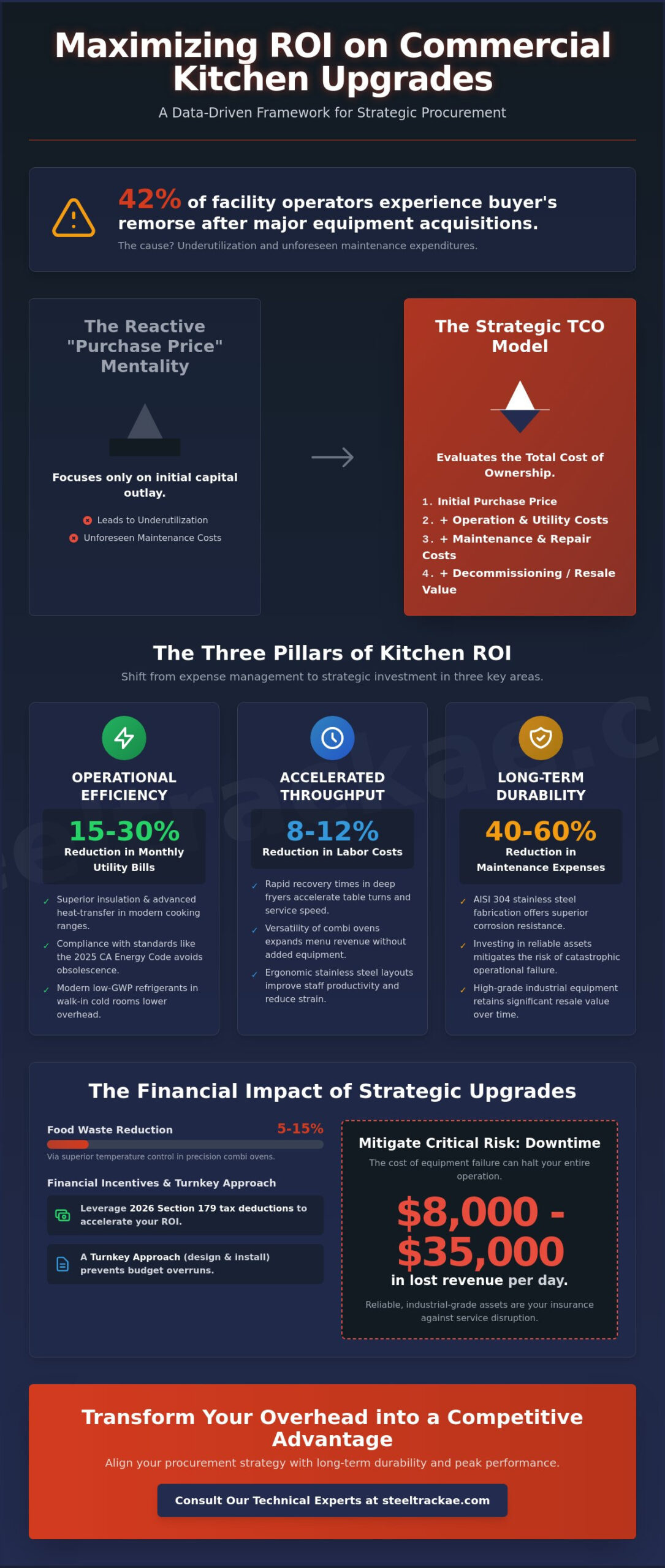
A January 2026 industry survey revealed that 42% of facility operators experience buyer’s remorse following major equipment acquisitions, primarily due to underutilization or unforeseen maintenance expenditures. This statistic underscores the critical necessity of a methodical, data-driven approach when calculating the ROI on commercial kitchen upgrades within high-volume environments. You recognize that in an era of rising utility rates and escalating labor costs, every square foot of your facility must contribute to the bottom line. Equipment downtime is more than a logistical hurdle; it’s a direct threat to service consistency and your institutional reputation.
This article demonstrates how strategic investments in industrial-grade assets, such as Rational Combi ovens or high-efficiency Walk-in Cold Rooms, transform operational overhead into a measurable competitive advantage. We’ll examine the technical architecture of profitability, ranging from the utilization of 2026 Section 179 tax deductions to the optimization of kitchen throughput through custom stainless steel configurations. By aligning your procurement strategy with long-term durability and energy standards like the 2025 California Energy Code, you can ensure your facility achieves peak operational excellence and sustained financial growth.
Key Takeaways
- Transition from a reactive “purchase price” mentality to a sophisticated Total Cost of Ownership model to better evaluate long-term capital efficiency.
- Quantify the fiscal benefits of thermal efficiency in heavy-duty cooking ranges and the utility savings generated by high-performance walk-in cold rooms.
- Examine how rapid recovery times in deep fryers and the versatility of multi-functional combi ovens accelerate table turns and expand menu revenue.
- Analyze the financial justification for AISI 304 stainless steel fabrication to maximize the ROI on commercial kitchen upgrades through superior durability.
- Understand how a turnkey approach to design and installation reduces business disruption and prevents the budget overruns common in complex industrial renovations.
Defining ROI in the Modern Commercial Kitchen Environment
Calculating the ROI on commercial kitchen upgrades requires a departure from simplistic accounting practices that focus solely on the initial capital outlay. While many operators view procurement as a one-time expense, industrial leaders adopt a Total Cost of Ownership (TCO) model. This sophisticated approach acknowledges that the true price of an asset includes its operation, maintenance, and eventual decommissioning. A successful financial strategy identifies the three pillars of kitchen return: efficiency, throughput, and durability. By establishing a baseline of current utility consumption and labor expenditures, facilities can measure the precise impact of technical advancements.
High-performance Cooking Ranges and Combi Ovens do more than just heat food; they act as precision instruments that reduce food waste by 5-15% through superior temperature control. Consistency is the hallmark of industrial excellence. When every dish meets exact specifications, the reduction in recooks and wasted ingredients contributes directly to the bottom line. Professional fabrication and installation services provide the structural foundation for these returns, ensuring that every asset is positioned for peak performance from the first day of service.
The TCO Framework for Equipment Procurement
Maintenance frequency is a silent profit killer in high-volume environments. Replacing aging equipment can reduce maintenance expenses by 40-60% within the first three years of operation. High-grade industrial equipment also retains significant resale value, unlike lower-tier alternatives that often reach their end-of-life prematurely. You must also factor in the cost of business disruption. For fine dining establishments, the lost revenue during a closure or equipment failure can range between $8,000 and $35,000 per day. Investing in reliable assets like a Rational Combi oven or heavy-duty Deep Fryers mitigates this risk by ensuring continuous operational uptime.
Direct vs. Indirect ROI Drivers
Direct ROI is often found in utility savings. Modern, energy-efficient equipment can reduce monthly bills by 15-30%, providing a predictable and steady return. Indirect drivers are equally vital but harder to quantify on a balance sheet. Ergonomic Stainless Steel Work Tables and optimized layouts can reduce labor costs by 8-12% by improving staff productivity and reducing physical strain. Furthermore, brand reputation gains from consistent food quality and high hygiene standards, supported by reliable Hood-type Dishwashers and Stainless Steel Sinks, foster long-term customer loyalty. These combined factors ensure that the ROI on commercial kitchen upgrades extends far beyond simple energy calculations.
Quantifying Operational Efficiency and Utility Savings
Technical efficiency serves as the primary driver of measurable fiscal returns in high-volume catering environments. Modern, energy-efficient equipment can reduce utility bills by 15-30%, providing a predictable trajectory toward a lower total cost of ownership. This reduction is achieved through the integration of superior insulation and advanced heat-transfer technologies that minimize energy waste. For instance, the 2025 update to the California Energy Code, which took effect on January 1, 2026, emphasizes “electric-ready” requirements and heat pump adoption. These regulatory shifts underscore the necessity of selecting assets that align with modern standards to avoid premature obsolescence and rising compliance costs.
Precision refrigeration is another critical component of a high-performance facility. Large-scale Walk-in Cold Rooms offer superior ROI compared to multiple standard units by consolidating bulk storage and utilizing advanced insulation to maintain tighter time-temperature controls. Under the federal AIM Act, the 2026 phase-down of HFCs has accelerated the transition toward low-GWP refrigerants like R-290. Implementing these modern cooling solutions ensures your facility remains compliant with the latest FDA Food Code 2022 standards while simultaneously lowering operational overhead. If you are evaluating your current infrastructure, you may consult with our technical team to identify specific efficiency gaps.
Energy-Efficient Thermal Processing
In 2026, the shift toward induction technology has become a standard strategy for optimizing the ROI on commercial kitchen upgrades. Induction systems are up to 90% energy efficient, significantly outperforming traditional gas Cooking Ranges. This efficiency translates to a cooler kitchen environment, which directly reduces the load on your HVAC system and lowers secondary cooling costs. Furthermore, multi-stage Combi Ovens utilize precise steam and convection cycles to reduce cooking times and energy consumption. This methodical approach to thermal processing ensures that heat is directed into the product rather than the ambient environment.
Optimizing Warewashing and Laundry Costs
Water conservation is a vital metric in industrial profitability. High-capacity Hood-type Dishwashers are engineered to minimize chemical and water consumption through recirculating wash cycles and precision detergent dosing. These systems provide a rapid payback period by reducing the volume of hot water required for sanitation, which in turn lowers the energy demand on water heaters. In environments managing high-volume textile processing, industrial laundry systems must balance throughput with resource conservation. Integrating Stainless Steel Sinks and specialized drainage solutions like Grease Traps further protects your infrastructure from long-term maintenance issues and ensures compliance with municipal water standards.
Accelerating Throughput and Revenue Potential
Revenue growth in high-volume hospitality environments is inextricably linked to the technical capacity of the kitchen line. While energy savings provide a reliable baseline for the ROI on commercial kitchen upgrades, the most significant financial gains often stem from increased throughput and expanded menu versatility. When equipment can handle higher volumes without compromising quality, the facility can process more covers during peak service windows. This operational acceleration is achieved through the integration of high-performance assets that offer rapid thermal recovery and multi-functional capabilities.
Advanced Cooking Ranges and Deep Fryers with superior recovery times are essential for maintaining momentum during high-demand periods. In traditional systems, oil temperature drops significantly after each batch, leading to longer wait times and inconsistent product quality. Modern, high-output Deep Fryers mitigate this through precision heating elements that return to optimal temperatures almost instantaneously. Similarly, the inclusion of a Rational Combi oven or specialized Pizza Ovens allows a single station to produce a wider variety of menu items with minimal manual intervention. This versatility enables operators to adapt to seasonal trends and consumer preferences without requiring additional footprint or specialized staff for every new dish.
Speed and Consistency as Revenue Drivers
Precision temperature control is the primary defense against the financial drain of re-fires and food wastage. When a kitchen utilizes multi-functional Combi Ovens, the margin for human error is reduced through automated cooking profiles that ensure every protein or baked good is finished to exact specifications. Achieving a 10% increase in throughput through optimized recovery times and automated cycles can result in a substantial uplift in annual gross profit by allowing the facility to maximize its capacity during the most profitable hours of operation. Large-scale Walk-in Cold Rooms further support this revenue potential by enabling bulk purchasing of premium ingredients, which lowers the cost per plate and facilitates more complex, seasonal menu planning.
Workflow Ergonomics and Labor Productivity
The physical architecture of a kitchen dictates the speed of the service. Professional comprehensive kitchen solutions prioritize the strategic placement of Stainless Steel Work Tables and refrigeration units to minimize staff motion. Every unnecessary step taken by a chef to reach a Counter Top Chiller or an Ice Machine represents a micro-delay that accumulates into significant ticket time inflation. By utilizing custom-fabricated Stainless Steel Wall Cabinets and Chef Bases Refrigerators, a facility can create self-contained workstations that empower staff to remain focused on production. This methodical approach to layout design ensures that the technical upgrades are supported by an ergonomic environment, resulting in sustained labor productivity and a faster return on capital investment.
Mitigating Long-Term Costs through Material Durability
Calculations regarding the ROI on commercial kitchen upgrades often overlook the fiscal significance of material science and industrial-grade fabrication. While utility savings provide immediate relief to operational budgets, the long-term durability of kitchen assets determines the frequency of capital replacement cycles. Selecting high-grade materials, specifically AISI 304 stainless steel, is a strategic decision that safeguards the facility against the corrosive effects of high-humidity and high-salinity environments. Unlike lower-tier 201-grade alternatives, which are susceptible to surface pitting and structural degradation, 304-grade stainless steel maintains its integrity over decades of intensive use.
Custom-fabricated infrastructure, such as Stainless Steel Work Tables and specialized Sinks, offers a significantly lower total cost of ownership than mass-produced modular units. These assets are designed with reinforced stress points and seamless welds that eliminate the structural failures common in lighter-duty equipment. In high-volume settings, the durability of heavy-duty Cooking Ranges and specialized Stainless Steel Tandoors ensures that the core of your operation remains functional without the need for frequent, costly repairs. By prioritizing industrial-grade construction, facilities can reduce maintenance expenses by 40-60% during the first three years of an asset’s lifecycle.
The Longevity of Industrial Grade Fabrication
The lifecycle of a custom-fabricated Stainless Steel 3 Bowl Sink far exceeds that of a standard residential or light-commercial alternative. Industrial environments subject equipment to aggressive chemical sanitizers and constant physical impact, conditions that quickly degrade inferior materials. Investing in heavy-duty assets allows for a longer depreciation period and preserves the resale value of the kitchen’s technical inventory. This methodical approach to specialized fabrication services ensures that every component, from Stainless Steel floor grating to wall-mounted shelves, contributes to a stable and enduring operational environment.
Compliance as an ROI Safeguard
Regulatory compliance serves as a vital safeguard for your capital investment. Adhering to the FDA Food Code 2022 and the NFPA 96 standards for ventilation is essential to avoid punitive fines and fire-related business interruptions. Properly installed Stainless Steel Exhaust Hoods and integrated Stainless Steel Grease Traps protect the building’s broader infrastructure from grease accumulation and structural damage, which can lead to astronomical remediation costs if left unchecked. Additionally, utilizing Stainless Steel Wall Cabinets with Doors ensures a sterile storage environment that meets stringent HACCP requirements. To ensure your facility meets these rigorous industrial standards, you should contact our technical consultants for a comprehensive assessment of your fabrication requirements.
Implementing High-Performance Infrastructure for Sustainable Returns
The final phase of realizing a superior ROI on commercial kitchen upgrades involves the precise execution of the technical design and the seamless integration of industrial assets. Excellence in procurement is only as effective as the installation and commissioning process that follows. Selecting a strategic partner who manages the entire lifecycle, from initial engineering and custom fabrication to final on-site assembly, eliminates the logistical friction typically associated with large-scale renovations. This methodical approach ensures that high-performance equipment, such as Rational Combi ovens and large-scale Walk-in Cold Rooms, operates at the exact technical specifications required for long-term profitability.
Turnkey solutions serve as a critical mechanism for minimizing project delays and preventing the budget overruns that often plague complex industrial projects. When a single industrial supplier handles the fabrication of Stainless Steel Exhaust Hoods alongside the procurement of heavy-duty Cooking Ranges, the risk of spatial misalignment or technical incompatibility is virtually eliminated. This integrated model allows for a more controlled capital expenditure, as operators can implement a phased upgrade plan that prioritizes the most critical operational bottlenecks first. By systematically replacing aging units with modern alternatives, facilities can manage cash flow while steadily improving their total cost of ownership.
The Turnkey Advantage
Integrated design and fabrication significantly reduce the necessity for costly on-site modifications that arise from fragmented procurement strategies. Streamlining the acquisition of diverse equipment, ranging from Ice Machines to custom Stainless Steel Sinks, under a single professional umbrella ensures that every component functions as part of a unified ecosystem. For a detailed analysis of procurement strategies specifically tailored for high-volume environments, you may refer to our Heavy-Duty Cooking Range UAE guide. This strategic alignment between design and delivery is what ultimately secures the projected ROI on commercial kitchen upgrades.
Strategic Maintenance Planning
Sustainable returns require a commitment to post-installation rigor and technical discipline. Preventative maintenance contracts for industrial refrigeration and high-output assets like Hood-type Dishwashers aren’t merely operational expenses; they’re essential safeguards for your capital investment. Training staff on the sophisticated operation of digital Combi Ovens and specialized deep fryers prevents the misuse that leads to premature mechanical failure and service downtime. A forward-looking kitchen layout should also incorporate future scalability, ensuring that the infrastructure can accommodate emerging technologies and menu expansions without requiring a complete overhaul of the existing stainless steel fabrication.
Securing Your Operational Future through Strategic Investment
True financial excellence in the industrial kitchen environment is achieved through the synergy of high-performance assets and methodical technical design. As established throughout this analysis, the ROI on commercial kitchen upgrades is a multi-dimensional metric. It encompasses total cost of ownership, increased throughput, and the superior longevity of AISI 304 stainless steel fabrication. By transitioning to precision thermal processing and advanced refrigeration, facilities can mitigate escalating utility costs while expanding their revenue potential through faster service cycles. Consistency remains the cornerstone of industrial profitability.
Our organization provides comprehensive turnkey solutions that bridge the gap between initial engineering and heavy-duty equipment supply. We specialize in custom fabrication and offer UAE national coverage for industrial installations, ensuring that every project meets the highest standards of professional rigor. You’re invited to consult with our technical experts for a custom kitchen ROI analysis to identify specific opportunities for operational optimization. Implementing a resilient, high-performance infrastructure today ensures your facility is prepared for the technical and economic demands of the future.
Frequently Asked Questions
What is the average payback period for a commercial kitchen upgrade?
The payback period depends on the scope of the project. Minor equipment upgrades typically demonstrate a full return within 12 to 18 months. Comprehensive workflow redesigns generally require 18 to 24 months; whereas complete kitchen renovations can take 24 to 36 months to show a full return on capital through increased efficiency and reduced overhead.
How does energy-efficient equipment impact the ROI of a restaurant?
Modern; energy-efficient equipment can reduce utility expenditures by 15% to 30%. This technical optimization directly improves the ROI on commercial kitchen upgrades by lowering monthly operational costs and reducing the secondary cooling load on HVAC systems. Induction technology; for example; operates at up to 90% energy efficiency compared to traditional thermal methods.
Why is custom stainless steel fabrication considered a better investment than standard equipment?
Custom AISI 304 stainless steel fabrication is a superior investment because it eliminates the frequent replacement cycles common with mass-produced alternatives. These heavy-duty assets are engineered specifically for high-volume environments. They ensure long-term durability and compliance with stringent hygiene standards that mass-market products cannot sustain in high-humidity or high-salinity settings.
Can a kitchen renovation truly increase revenue by 20%?
Revenue increases of up to 20% are achievable if the renovation specifically resolves major operational bottlenecks. While the typical revenue uplift post-renovation ranges from 7% to 10%; establishments that optimize throughput through faster equipment recovery times and ergonomic layouts often see higher gains. Success depends on aligning equipment capacity with peak demand periods.
How do I calculate the ROI of a new combi oven?
Calculating the return for a new combi oven involves evaluating the reduction in food shrinkage and the expansion of menu capabilities. You should also factor in labor savings from automated cooking cycles and the lower energy consumption compared to traditional convection units. This total cost of ownership model provides a clearer picture of long-term profitability.
What role does kitchen ventilation play in overall operational ROI?
Modern ventilation systems; including demand-controlled exhaust hoods; optimize energy usage by adjusting fan speeds based on real-time cooking activity. Beyond utility savings; proper ventilation is critical for NFPA 96 compliance. This prevents fire-related business interruptions that can cost fine-dining establishments between $8,000 and $35,000 in lost revenue per day.
Is it worth upgrading refrigeration systems if they are still functional?
Upgrading functional but dated refrigeration is often fiscally prudent due to the 2026 federal AIM Act requirements and the transition to low-GWP refrigerants like R-290. New systems can reduce maintenance costs by 40% to 60% in the first three years. They also prevent the catastrophic product loss associated with the compressor failures common in aging units.
How does industrial laundry equipment contribute to hotel profitability?
Industrial laundry systems contribute to profitability by allowing establishments to manage textile processing in-house rather than relying on expensive outsourcing contracts. While our current portfolio focuses on specialized kitchen and refrigeration infrastructure; industry data suggests that high-efficiency laundry solutions can significantly reduce the cost per cycle for large-scale hospitality operations through water and chemical conservation.