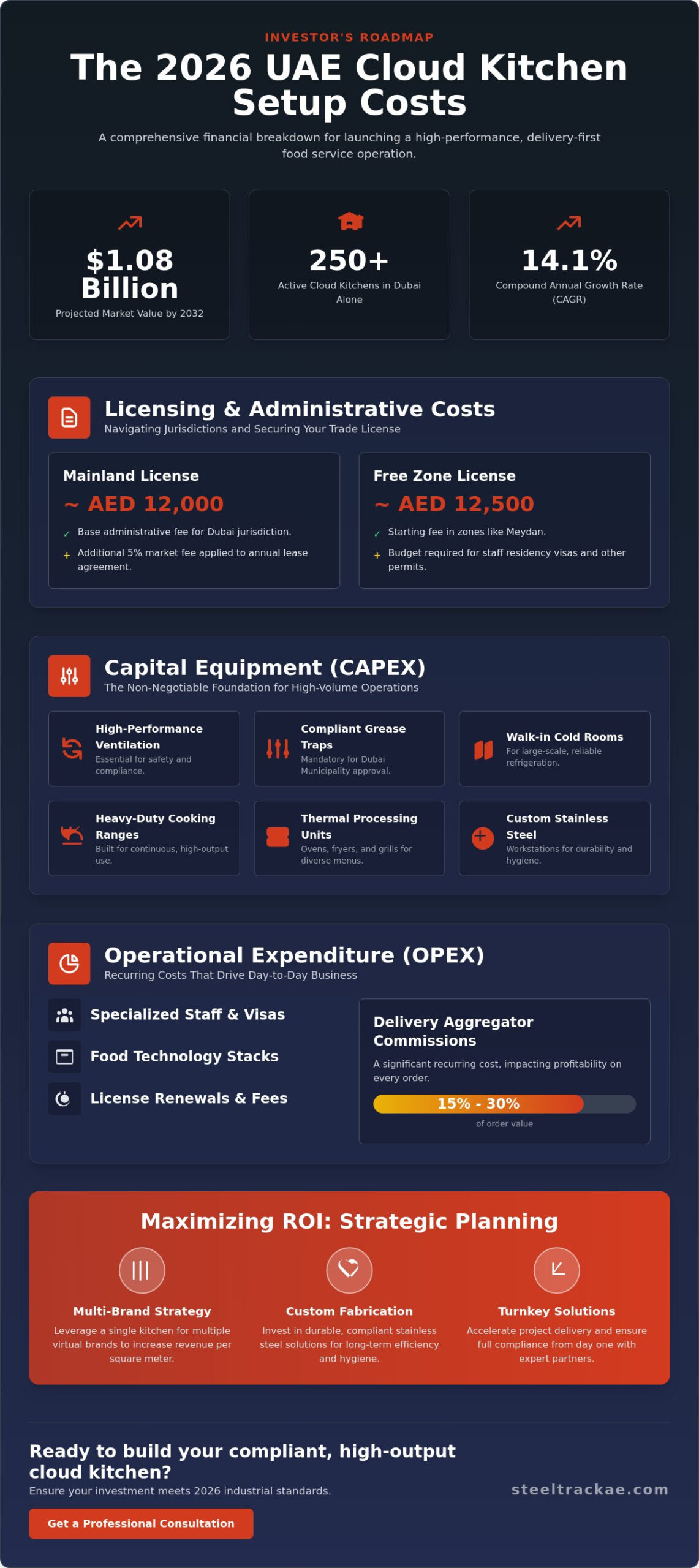
With the UAE cloud kitchen market projected to grow at a compound annual rate of 14.1 percent to reach $1.08 billion by 2032, the transition toward delivery-first models has become a cornerstone of regional food service strategy. There are already between 200 and 250 active cloud kitchens in Dubai alone; however, many operators find that the initial cloud kitchen setup cost UAE involves far more than just trade license fees. While a mainland license may start at approximately AED 12,000, the true capital requirement is often dictated by the technical complexity and the industrial standards of the facility itself.
You likely understand that while eliminating front-of-house expenses offers a clear advantage, the pressure on your back-of-house infrastructure is significantly intensified. This article provides an authoritative roadmap for your 2026 capital expenditure, detailing the essential investments in industrial-grade equipment and municipality-compliant fabrication. We will examine the specific costs associated with high-performance ventilation, grease traps, and durable thermal processing units that ensure your facility passes every inspection and maintains a high-volume output without the risk of mechanical failure or unexpected operational downtime.
Key Takeaways
- Analyze the 2026 administrative landscape to determine the most cost-effective trade license jurisdiction between mainland and free zone options for your specific business model.
- Identify the critical infrastructure investments, such as compliant ventilation systems and grease traps, that define the realistic cloud kitchen setup cost UAE for industrial-grade operations.
- Evaluate technical specifications for essential thermal and refrigeration equipment, including walk-in cold rooms and heavy-duty cooking ranges, to ensure full compliance with Dubai Municipality standards.
- Develop a comprehensive understanding of operational expenditures, spanning specialized staff recruitment, visa allocations, and the integration of sophisticated food technology stacks.
- Explore the strategic advantages of turnkey kitchen solutions and custom stainless steel fabrication in accelerating project delivery and maximizing long-term return on investment.
Understanding the Cloud Kitchen Financial Landscape in the UAE
The cloud kitchen model represents a strategic pivot from high-rent retail to high-efficiency industrial production. This transition is fueled by the UAE’s position as a global leader in food delivery penetration, where consumer demand for digital-first dining experiences continues to accelerate. By 2026, the industry has matured into a tech-driven ecosystem designed for high-throughput operations that prioritize logistical precision over physical storefront presence. For investors, calculating the cloud kitchen setup cost UAE requires a methodical approach to capital expenditure (CAPEX), balancing the initial acquisition of industrial assets against recurring operational expenses (OPEX). While the removal of front-of-house overhead reduces total square footage requirements, the demand for high-performance fabrication and thermal processing equipment remains a non-negotiable factor for long-term stability.
The financial viability of a delivery-only facility depends on its ability to maintain peak operational efficiency without the interruptions caused by equipment failure. CAPEX typically encompasses the procurement of specialized industrial assets, including walk-in cold rooms, heavy-duty cooking ranges, and custom stainless steel workstations. In contrast, OPEX is dominated by trade license renewals, staff salaries, and aggregator commissions. In a market where the UAE cloud kitchen sector is projected to reach USD 1.08 billion by 2032, maintaining a focus on technical excellence is vital. Attempting to reduce initial costs by selecting substandard equipment often results in higher long-term maintenance fees and potential non-compliance with municipality standards, which can jeopardize the entire investment.
The Strategic Shift to Virtual Brands
Modern operators are increasingly adopting a multi-brand strategy to maximize the utility of their licensed facilities. By leveraging a single infrastructure to support several virtual concepts, businesses can achieve significant real estate optimization, effectively increasing the revenue output per square meter. Understanding the Cloud Kitchen Model involves recognizing that these facilities are industrial hubs rather than traditional eateries. This approach allows operators to mitigate the impact of delivery platform commission structures, which typically range from 15% to 30% of order value, by distributing fixed costs across a broader portfolio of brands. It’s a systematic way to ensure that every square centimeter of the kitchen contributes to the bottom line.
Key Financial Drivers in the UAE Market
Strategic location selection plays a vital role in determining the overall cloud kitchen setup cost UAE. Unlike traditional restaurants that require prime, high-visibility retail space, cloud kitchens can operate from industrial zones where rents are more sustainable. Investment tiers generally fall into two categories: boutique startups, which may utilize shared kitchen spaces to lower initial barriers, and industrial production units, which require comprehensive custom fabrication and dedicated cold chain infrastructure. For those seeking large-scale success, investing in professional kitchen solutions and fabrication services ensures that the facility meets the rigorous technical standards required for 2026 compliance while providing a durable foundation for rapid scaling.
Licensing, Permits, and Administrative Expenditure
Securing a trade license is the primary administrative milestone for any food service operator, yet the total cloud kitchen setup cost UAE is significantly influenced by the chosen jurisdiction and the subsequent technical approvals. For 2026, a standard cloud kitchen trade license in Dubai ranges between AED 10,000 and AED 28,000, depending on the specific activity and location. While mainland licenses typically require an investment of approximately AED 12,000, free zones such as Meydan offer starting points around AED 12,500. It’s vital to recognize that these figures represent only the base administrative fee. Comprehensive budgeting must also account for the 5% market fee applied to the annual lease agreement and the cost of staff residency visas, which generally range from AED 3,750 to AED 5,000 per person.
Jurisdictional Cost Variations
The choice between mainland and free zone jurisdictions dictates both your initial expenditure and your long-term operational reach. Mainland licensing allows for unrestricted delivery across the Emirates, making it the preferred choice for high-volume brands targeting a wide demographic. Free zones offer 100% corporate ownership and streamlined tax registration, which appeals to international entities and tech-driven startups. Beyond the license, you must calculate hidden administrative costs such as Ejari registration fees and professional service fees for corporate structuring. These elements form the foundation of your regulatory framework, ensuring that your business remains compliant with the Department of Economy and Tourism (DET) and the Dubai Municipality Food Safety Department.
Technical Approval and Site Inspections
Obtaining government approval for your facility requires precise technical drawings that meet the UAE’s 2026 fire safety and environmental codes. Civil Defence and Municipality inspections are rigorous; they focus on the integration of safety systems and industrial hygiene. A common financial risk involves failing these inspections due to the installation of non-compliant hardware. For example, utilizing substandard grease traps or inadequately fabricated exhaust hoods can lead to immediate rejection, resulting in costly retrofitting and operational delays. Ensuring your layout adheres to HACCP standards is not merely a legal requirement; it’s a strategic investment in operational continuity.
To mitigate these risks, many operators partner with STEELTRACK KITCHEN EQUIPMENT IND LLC for professional installation and design support that aligns with municipality standards. Investing in high-quality stainless steel floor gratings and robust grease traps during the initial build ensures that your facility passes inspections on the first attempt. If you require expert guidance on navigating these technical requirements to protect your investment, consider reaching out for a professional consultation on compliant kitchen fabrication.
Capital Equipment and Industrial Infrastructure Costs
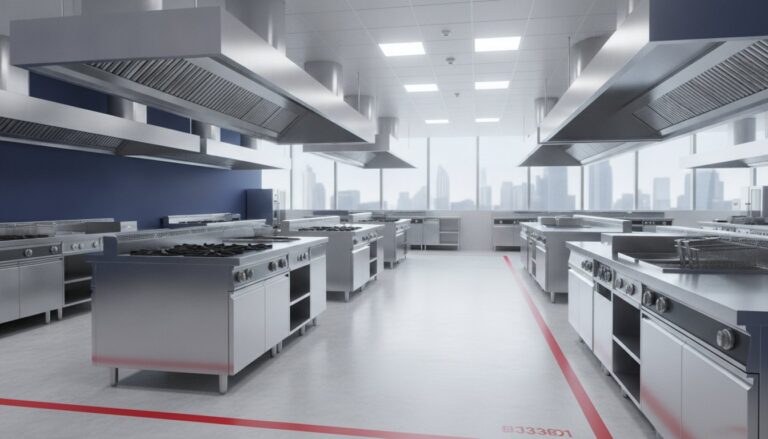
While licensing provides the legal framework for operation, the physical infrastructure of the facility represents the most significant portion of the cloud kitchen setup cost UAE. Investing in industrial-grade hardware isn’t merely a matter of operational preference; it’s a technical necessity to meet the high-throughput demands of the 2026 delivery market. Unlike traditional restaurants where equipment might face intermittent use, a cloud kitchen’s thermal processing units and refrigeration systems often run at peak capacity for eighteen hours a day. This relentless operational stress requires a meticulous selection of durable assets that minimize the risk of mechanical failure and subsequent revenue loss.
Thermal processing stands as the core of your production line. Selecting high-performance heavy duty cooking ranges and precision combi ovens ensures consistent food quality at scale. These units must be complemented by a robust industrial ventilation system. High-capacity stainless steel exhaust hoods are essential for maintaining air quality and managing the intense heat generated by multiple cooking stations. Without a properly engineered extraction system, kitchens risk failing municipality safety inspections and compromising the health of their technical staff.
High-Throughput Cooking and Baking Hardware
The choice between gas-powered cooking ranges and precision electric combi ovens often depends on the specific culinary requirements of your virtual brands. High-volume delivery environments frequently rely on specialized hardware such as deep fryers and pizza ovens to maintain speed-of-service targets. While the initial capital outlay for industrial-grade equipment is higher than domestic or light-commercial alternatives, the long-term return on investment is realized through reduced maintenance expenditure and superior energy efficiency. Durable hardware doesn’t just cook food; it protects your operational continuity.
Stainless Steel Solutions and Hygiene Infrastructure
Custom stainless steel fabrication is the backbone of a compliant and ergonomic kitchen layout. Food-grade work tables, sinks, and wall shelves must be specified to maximize the utility of every square meter. 304-grade stainless steel remains the industry standard for durability in high-salinity UAE environments because its superior corrosion resistance ensures a hygienic and long-lasting surface under intense operational stress. This material choice is vital for passing the strict hygiene audits conducted by regional authorities.
Beyond the visible work surfaces, the hygiene infrastructure must include technical components that manage waste effectively. Stainless steel grease traps and floor gratings are mandatory requirements for 2026 municipality compliance. These elements prevent the accumulation of debris and fats in the drainage system, which is a common cause of inspection failures in poorly designed facilities. By integrating these solutions during the initial fabrication phase, operators can avoid the prohibitive costs of retrofitting and ensure their facility remains an asset rather than a liability.
Operational Expenditure: Staffing, Tech, and Marketing
While the initial cloud kitchen setup cost UAE covers the physical and regulatory foundation, long-term profitability is dictated by the efficiency of ongoing operational expenditure. OPEX in 2026 is a complex interplay between human capital, technical integration, and market positioning. Unlike traditional restaurants, cloud kitchens operate with high utility demands and tight logistical windows. Managing these costs requires a systematic approach to resource allocation, ensuring that every dirham spent on staff or software contributes directly to order throughput. A methodical plan for recurring costs is what separates a sustainable industrial operation from a short-term venture.
Utility consumption represents a substantial recurring cost that operators often underestimate. Industrial-grade refrigeration units, walk-in cold rooms, and high-capacity cooking ranges consume significant electricity and water to maintain peak performance. Implementing a methodical maintenance schedule for these assets is essential; it prevents the efficiency drops that lead to inflated utility bills and protects the equipment from premature wear. In the high-salinity environment of the UAE, technical rigor in maintenance isn’t just an option, it’s a financial necessity for protecting your capital assets.
Staffing and Workforce Management
Recruiting specialized kitchen staff involves significant administrative investment, including residency visa costs which typically range from AED 3,750 to AED 5,000 per person. In a delivery-only model, the ratio of head chefs to line cooks is often leaner than in traditional dining, focusing on technical precision and speed rather than front-of-house service. Mandatory health certifications and insurance are non-negotiable regulatory requirements that add to the monthly payroll burden. Kitchen ergonomics also play a vital role here. A well-designed layout using custom stainless steel work tables reduces physical strain, which directly improves staff retention and productivity in high-pressure environments.
Technology Integration and Platform Fees
The food tech stack is the central nervous system of a virtual brand. Operators must budget for subscription-based kitchen display systems (KDS) and point-of-sale (POS) software that integrate seamlessly with third-party delivery platforms. Commission rates from major UAE aggregators remain a significant factor, typically consuming 20% to 30% of gross order value. To mitigate this, sophisticated operators invest in data analytics software to optimize menu performance and minimize food waste. This data-driven approach allows for precise inventory management, ensuring that raw material costs remain aligned with actual demand patterns. It’s about using technology to reclaim margins that aggregator commissions often erode.
Optimizing your operational efficiency begins with a facility designed for professional rigor and industrial endurance. If you’re ready to engineer a kitchen that balances technical excellence with cost-effective production, contact our industrial fabrication experts for a detailed consultation on your facility requirements.
Maximizing ROI: Strategic Planning and Turnkey Solutions
The ultimate metric for assessing the cloud kitchen setup cost UAE is the speed and sustainability of the return on investment. Strategic planning in 2026 requires moving beyond simple equipment procurement toward a holistic turnkey approach. By opting for integrated solutions, operators can significantly accelerate their time-to-market, ensuring that the facility is revenue-ready within weeks rather than months. Turnkey solutions eliminate the fragmented procurement process, ensuring that every industrial asset, from walk-in cold rooms to high-performance cooking ranges, is integrated into a workflow that meets both operational requirements and municipality safety standards from day one.
Preventative maintenance is the primary defense against capital depreciation in a high-utilization environment. Regular servicing of refrigeration units, combi ovens, and ventilation systems protects your initial investment by preventing the mechanical failures that cause expensive downtime. In the UAE’s demanding climate, a methodical maintenance schedule isn’t just a recommendation; it’s a technical requirement for ensuring that your equipment operates at peak energy efficiency. This proactive approach reduces the long-term utility burden and extends the operational lifespan of your industrial assets, ensuring the facility remains a high-performance asset for years to come.
The ROI of High-Quality Fabrication
Selecting custom fabrication over off-the-shelf alternatives offers a superior operational fit that directly impacts your bottom line. While the initial cloud kitchen setup cost UAE may be higher for bespoke stainless steel furniture, the reduction in replacement cycles provides a clear financial advantage. Durable work tables, sinks, and wall shelves fabricated from high-grade materials resist the rigors of industrial cleaning and heavy use. Establishing a strategic partnership with an established manufacturer like STEELTRACK KITCHEN EQUIPMENT IND LLC ensures that your facility is built with the precision required for large-scale commercial success, providing a stable foundation for modular expansion across the Emirates.
Finalizing Your Cloud Kitchen Strategy
Before commencing full-scale operations, a comprehensive final site inspection and equipment commissioning process are vital. This phase ensures that all thermal units, ice machines, and hood-type dishwashers are calibrated for maximum efficiency and safety. Operators must also secure long-term support for their industrial warewashing and laundry equipment to maintain hygiene standards without interruption. A well-executed commissioning phase prevents the “hidden costs” associated with poor hardware performance and inspection failures, which often plague less methodical setups. Precision in the final stages of development is what transforms a technical layout into a high-performance production hub.
Engineering a facility that balances high-throughput capacity with regulatory compliance requires deep-seated technical skill. To ensure your project meets the highest industrial standards, consult with STEELTRACK KITCHEN EQUIPMENT IND LLC for a custom turnkey kitchen solution that prioritizes durability, efficiency, and long-term profitability.
Engineering Your Industrial Future in the UAE Food Sector
Establishing a cloud kitchen in 2026 requires a methodical approach to capital deployment that balances administrative fees with high-performance infrastructure. While the cloud kitchen setup cost UAE involves significant initial expenditure, the strategic selection of durable assets ensures long-term profitability and operational continuity. Success depends on moving beyond surface-level compliance to embrace the technical rigor required by modern industrial standards. By prioritizing industrial-grade fabrication and thermal precision, operators can mitigate the financial risks associated with mechanical failure and inspection delays.
Our position as a specialized manufacturer of high-performance cooking ranges and ovens allows us to provide the technical expertise necessary for regional leadership. We offer expert custom stainless steel fabrication for UAE compliance and comprehensive turnkey industrial kitchen and laundry solutions designed for high-volume environments. If you’re ready to build a facility that reflects your commitment to excellence and precision, Request a Custom Quote for Your Cloud Kitchen Setup today. The path to regional market leadership is clear for those who value technical mastery and methodical progress.
Frequently Asked Questions
How much does a cloud kitchen license cost in the UAE for 2026?
A cloud kitchen trade license in the UAE for 2026 typically costs between AED 10,000 and AED 28,000, depending on the chosen jurisdiction and specific business activities. Mainland licenses in Dubai are approximately AED 12,000, while free zone options such as Meydan start at AED 12,500. These figures represent the base administrative fees and don’t include the 5% market fee applied to the annual lease agreement or staff visa costs.
Is it better to open a cloud kitchen in a Free Zone or Mainland?
The decision between Mainland and Free Zone depends on your target delivery radius and ownership preferences. Mainland licenses allow for unrestricted delivery across all Emirates, which is essential for high-volume virtual brands seeking maximum market penetration. Conversely, Free Zones provide 100% corporate ownership and streamlined tax registration, making them a suitable choice for tech-focused startups or international entities centralized in specific industrial hubs.
What are the mandatory equipment requirements for a UAE food license?
Mandatory equipment for a UAE food license includes industrial-grade thermal processing units, robust refrigeration systems, and compliant hygiene infrastructure. Specifically, the Dubai Municipality requires approved stainless steel exhaust hoods, grease traps, and floor gratings to ensure environmental safety and waste management. These assets must be integrated into a layout that adheres to HACCP standards for food safety and industrial hygiene to pass official inspections.
Can I start a cloud kitchen from a residential property in the UAE?
No, you cannot operate a cloud kitchen from a residential property in the UAE. Regulatory authorities require all food production facilities to be located within designated commercial or industrial zones. These sites must possess a valid Ejari and meet strict technical requirements for ventilation, waste management, and fire safety that residential structures aren’t designed to support. Violating these zoning laws results in significant fines and immediate closure.
How long does it take to get all the necessary approvals for a cloud kitchen?
Obtaining all necessary approvals for a cloud kitchen generally takes between four and eight weeks. This timeline includes securing initial trade name approval, finalizing a compliant lease agreement, and receiving technical drawing approvals from the Dubai Municipality and Civil Defence. The total duration often depends on the precision of your kitchen layout and the speed at which your industrial fabrication meets the required government safety standards.
What is the average monthly operating cost for a delivery-only kitchen?
Monthly operating costs for a delivery-only kitchen vary based on the facility’s scale and production volume. Rent for dedicated industrial units typically starts between AED 12,000 and AED 30,000, while staff salaries for specialized personnel range from AED 5,000 to AED 15,000. These expenses are a core part of the cloud kitchen setup cost UAE, compounded by delivery platform commissions which often consume 20% to 30% of total order value.
Why is a custom exhaust hood system necessary for UAE compliance?
A custom exhaust hood system is a technical necessity for UAE compliance because it ensures the safe extraction of heat, grease, and smoke in high-throughput environments. Dubai Municipality and Civil Defence standards require these systems to meet specific fire safety and air quality codes. Properly engineered ventilation prevents the accumulation of combustible residues, protecting the facility from fire hazards and ensuring a safe working environment for your technical staff.
How does stainless steel fabrication quality affect municipality inspections?
The quality of stainless steel fabrication directly influences the outcome of municipality inspections by determining the facility’s hygiene and durability standards. High-grade 304 stainless steel is the industry standard for its superior corrosion resistance in the UAE’s high-salinity environment. Utilizing substandard materials often leads to inspection failures due to surface degradation or the inability to maintain a sterile production environment under the intense stress of industrial operations.