
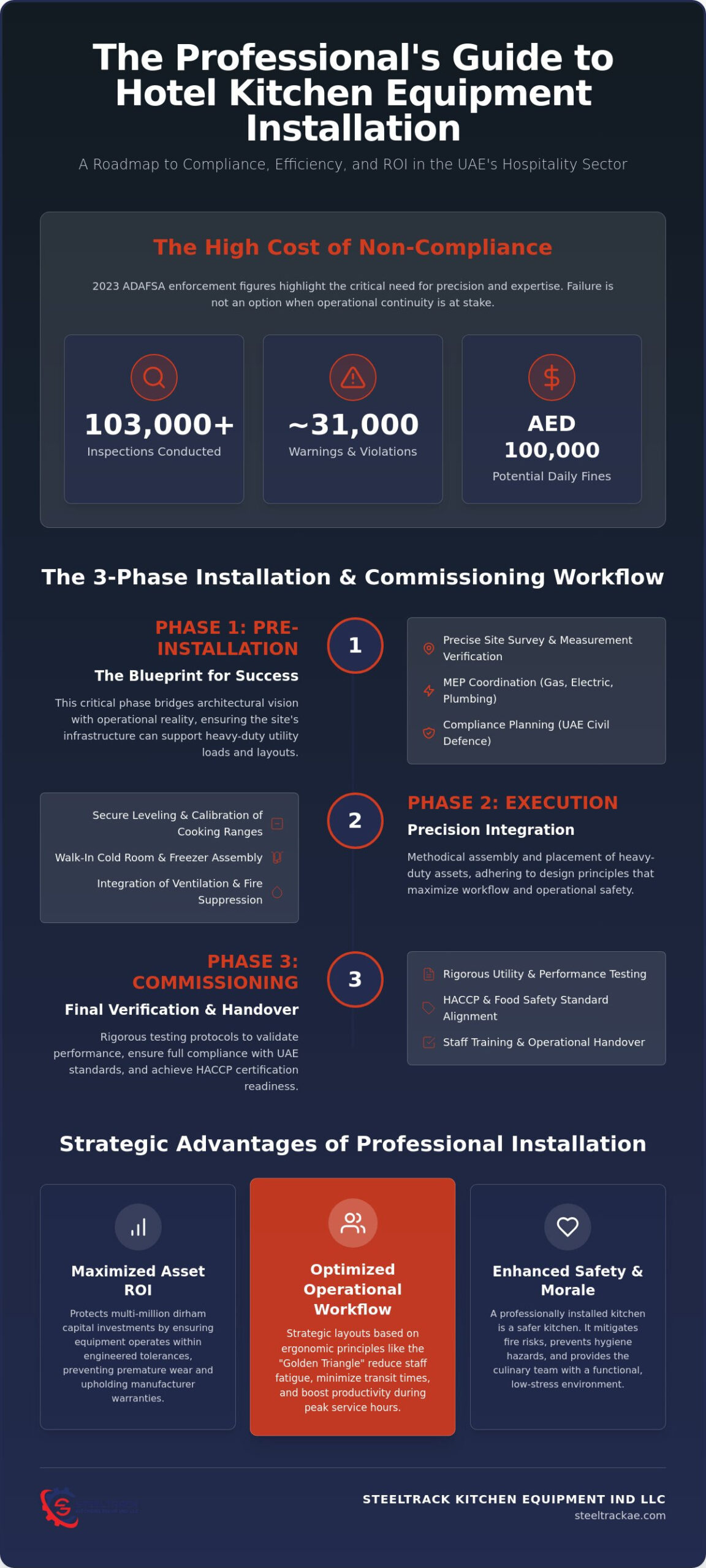
In 2023, the Abu Dhabi Agriculture and Food Safety Authority (ADAFSA) conducted over 103,000 inspections, resulting in nearly 28,000 warnings and 3,391 violations. For hospitality leaders, these figures underscore the immense pressure of maintaining regulatory standards while managing complex MEP coordination and high-volume service demands. A successful hotel kitchen equipment installation is not merely a procurement task. It’s a high-stakes engineering endeavor where technical precision determines operational longevity and safety.
We understand that project overruns and non-compliance fines, which can reach AED 100,000 per day in certain jurisdictions, are unacceptable risks for established brands. This guide provides a professional roadmap to executing seamless, compliant, and high-performance kitchen installations for large-scale hotel operations in the UAE. We’ll examine critical compliance requirements from the UAE Civil Defence and Dubai Municipality, the necessity of T3-rated refrigeration for high-ambient environments, and the systematic workflows required to ensure HACCP-certified excellence.
Key Takeaways
- Understand why systematic integration is essential for maximizing the operational lifespan and long-term ROI of your industrial kitchen assets.
- Learn the critical steps for conducting precise site surveys and MEP coordination to ensure your infrastructure can support heavy-duty utility loads.
- Discover a methodical approach to hotel kitchen equipment installation that covers everything from cold room assembly to the secure leveling of advanced cooking ranges.
- Identify the rigorous testing protocols required during the commissioning phase to achieve full compliance with UAE industrial standards and HACCP regulations.
- Explore the strategic benefits of leveraging factory-direct custom stainless steel fabrication to create bespoke layouts that optimize workflow and staff efficiency.
The Strategic Importance of Professional Hotel Kitchen Equipment Installation
Professional hotel kitchen equipment installation is defined as the methodical integration of heavy-duty cooking, refrigeration, and ventilation assets into a purpose-built, compliant infrastructure. It’s far more than the simple placement of machinery; it’s a precise engineering discipline that aligns architectural intent with operational reality. When executed correctly, this process secures the long-term return on investment (ROI) by ensuring every asset functions within its engineered tolerances. Conversely, an amateur setup often leads to chronic energy inefficiency, safety hazards that jeopardize staff well-being, and the immediate voiding of manufacturer warranties. Successful hospitality developers have moved beyond a vendor mindset, instead engaging with a strategic technical partner who views the kitchen as a unified, high-performance engine.
The transition from procurement to partnership is vital for managing the complexities of modern hotel builds. A strategic partner doesn’t just deliver a crate; they oversee the technical synchronization of gas, electrical, and water systems. This level of oversight prevents the common pitfalls of project overruns. It ensures that when the first guest checks in, the back-of-house operations are already stabilized and capable of meeting the rigorous demands of a 24/7 service environment.
Protecting Your Capital Investment
Industrial installation serves as a comprehensive safeguard for multi-million dirham hospitality assets. Precision matters at the most granular level; for example, heavy-duty cooking ranges require exact leveling and rigorous gas pressure calibration to prevent uneven heating and structural fatigue. Inaccurate setup often places undue stress on sensitive components, causing premature wear on combi oven gaskets and heating elements. By adhering to strict engineering protocols, operators ensure their specialized kitchen services and equipment remain operational for their intended lifecycle. This methodical approach protects the manufacturer’s warranty and reduces the frequency of emergency repairs during peak seasons.
Operational Efficiency and Workflow Design
The physical layout of a kitchen is the primary driver of staff productivity and safety. Professional installation ensures that equipment placement adheres to fundamental commercial kitchen design principles, specifically the ergonomic “Golden Triangle” that connects storage, preparation, and cooking zones. By strategically positioning walk-in cold rooms, stainless steel work tables, and cooking lines, developers can significantly reduce staff fatigue and transit times. In 5-star hotel environments, where high-volume throughput is the standard, this technical precision is what separates a chaotic service from a seamless operation. Every millimeter of space is optimized to facilitate a unidirectional flow that meets both HACCP standards and peak demand requirements. This systematic placement doesn’t just improve speed; it enhances the overall safety and morale of the culinary team.
The Pre-Installation Phase: Technical Layout and MEP Coordination
The pre-installation phase serves as the critical bridge between architectural vision and operational reality. A successful hotel kitchen equipment installation relies on a comprehensive site survey that verifies theoretical drawings against the physical environment. Discrepancies in wall measurements or ceiling heights can derail a project if they aren’t identified before heavy-duty assets arrive on-site. This stage requires a meticulous assessment of gas line capacities and electrical load schedules to ensure the facility can support high-capacity assets like Combi Ovens and industrial Cooking Ranges without compromising safety or performance.
Mechanical, Electrical, and Plumbing (MEP) coordination is the cornerstone of industrial kitchen readiness. It’s not just about the availability of utilities; it’s about ensuring the infrastructure can handle simultaneous peak loads. Drainage design is particularly sensitive, as floor gratings and grease traps must align perfectly with equipment discharge points to prevent hygiene risks. Furthermore, coordinating with UAE Civil Defence is essential to ensure that fire suppression systems within stainless steel exhaust hoods are fully compliant with the UAE Fire and Life Safety Code of Practice. This alignment prevents costly retrofitting and ensures the facility passes its final inspections without delay.
Mechanical and Electrical (MEP) Readiness
Achieving technical readiness follows a systematic three-step protocol. First, engineers must verify that the electrical infrastructure supports the specific phase requirements of high-capacity Combi Ovens and hood-type dishwashers. Second, gas pressure regulators require calibration to match the precise input needs of industrial ranges. Finally, water filtration systems must be operational prior to connecting any steam-generating equipment. This methodical preparation ensures that your hotel kitchen equipment installation proceeds without technical bottlenecks. If you’re currently reviewing your technical drawings, our team can provide a detailed technical consultation to ensure your site is fully prepared for installation.
Spatial Planning and Fabrication Integration
Spatial planning involves more than just fitting equipment into a room; it requires mapping the footprint of custom stainless steel work tables and sinks to ensure a unidirectional workflow. Adequate clearance is essential for the installation of walk-in cold room panels and ventilation hoods. Engineers must also designate maintenance access zones around refrigeration compressors and boiler units to facilitate future servicing. By integrating professional fabrication services early in the planning phase, hotel operators can account for every millimeter of space, reducing staff transit times and maximizing high-volume throughput in 5-star environments.
Executing the Installation: Integrating Heavy-Duty Assets and Laundry Systems
The execution phase transforms a technical layout into a functioning operational engine. A successful hotel kitchen equipment installation requires a manufacturer’s insight into how disparate mechanical systems interact within a high-stress environment. This process begins with the methodical assembly of walk-in cold rooms and the secure anchoring of heavy-duty cooking ranges. Every unit must be leveled with absolute precision to ensure optimal gas combustion and fluid drainage. By adhering to UAE Commercial Kitchen Standards, engineers guarantee that the transition between the hot line, cold prep, and warewashing zones remains seamless and compliant.
Execution isn’t just about placement; it’s about the technical synchronization of utilities. When we integrate high-capacity assets, we prioritize the integrity of the connection points. This methodical approach ensures that the kitchen can handle the rigorous throughput demands of a 5-star hotel while maintaining strict safety protocols. Whether it’s a standalone pizza oven or a complex battery of cooking ranges, the focus remains on stability and performance.
Installing High-Performance Thermal Equipment
Precision mounting is vital for high-capacity combi ovens. Inadequate leveling compromises steam drainage and door seal integrity, leading to energy loss and potential equipment failure. Our installation protocols include the meticulous calibration of deep fryers and pizza ovens to ensure consistent thermal distribution across all cooking surfaces. For specialized assets like tilting boiling pans, we implement safety bypasses and secure connections to industrial steam or gas lines. This rigorous attention to detail prevents operational bottlenecks during peak service hours.
Refrigeration and Laundry Infrastructure
Refrigeration assets in the UAE must withstand extreme ambient temperatures. Assembling walk-in cold rooms involves airtight panel sealing and the installation of T3-rated compressors to ensure climate resilience. Industrial ice machines require dedicated drainage and high-performance filtration to prevent scale buildup. Beyond the kitchen, setting up industrial laundry systems demands structural engineering expertise. We anchor high-spin washers to reinforced flooring to mitigate vibration and ensure long-term mechanical stability.
Stainless Steel Fabrication and Ventilation
The integration of custom stainless steel fabrication with standard equipment is often where generic installations fail. We ensure that stainless steel exhaust hoods are mounted with precise alignment to the cooking lines below, maximizing smoke and heat extraction. Preparation stations, including stainless steel work tables and sinks, are secured directly to architectural wall structures to provide a stable, hygienic surface. Every installation includes the strategic placement of grease traps and floor gratings, ensuring the facility meets all Dubai Municipality hygiene requirements. For projects requiring bespoke solutions, our custom fabrication services bridge the gap between architectural drawings and operational reality.
Commissioning and Compliance: Meeting UAE Industrial Standards
The commissioning phase represents the final validation of the entire engineering process. It’s the moment where theoretical design meets operational reality. A professional hotel kitchen equipment installation is only complete when every asset has been tested under a simulated full load, ensuring that the infrastructure can sustain the intense pressures of 5-star hospitality service. In the UAE, this phase is governed by strict regulatory frameworks. Compliance with Hazard Analysis and Critical Control Points (HACCP) is a federal mandate, and our commissioning protocols are designed to ensure your hotel kitchen equipment installation meets these requirements from day one.
Beyond food safety, we prioritize the integration of fire suppression systems within exhaust hoods, strictly adhering to UAE Civil Defence codes. This systematic approach eliminates the risk of failed inspections and costly delays. We move beyond basic functionality to verify that every component, from the smallest grease trap to the largest walk-in cold room, operates at peak efficiency. Our engineers ensure that all electrical appliances are registered under the Emirates Conformity Assessment Scheme (ECAS), providing peace of mind regarding equipment safety and regional compliance.
Safety Testing and Load Calibration
Safety testing begins with rigorous pressure testing of gas lines to ensure the integrity of every connection made during the assembly phase. Engineers conduct thorough checks for electrical continuity and earthing, preventing potential hazards in high-moisture environments. We also perform precise measurements of exhaust airflow rates; this ensures that heat and smoke extraction meet the specific cubic-meter-per-hour requirements of your cooking line. Finally, we calibrate temperature sensors in walk-in cold rooms and ovens to ensure they maintain the mandatory 4°C for chilled storage and -18°C for freezers, as required by Dubai Municipality and ADAFSA standards.
Staff Training and Handover
The transition to live operations requires that your culinary and housekeeping teams are fully proficient with their new assets. We conduct hands-on demonstrations for advanced equipment, such as programming multi-stage cooking profiles into Combi Ovens and Rational units. For the laundry department, we provide specialized training on optimal cycles for high-capacity washing machines and dryers to maximize textile longevity and energy efficiency. The process concludes with the delivery of a comprehensive technical documentation pack. This includes detailed O&M manuals, warranty certificates, and as-built drawings. Secure your facility’s operational license and ensure long-term reliability by partnering with our compliance and commissioning experts for your next project.
STEELTRACK KITCHEN EQUIPMENT IND LLC: Precision Fabrication and Installation Excellence
STEELTRACK KITCHEN EQUIPMENT IND LLC operates as a strategic engineering partner for the UAE’s sophisticated hospitality sector. Our status as a domestic manufacturer provides a decisive advantage in the execution of complex projects. A professional hotel kitchen equipment installation is only as reliable as the physical components within the system. By controlling the fabrication process in our local facility, we ensure that every stainless steel work table, sink, and exhaust hood integrates perfectly with standard industrial assets. This manufacturer-led approach eliminates the common friction points between equipment procurement and on-site fit-out.
Our commitment to excellence extends to our high-performance cooking ranges and industrial refrigeration solutions. We understand that hotel operations in this region require equipment capable of withstanding extreme environmental demands. By leveraging our regional expertise, we provide assets that are engineered for durability and high-volume throughput. This ensures your back-of-house infrastructure remains a stable asset rather than a source of operational risk.
The Manufacturer’s Edge in Installation
Our fabrication expertise ensures a precise fit for every custom component. When on-site conditions deviate from architectural drawings, our local presence allows STEELTRACK KITCHEN EQUIPMENT IND LLC to adjust stainless steel assets with minimal lead time. This flexibility prevents the significant project overruns often associated with imported equipment. We design our locally manufactured units to meet the UAE’s specific environmental rigors, such as high-ambient temperatures that challenge standard refrigeration cycles. This vertical integration streamlines the hotel kitchen equipment installation process, reducing logistical bottlenecks and ensuring a faster transition to live operations.
Your Partner for Turnkey Hospitality Solutions
STEELTRACK KITCHEN EQUIPMENT IND LLC provides a single point of accountability for large-scale hotel developments across the Emirates. From initial spatial planning and MEP coordination to the final commissioning of heavy-duty assets, our team manages the entire technical lifecycle. Our extensive experience in delivering 5-star hospitality projects ensures that your facility meets all Dubai Municipality and UAE Civil Defence standards without the need for costly retrofitting. We invite you to explore our full range of professional kitchen services to understand our systematic approach to facility setup. For those currently in the procurement phase, reference our guide on the heavy-duty cooking range UAE market for comprehensive technical insights. Contact our technical team today to schedule a comprehensive site evaluation and receive a professional installation proposal tailored to your operational requirements.
Optimizing Hospitality Infrastructure for Long-Term Excellence
Success in high-volume hospitality environments depends on the seamless integration of technical precision and regulatory compliance. We’ve examined how methodical MEP coordination and rigorous load testing during the commissioning phase safeguard your capital investment and operational continuity. A professional hotel kitchen equipment installation isn’t just about the placement of hardware; it’s about building a compliant, high-performance engine that supports your culinary team’s efficiency while meeting the strict mandates of the Dubai Municipality and ADAFSA.
STEELTRACK KITCHEN EQUIPMENT IND LLC offers a definitive advantage through our UAE-based manufacturing facility and deep-seated expertise in Civil Defence and HACCP standards. Our custom stainless steel fabrication capabilities ensure that every preparation station and exhaust hood fits your bespoke layout with absolute engineering accuracy. This level of vertical integration reduces lead times and guarantees that your facility’s ready for high-capacity service on schedule. Partner with STEELTRACK KITCHEN EQUIPMENT IND LLC for your next hotel kitchen installation to ensure your project benefits from industrial-grade precision and seasoned regional leadership. We’re ready to help you build a foundation for culinary excellence.
Frequently Asked Questions
What are the first steps in planning a hotel kitchen equipment installation?
The initial phase begins with a methodical site survey and the verification of architectural drawings against the physical environment. It’s essential to secure design approvals from the Dubai Municipality or ADAFSA before any fit-out work commences. This proactive approach prevents structural discrepancies and ensures the infrastructure is engineered to support heavy-duty utility loads from the outset.
How long does a typical commercial kitchen installation take in the UAE?
While timelines vary based on project scale, a comprehensive hotel kitchen equipment installation for a 4-star or 5-star hotel typically spans eight to twelve weeks. This duration accounts for custom fabrication, MEP coordination, and the final commissioning phase. Establishing a clear project roadmap with a strategic partner helps mitigate delays associated with regulatory approvals and utility readiness.
Do I need a separate contractor for stainless steel fabrication and equipment installation?
Engaging a single strategic partner for both stainless steel fabrication and equipment installation is the most efficient approach. This vertical integration ensures that custom work tables and exhaust hoods align perfectly with industrial cooking ranges. It eliminates communication gaps between disparate vendors, resulting in a more cohesive and high-performance kitchen environment.
What UAE regulations govern the installation of commercial exhaust hoods?
Commercial exhaust hoods must comply with UAE Civil Defence codes and Dubai Municipality standards for fire safety and ventilation. These regulations mandate the integration of certified fire suppression systems and high-efficiency grease extraction. All surfaces must be constructed from non-porous materials, typically Grade 304 stainless steel, to meet mandatory hygiene and durability requirements.
Why is MEP coordination critical for hotel kitchen projects?
MEP coordination is vital because it ensures the facility’s electrical, gas, and plumbing systems can sustain simultaneous peak operational loads. High-capacity assets like combi ovens and industrial dishwashers require specific electrical phases and calibrated gas pressures. Without precise coordination, operators risk utility failures, safety hazards, and the voiding of manufacturer warranties.
What training is provided after the kitchen equipment is installed?
Comprehensive hands-on training is provided to ensure culinary and housekeeping teams operate advanced assets safely. This includes programming multi-stage cycles for combi ovens and managing industrial laundry workflows. We also deliver a complete technical documentation pack, including O&M manuals and warranty certificates, to support long-term equipment reliability.
Can industrial laundry equipment be installed by the same team as the kitchen equipment?
Yes, a technically skilled engineering team can manage the installation of both kitchen and industrial laundry systems. This involves anchoring high-spin washers to reinforced flooring and connecting steam-generating equipment to specialized utility lines. Consolidating these installations under a single partner ensures a uniform standard of engineering excellence across all back-of-house operations.
How do I ensure my kitchen installation is HACCP compliant?
Ensuring HACCP compliance requires a kitchen layout that facilitates a unidirectional workflow to prevent cross-contamination. Every hotel kitchen equipment installation must include precise temperature monitoring systems for cold rooms, maintaining 4°C for chilled food and -18°C for freezers. Strategic placement of stainless steel floor gratings and grease traps is also essential for maintaining required hygiene standards.