In the high-intensity hospitality sector of the UAE, a standard kitchen layout is no longer a strategic choice; it’s a liability that risks both regulatory non-compliance and operational failure. You’re likely aware that the relentless humidity of the region and the strict 2026 national regulatory standards demand infrastructure that performs under pressure. Specifying custom commercial cooking ranges Dubai that meet national approval standards is the only way to avoid failing an inspection due to poor fabrication or equipment that doesn’t meet the 150 mm floor clearance mandate.
We’ll show you how precision-engineered fabrication guarantees full HACCP compliance and provides an operational lifespan of over a decade. This guide explores the technical superiority of Grade 304 stainless steel, the
Key Takeaways
- Evaluate the strategic shift from modular units to bespoke solutions to maximize commercial real estate ROI and operational efficiency in high-demand UAE kitchens.
- Identify why Grade 304 and 316 stainless steel are the mandatory specifications for custom commercial cooking ranges Dubai operators utilize to resist oxidation in extreme ambient heat.
- Master the technical requirements for HACCP and Dubai Municipality inspections, focusing on zero-radius hygiene engineering and integrated fire suppression systems.
- Gain insight into the precision fabrication lifecycle, utilizing CAD technical drawings and CNC laser processing to ensure exact dimensional accuracy for unique floor plans.
- Understand how turnkey procurement models consolidate design and installation to mitigate project risk and significantly reduce long-term maintenance costs.
Custom Commercial Cooking Ranges Dubai: Engineering for High-Performance Environments
Custom stainless steel fabrication represents far more than the assembly of kitchen hardware; it’s the systematic integration of precision engineering with the specific operational demands of a facility. In the high-velocity environment of Dubai’s hospitality sector, generic equipment often falls short of the rigorous performance benchmarks required by 4-star and 5-star establishments. Choosing custom commercial cooking ranges Dubai professionals trust ensures that every millimeter of the kitchen footprint is utilized effectively, directly impacting the return on investment for high-value commercial real estate.
Standardized, off-the-shelf units frequently fail in the UAE’s industrial settings because they aren’t designed to withstand the combination of extreme ambient humidity and the relentless throughput of high-volume catering. When equipment isn’t built to precise specifications, gaps in workflow and structural weaknesses become points of failure. Heavy-duty fabrication provides the structural integrity needed to support massive industrial cooking ranges and high-capacity ventilation systems that must run 24/7 without compromise. This methodical approach to manufacturing ensures that the infrastructure supports the chef’s vision rather than restricting it.
Bespoke vs. Modular: The Strategic Choice
The decision between modular units and bespoke solutions is a strategic procurement move that influences long-term overheads. While modular kitchens offer a lower initial entry cost, they often lead to wasted floor space and inefficient workflows in complex layouts. Custom-sized work tables and sinks allow for a seamless fit into existing architecture, eliminating “dead zones” where debris can accumulate. For large-scale UAE catering operations, this level of optimization reduces labor fatigue and speeds up service delivery. Investing in custom-built durability prevents the cycle of frequent modular replacement, ensuring the infrastructure remains robust for over a decade.
Key Components of Industrial Fabrication
A truly integrated kitchen relies on the synergy between various fabricated elements. High-performance services in this sector focus on aligning thermal efficiency with architectural constraints. This requires a deep understanding of material properties and industrial standards.
- Integrated Exhaust Hoods: These units are custom-designed to match specific custom commercial cooking ranges Dubai installations, ensuring optimal grease extraction and heat management according to UAE Fire & Life Safety Codes.
- Heavy-Duty Preparation Stations: Stainless steel work tables are engineered with the correct stainless steel grades to handle high-load capacities and ergonomic prep requirements without warping or pitting.
- Sanitary Drainage and Floor Grating: Bespoke drainage solutions and floor grating are essential for maintaining hygiene in wet-area kitchens, preventing water stagnation and meeting strict Dubai Municipality health standards.
By consolidating these components into a unified, custom-fabricated system, operators can ensure their facility meets the highest standards of safety and operational excellence.
Material Science: Selecting Stainless Steel Grades for the UAE Climate
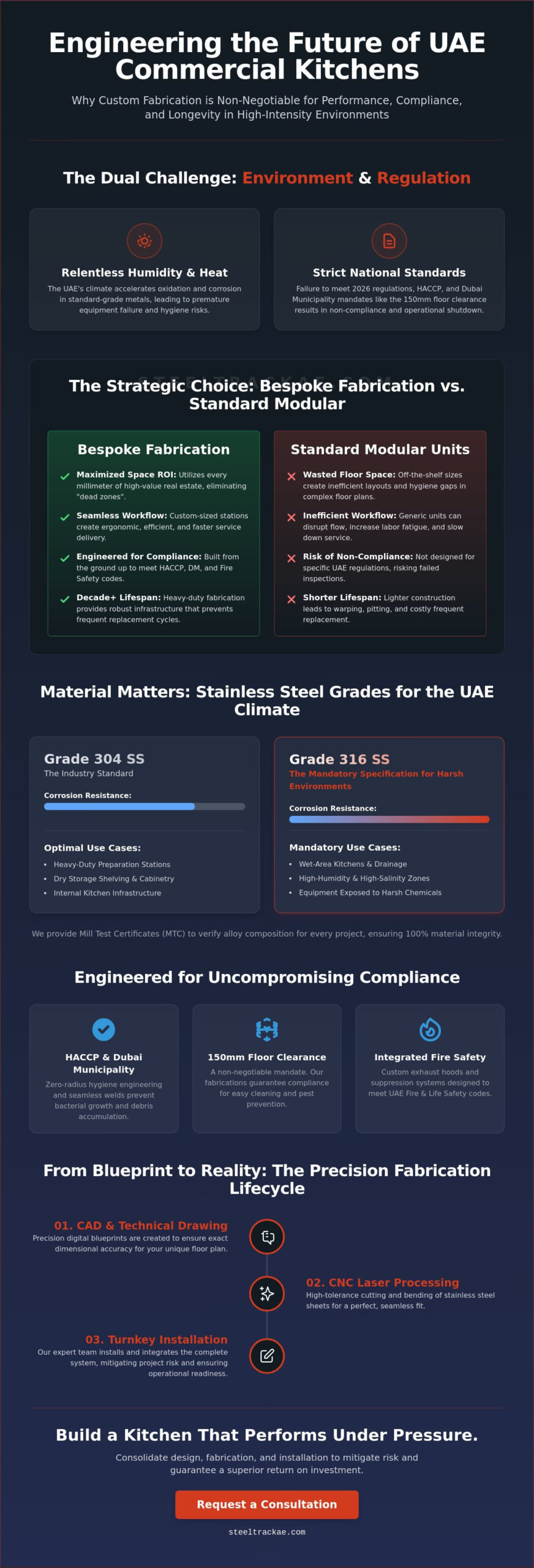
The technical integrity of a commercial kitchen in the Emirates depends entirely on the material’s ability to resist environmental degradation. Dubai’s unique climate, characterized by high ambient temperatures and humidity levels that frequently peak during summer months, accelerates oxidation in sub-standard alloys. For the procurement of custom commercial cooking ranges Dubai facilities require, understanding the chemical nuances between stainless steel grades is a prerequisite for operational longevity. We prioritize the provision of Mill Test Certificates (MTC) for every project; these documents provide verified proof of the alloy’s chemical composition, ensuring the material meets international B2B standards before the fabrication process commences.
SS 304: The Industry Standard for Dry and Prep Areas
Grade 304 serves as the primary choice for the majority of internal kitchen infrastructure, including work tables, shelving, and cabinetry. It offers a sophisticated balance of tensile strength and corrosion resistance, making it ideal for preparation areas where moisture is managed. However, its performance relies on the preservation of its passive chromium oxide layer. Maintaining this barrier requires strict adherence to non-abrasive cleaning protocols, especially in high-volume industrial settings where chemical exposure is frequent. It’s the most cost-effective solution for environments that don’t face direct exposure to high-salinity air or extreme chemical cleaners.
SS 316: Solving for High-Salinity and Extreme Moisture
In specialized applications such as walk-in cold rooms or facilities located in high-salinity coastal zones, Grade 316 is the required industrial standard. The inclusion of Molybdenum in its composition provides enhanced resistance to pitting and crevice corrosion. While Grade 316 carries a higher initial cost, its use is technically justified in environments where constant moisture or salt exposure would cause Grade 304 to fail prematurely. This grade is essential for high-capacity industrial fabrication services that prioritize a 10+ year lifespan in demanding UAE conditions.
Beyond the alloy itself, the surface finish dictates the ease of hygiene maintenance. Brushed finishes (No. 4) are often preferred for their ability to mask minor abrasions in high-traffic zones, whereas mirror finishes offer a smoother surface that eliminates microscopic bacteria traps. Selecting the correct finish is a critical step in aligning with HACCP and UAE Standards. If you’re currently specifying materials for a new facility, you can consult our engineering team to ensure your selection matches your specific environmental risk profile.
Compliance and Hygiene: Engineering for HACCP and UAE Standards
Achieving operational status in the UAE requires more than just functional equipment; it demands a rigorous adherence to the Dubai Food Code and Civil Defense regulations. The quality of fabrication is the primary factor that determines whether a facility passes municipality inspections or faces costly delays. Engineering for “Zero-Radius” hygiene is a central pillar of our methodology. This involves eliminating bacteria traps in welded joints and internal corners where microscopic pathogens often accumulate. By prioritizing these technical details during the design of custom commercial cooking ranges Dubai inspectors verify, operators ensure their infrastructure supports a safe, compliant environment from day one.
High-quality TIG (Tungsten Inert Gas) welding is non-negotiable for maintaining food-grade surface integrity. Unlike standard welding techniques that may leave porous residues or uneven beads, TIG welding provides a seamless, high-strength bond that can be ground and polished to a mirror finish. This level of precision prevents the formation of crevices where organic matter can lodge. It’s a methodical process that reflects a commitment to industrial excellence and regional leadership in technical engineering. When joints are perfectly fused and polished, the risk of biofilm development is virtually eliminated, which is critical for passing high-frequency health audits.
HACCP-Compliant Design Features
Integrating Hazard Analysis and Critical Control Points (HACCP) principles into the physical design of prep tables and sinks is essential for modern food safety. We utilize coved corners and marine edges to engineer out contamination risks. Coved corners replace sharp 90-degree angles with smooth, curved transitions that are significantly easier to sanitize. Marine edges, or raised perimeters, prevent liquid runoff from reaching the floor, maintaining a dry and safe workspace. These non-porous surfaces are vital for industrial food processing stations where cross-contamination must be strictly mitigated. Every sink bowl and preparation surface is fabricated with seamless welding to ensure no hidden gaps exist.
Ventilation and Safety Compliance
Safety compliance extends beyond the cooking surface to the air management systems above. Engineering custom exhaust hoods to meet UAE Civil Defense fire safety regulations is a complex task that requires precise airflow optimization. These systems must balance extraction power with makeup air requirements to prevent negative pressure zones that can compromise kitchen safety. In accordance with the UAE Fire & Life Safety Code, all Type I hoods over custom commercial cooking ranges Dubai installations must feature automatic wet-chemical fire suppression systems. You can view our comprehensive kitchen services for integrated ventilation solutions that align with these strict safety protocols. This systematic approach ensures that high-capacity kitchens remain both productive and secure under demanding conditions.
The Fabrication Process: From Technical Drawing to Precision Installation
The transition from a conceptual kitchen layout to a fully operational facility requires a unified engineering lifecycle rather than a series of disconnected tasks. At the core of this progression is a systematic approach that ensures custom commercial cooking ranges Dubai operators invest in are both dimensionally accurate and structurally sound. The process begins with meticulous site measurements, as even a minor discrepancy in floor levels or wall angles can compromise the efficiency of the entire workflow. These measurements are translated into comprehensive CAD-based technical drawings, providing a digital blueprint that allows for client approval and revision before any material is cut. This phase is critical for aligning the equipment with the architectural constraints of the UAE’s sophisticated commercial spaces.
Once the technical specifications are finalized, the project moves into the manufacturing stage, which is characterized by a high degree of technical rigor. The fabrication sequence follows five distinct phases to ensure excellence:
- Phase 1: Site analysis and CAD-based technical drawing for final engineering approval.
- Phase 2: Precision CNC cutting and laser processing to achieve exact dimensional accuracy.
- Phase 3: Expert TIG and MIG welding followed by methodical surface finishing and polishing.
- Phase 4: Rigorous quality control protocols, including pre-installation testing and stress analysis.
- Phase 5: Seamless on-site installation and integration with existing plumbing and electrical utilities.
Precision Engineering Technologies
Utilizing CNC laser cutting technology allows for a level of fitment that manual methods simply cannot replicate, especially when dealing with complex kitchen layouts or unique architectural features. We employ hydraulic press brakes to create durable, structural stainless components that maintain their shape under the heavy load of industrial use. Engineering to 0.1mm tolerances ensures that every component fits perfectly upon arrival, effectively eliminating the risk of costly installation delays. This precision is what differentiates high-end fabrication services from standard vendor offerings.
The Critical Role of Professional Installation
Industrial-grade equipment requires specialized on-site assembly and leveling to function correctly over a 10+ year lifespan. Our installation teams focus on integrating custom furniture with existing plumbing and electrical points without compromising the structural integrity of the units. This stage includes post-installation calibration to verify that exhaust hoods, sinks, and custom commercial cooking ranges Dubai facilities utilize are performing to their exact technical specification. Ensuring that every unit is perfectly level and securely anchored is essential for both safety and long-term durability. If you’re ready to begin the technical planning for your facility, you can request a professional site consultation with our engineering team today.
Strategic Procurement: Why Turnkey Fabrication Models Optimize ROI
The procurement of industrial kitchen infrastructure in the UAE often suffers from fragmented supply chains where design, manufacturing, and installation are handled by separate entities. This disconnection introduces significant project risk, as any misalignment between the technical drawings and the physical site can lead to expensive delays and structural compromises. Adopting a turnkey fabrication model mitigates these risks by consolidating all phases of the project under a single point of accountability. When a single strategic partner manages the lifecycle of custom commercial cooking ranges Dubai facilities require, the result is a unified system where every weld and utility connection is pre-engineered for peak performance.
High-quality fabrication directly impacts the total cost of ownership by drastically reducing long-term maintenance overheads. Standard modular equipment often lacks the structural reinforcement necessary to withstand the mechanical stress of high-volume industrial use. Over time, these units develop “hidden costs” such as warped surfaces, failing hinges, and compromised hygiene seals. Bespoke fabrication eliminates these vulnerabilities by using superior materials and methodical construction techniques. Investing in precision-engineered solutions ensures that the kitchen remains operational without the need for frequent, disruptive repairs that can halt service in a 24/7 hospitality environment.
Maximizing Equipment Lifespan
The longevity of a commercial kitchen is fundamentally tied to the thickness and quality of the materials used. We prioritize the use of heavy-duty gauges that provide the necessary resistance to the physical impacts and thermal fluctuations common in professional environments. You can learn more about our heavy-duty cooking ranges and their fabrication standards to understand how material selection influences durability. By implementing a maintenance-first mindset during the design phase, we ensure that every component is accessible for cleaning and inspection, which is vital for preserving the equipment’s 10+ year lifespan in the demanding UAE climate.
Turnkey Efficiency for New Projects
Single-source fabrication streamlines the procurement timeline for new hotel and restaurant openings, which is critical in the fast-paced Dubai market. This approach eliminates vendor conflict, as the responsibility for dimensional accuracy and regulatory compliance rests with one entity. There’s no room for error when integrating custom commercial cooking ranges Dubai inspectors must approve with complex plumbing and electrical systems. STEELTRACK KITCHEN EQUIPMENT IND LLC serves as a strategic partner rather than just a vendor, providing the technical mastery and regional leadership needed to deliver high-capacity projects on schedule. If you’re planning a new facility or upgrading an existing operation, you should consult with STEELTRACK KITCHEN EQUIPMENT IND LLC for your next custom fabrication project to ensure a seamless transition from engineering to installation.
Advancing Industrial Excellence in the UAE Hospitality Sector
The landscape of commercial kitchen operations in the Emirates is evolving toward a standard defined by precision engineering and long-term durability. We’ve detailed how the strategic selection of custom commercial cooking ranges Dubai inspectors approve, combined with advanced material science, forms the foundation of a high-performance facility. By integrating HACCP-compliant engineering standards with in-house CNC and laser precision technology, operators can achieve a level of operational uptime that modular alternatives simply cannot match. This commitment to technical mastery ensures your infrastructure survives the region’s most demanding environments.
Our methodical approach ensures that every project benefits from expert installation across the UAE national territory, providing a seamless transition from the initial technical drawing to a fully commissioned industrial kitchen. Consolidating your procurement through a single-source fabrication partner minimizes project risk and optimizes your long-term return on investment. We invite you to Request a Technical Consultation for Your Custom Fabrication Project to discuss your specific engineering requirements with our veteran team. We’re ready to help you establish a facility that reflects the highest standards of industrial excellence and regional leadership.
Frequently Asked Questions
What is the difference between SS 304 and SS 316 for custom fabrication in the UAE?
Grade 304 serves as the industrial standard for general preparation areas, while Grade 316 contains molybdenum for superior resistance to pitting in high-salinity coastal environments. Grade 316 is technically required for walk-in cold rooms and marine-proximate facilities where moisture levels are extreme. Grade 304 provides excellent tensile strength for standard work tables and cabinetry in controlled internal environments where salinity isn’t a primary concern.
How long does the custom stainless steel fabrication process typically take for a commercial kitchen?
The timeline for fully custom kitchen fabrication typically ranges from 60 to 90+ days, depending on the complexity of the engineering requirements. This duration includes site measurement, CAD-based technical drawing approval, precision CNC laser cutting, and methodical TIG welding. In contrast, simpler modular installations may be completed within 25 to 45 days. Proper planning ensures that the infrastructure supports high-volume throughput without operational failure.
Is custom-fabricated equipment compliant with UAE Municipality and HACCP standards?
Yes, professional custom fabrication is engineered specifically to meet Dubai Municipality Food Code and HACCP standards. This includes maintaining a 150 mm floor clearance for freestanding equipment and utilizing zero-radius welding to eliminate bacteria traps. Every component is designed to facilitate effective sanitization and pass rigorous health and safety inspections, ensuring your facility remains compliant with the latest 2026 regulatory updates.
Can you fabricate custom stainless steel furniture to fit existing kitchen layouts?
Precision engineering allows for the creation of bespoke stainless steel furniture that integrates seamlessly with complex or irregular floor plans. We utilize CAD technology to ensure that work tables, sinks, and custom commercial cooking ranges Dubai operators require fit within 0.1mm tolerances. This optimization maximizes floor space utilization and eliminates dead zones where debris might accumulate, which is essential for maintaining a hygienic workspace.
What thickness or gauge of stainless steel is recommended for industrial work tables?
Industrial-grade work tables typically require 1.2mm to 1.5mm stainless steel to ensure structural integrity under heavy mechanical stress. Thinner gauges are often insufficient for high-volume commercial environments and may warp or vibrate under load. Selecting the appropriate thickness is a critical factor in achieving the 10+ year lifespan expected of professional kitchen infrastructure in the demanding UAE market.
Do you provide on-site installation services for fabricated exhaust hoods and sinks?
Comprehensive on-site installation is a standard component of our turnkey service model across the UAE national territory. Our specialized teams manage the assembly, leveling, and integration of fabricated exhaust hoods and sinks with existing plumbing and electrical points. This ensures that every unit performs to its exact technical specification and meets Civil Defence fire safety regulations, providing a seamless transition from fabrication to operation.
Why is TIG welding preferred over other methods for food-grade stainless steel?
TIG welding is the preferred method because it produces high-strength, seamless bonds that are ground and polished to a mirror finish. This process creates a non-porous surface that’s essential for food-grade integrity and HACCP compliance. Unlike other welding techniques, TIG provides the precision needed to eliminate crevices where organic matter could lodge, ensuring the equipment remains safe for industrial food processing.
How does custom fabrication help in managing high heat in UAE kitchens?
Custom fabrication optimizes heat management by integrating high-capacity ventilation systems specifically designed for the thermal load of custom commercial cooking ranges Dubai facilities utilize. Bespoke exhaust hoods are engineered with precise extraction power and makeup air requirements to maintain a safe working environment. This systematic approach prevents heat accumulation and ensures compliance with the UAE Fire & Life Safety Code during peak operational hours.